It would appear the great startup-prime defense tech partnership fever has spread across the pond.
On Thursday, Estonian counter-drone interceptor startup Frankenburg Technologies announced that its teaming up with Polska Grupa Zbrojeniowa (Polish Armaments Group, or PGZ)—the holding company for Poland’s state-owned defense companies— to integrate and produce interceptors, with plans to build up to 10,000 mini-missiles in the country per year.
If that sounds like a lot of missiles—that’s ‘cause it is.
E-stone’s throw away: Frankenburg, founded just last year, has quickly made a name for itself in the Baltics, building mass-manufacturable interceptor missiles for short-range air defense. Since launching, they’ve opened up shop in Estonia, Latvia, Lithuania, and Ukraine, which makes a whole lotta sense given Estonia’s nearly 200-mile-long border with Russia.
Like a few other newcomers and primes, they’re of the mind that the best way to take out drones is by blowing them out of the air:
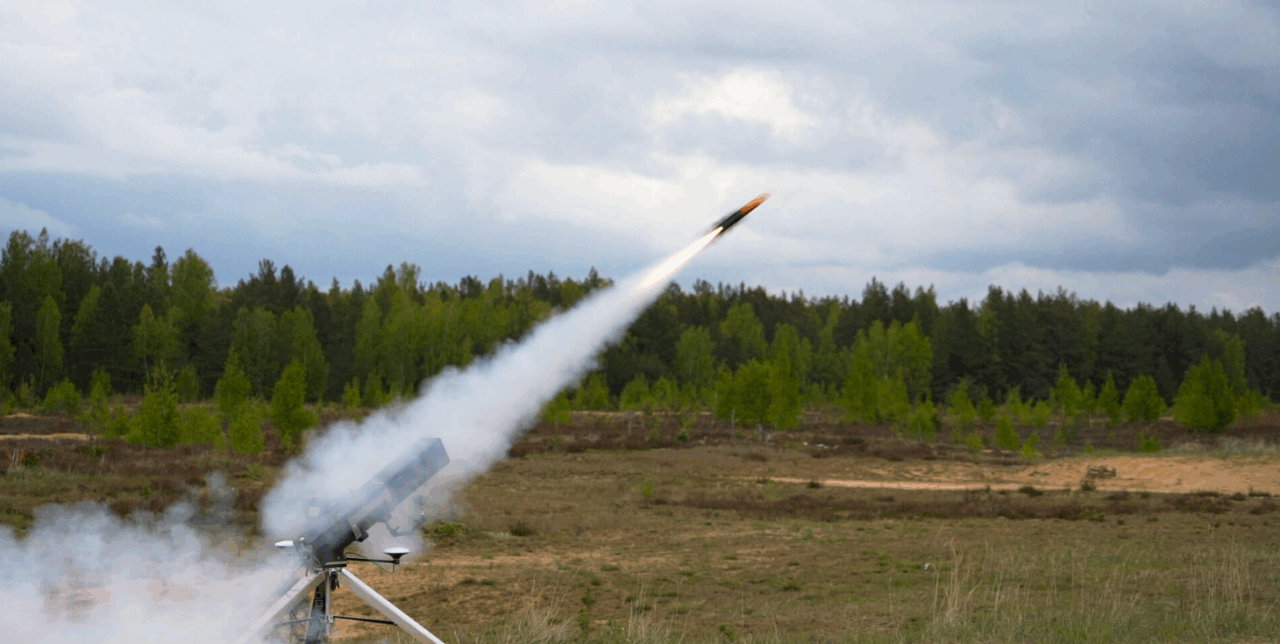
- Frankenburg’s Mark-1 interceptor is designed to defeat Group 1–3 drones and loitering munitions, with an eye on the Shahed drones Russia’s been pumping out across the border.
- The Mark-1 is about 25 inches from top to tail and is powered by a solid fuel motor and AI guidance tech.
- It has a range of 1.2 miles, a max speed of 750 miles per hour, and comes in at less than $50,000 a pop.
No shame: As those at our conference will know, Salm isn’t one to hold punches.
“We are not apologetic about the fact we manufacture weapons,” Kusti Salm, Frankenburg’s CEO and former Permanent Secretary of the Estonian Ministry of Defence, recently told The Telegraph. “We are not afraid to say we are manufacturing them to take down Russian long-range drones, and we are not all apologetic about the fact that this will be the most-needed capability in the Western world in the next five to 10 years.”
Under their new partnership with PGZ, Frankenburg will set up co-production of Mark-1s and other future counter-drone systems in Poland to bolster the much-hyped “drone wall” along NATO’s eastern front.
“Collaborating with Frankenburg Technologies has a dual significance for us – not only will we gain new competencies and a valuable partner, but we will also strengthen our cooperation with Estonia,” PGZ exec Arkadiusz Bąk said in a statement. “Due to our shared location, we are jointly strengthening NATO’s eastern flank.”
Pole position: A source told Tectonic that Poland—which spends the highest percentage of GDP on defense in NATO at 4.7 percent—is also set to receive a big chunk of money from the EU’s SAFE (Security Action for Europe) program announced in May, which allocates up to €150B in long-maturity loans to EU member states to invest in defense capabilities.
By teaming up with Poland’s state-owned defense conglomerate and ramping up interceptor production to 10,000 per year, Frankenburg could take a big chunk out of that home. (A $500M chunk, based on the $50,000/missile price-tag, to be exact). Frankenburg plans to approach that ambitious target over the next two years.
The partnership with PGZ isn’t Frankenburg’s first rodeo in Poland—they also teamed up with Advanced Protection Systems (APS), a Polish company that builds radar and advanced protection systems, in September, and Salm likes what the Poles are cooking.
“Poland is at the forefront of defense, defense investments, and the defense industry’s new way of functioning, where the government needs large players to marry their efforts with the newcomers,” Salm told Tectonic. “Frankenberg is well-positioned to be the partner for Poland in executing that vision.”
If Frankenburg can indeed pump out 10,000 of their interceptors with the help of Poland’s defense industry big dawg, they could very well find themselves in pole position in the mini-interceptor race.