
Look out, world. The Eastern Europeans are (formally) teaming up.
On Friday, Estonian interceptor hotshot Frankenburg Technologies announced that it’s officially inked a production partnership with Poland’s state-owned defense company—Polska Grupa Zbrojeniowa (PGZ)—to produce its air defense systems in Poland.
“Lessons learned from the war in Ukraine clearly demonstrate that attacks carried out by dangerous yet inexpensive drones are mass in scale. Countering them with advanced – and therefore more costly – air defence systems is operationally and economically unjustified,” PGZ Board President Adam Leszkiewicz said in a statement announcing the team up.
“Cooperation with Frankenburg will enable us to jointly produce and offer the Polish Armed Forces and other customers the most economically advantageous effector to date for countering this specific category of drone threats,” he added.
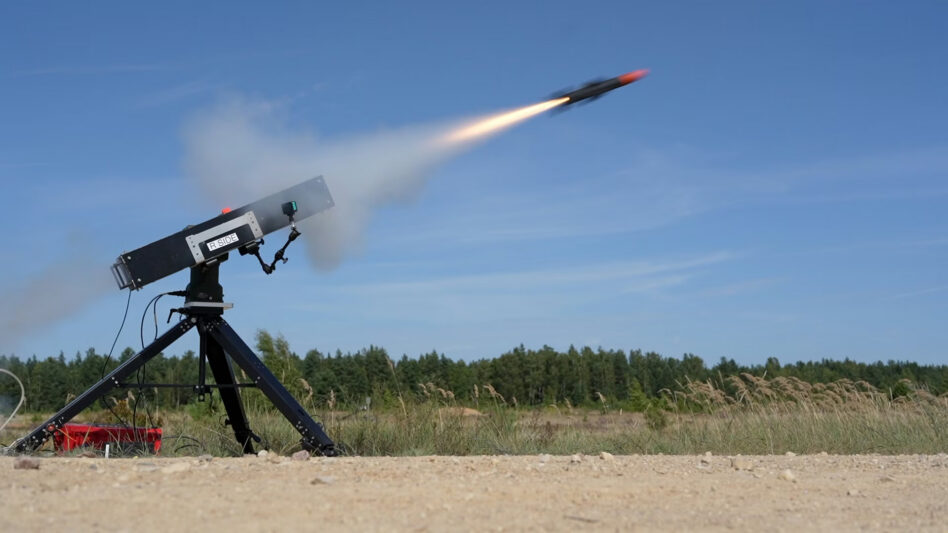
The partnership will largely focus on local production of Frankenburg’s Mark-1 mini-missile—the two companies say they’re going to set up a production facility in Poland that can produce up to 10,000 of the interceptors a year.
“Air defence today is defined by scale – how many interceptors you can produce, deploy and sustain. This agreement…creates a clear pathway to deploy it for Poland’s defence needs,” Frankenburg CEO Kusti Salm said in a statement.
No better place to build your interceptors than the place dealing with, well, all the Russo-Iranian drones.
BFFs: This isn’t the first time we’ve talked about this deal—the team-up was first floated back in November (around the time of our Paris conference), but this “marks the transition to operational implementation… concerning integration and joint offering of advanced counter‑unmanned aircraft systems (C‑UAS) and air defence solutions.”
For a country facing some pretty spicy drone threats from the Ruskis, Frankenburg’s tech is pretty ideal.
- The startup’s Mark-1 interceptor is designed to defeat Group 1–3 drones and loitering munitions, with an eye on Shaheds (and their Russian clones).
- The Mark-1 is about 25 inches from top to tail and is powered by a solid fuel motor and AI guidance tech.
- It has a range of 1.2 miles, a max speed of 750 miles per hour, and comes in at less than $50,000 a pop.
And the tech has been popular with militaries and investors alike—back in February, Salm and his team announced a €30M ($35M) Series A led by Plural.
PGZ is basically providing Frankenburg with the production muscle to build these mini-missiles at scale.
- The mega-prime will localize production in Poland, and (presumably) funnel Mark-1’s to the Polish military—all out of a local production facility (location TBD).
- Development won’t be limited to Mark-1, either: The two companies say they’ll work together to develop the Mark-2, which is “expected to expand coverage into the 5–8 kilometers range, further strengthening layered air defense capabilities.”
The partnership is expected to be a “foundation for broad, long‑term, and development‑oriented cooperation” and focus on a whole range of joint-produced c-UAS and air defense.