
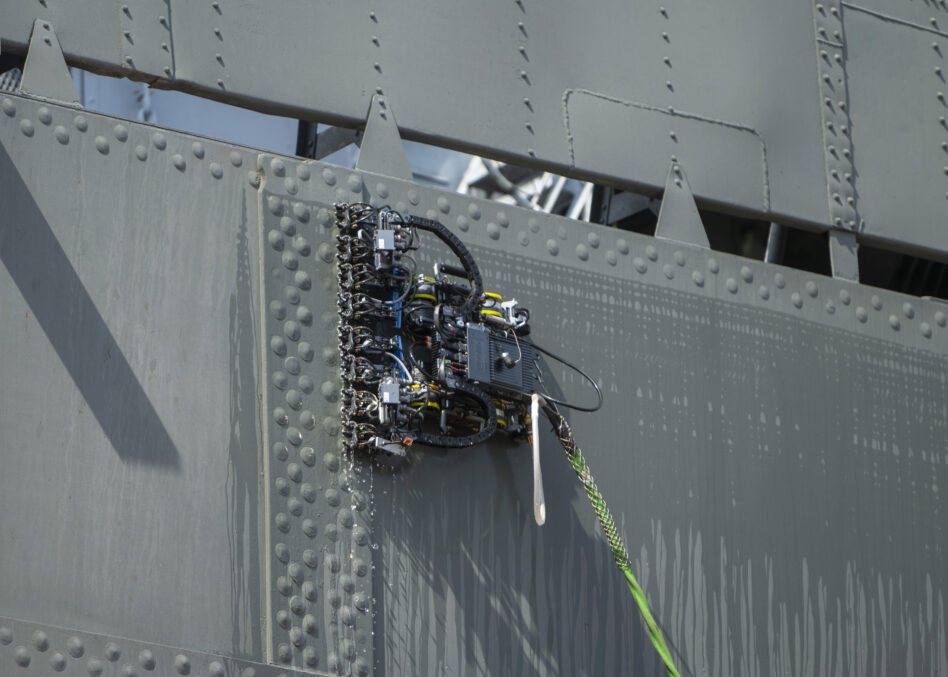
This Gecko is going green.
This morning, Pittsburgh-based Gecko Robotics announced a five-year, $71M IDIQ contract with the US Navy to deploy its wall-crawling robots and AI maintenance software to 18 ships in the Pacific Fleet—at least to start.
The contract, which has an initial award worth $54M with the potential to scale up to $71M, will be carried out at the fleet’s Pearl Harbor HQ and at shipyards and installations in the continental US, CEO Jake Loosararian told Tectonic.
Fast climber: Gecko, founded in 2013 by college friends Troy Demmer and Loosararian, has had a busy year. The company hit unicorn status after a $125M Series D led by Cox Enterprises last June and inked major deals with grid operators, oil and gas firms, the US Navy, Air Force, and defense primes—all in the last 12 months.
Put simply, the company’s robots and AI-powered inspection software analyze the health of critical infrastructure.
- Gecko’s climbing, crawling, and swimming robots inspect hard-to-reach infrastructure like power plants, submarines, and aircraft carriers.
- The company currently operates a fleet of about 250 of ‘em across both commercial and government customers, with plans to produce dozens more this year.
- Their ultrasonic sensors and Cantilever software detect corrosion, cracks, and structural issues before they become failures and produce 3D visualizations and maintenance insights to help customers plan repairs, extend asset life, and avoid downtime.
- The company says its tech can identify repairs up to 50 times faster and more accurately than manual inspection methods.
Naval gazing: That tech has proven pretty popular with the Navy, especially in light of, well, all of the shipbuilding and fleet maintenance issues the service is (in)famous for.
- On top of active contracts with the Navy for maintenance of assets in service, including destroyers, amphibious ships, aircraft carriers, and Virginia and Columbia-class nuclear subs, they’ve gone into the shipbuilding industrial base with component manufacturers.
- In the past few months, they’ve teamed up with major Navy supplier Trident Maritime Systems and BPMI, the prime for the Naval Nuclear Propulsion Program (NNPP), to speed up the production of components and cut inspection time.
Fleet weak: Under the new $71M-ceiling IDIQ, Gecko’s heading to the Pacific to put its robots and software to work on 18 ships in the Pacific Fleet, starting off with guided missile destroyers (DDGs) and amphibious assault ships (AAS), according to Loosararian. But they’re betting it’ll quickly expand further.
“I’m super shocked by the pace of the demand. We just got this task order this month, and we’re already on two ships,” he said. “It speaks to how important and how in-demand the tech is, and all indications seem to show that 18 ships is going to [be the start] and they’re going to try to get more in.”
Ready or not: The goal, according to the company, is to help the Navy reach the Chief of Naval Operations’ 80 percent fleet readiness target by 2027, which is a date we’re guessing is circled on a lot of calendars in the Pacific.
“Look, you go to war with the army, or in this case, the navy, that you have, and so it’s just not good enough to wait five or ten years for results and impact by robotics and AI,” Loosararian said. “Getting this [contract] represents the pragmatism of the Navy, which I think they’re pretty known for.”