Lock in, kids. It’s time for a dose of the super-scary, invisible threats we all know and love.
This morning, Ginkgo Biosecurity—the biosecurity arm of Ginkgo Bioworks—officially spun out from its Boston-based parent company as Perimeter.
The new firm—led by founder and CEO Matt McKnight—has already secured a cool $60M in growth capital from Kanders & Company in partnership with SCS Financial, Goldcrest Capital, Four Cities Capital, and the Safe Artificial Intelligence Fund (SAIF).
Perimeter EMEA Senior Director Max Breet told Tectonic that the spinout will allow the company to “ruthlessly” focus on the very scary and very urgent biothreats facing countries around the world.
“The mission…is to act as the world’s best capitalized biosecurity startup. [To] work with both nation states and corporations and multinationals on their biosecurity strategies,” he said, “[We’ll play that] trusted expert advisory function, but act as the operational partner too. Stand up these biosurveillance programs…and then use that insight from the deployed work we do with trusted government partners to better inform and design the response protocols.”
Love a reminder of the terrifying biothreats we face on a Monday morning.
Creepy crawlies: Perimeter (the artist formerly known as Ginkgo Biosecurity) is an interesting one—the company was born out of Ginkgo Bioworks, which was itself founded by MIT researchers in Boston back in 2008.
- The idea is to treat biology like software—programming and building cells and organisms to address certain threats or issues.
- Basically, companies come to Ginkgo with a problem, and the company builds a microbe or cell to fix it. Sweet-spot industries for the company are biopharma, agriculture, and consumer goods.
As a result of all of this work designing and building DNA, Ginkgo has amassed, like, a crap-ton of data.
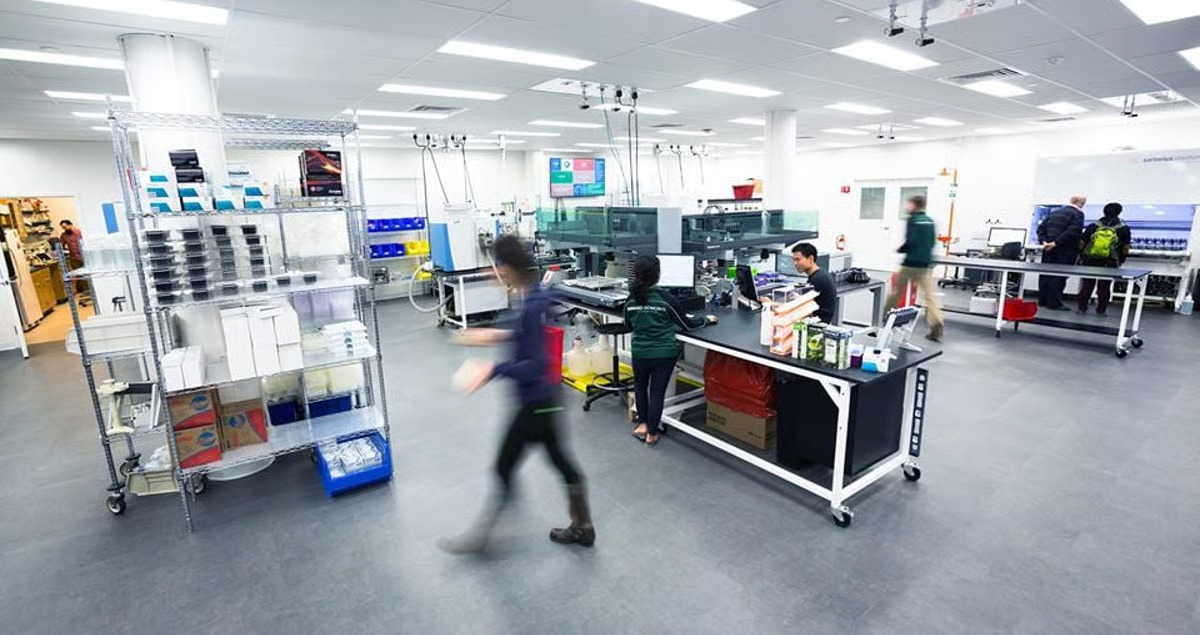
- Their biological solutions (our term, not theirs) are built in biotech factories called biofoundries. There, robots run tons of experiments in parallel to figure out what works to address those aforementioned biological problems.
- All of this work means Ginkgo has a massive dataset of biological designs, DNA sequences, and experimental results—all of the fun stuff you forgot from middle school science class.
- Those masses of data mean that they’re also really good not only at spotting when stuff is good and works, but when it’s bad and potentially very dangerous. The company can also help build solutions to address those threats.
The invisible battlefield: That’s the biosecurity portion of the business—and now, Perimeter’s mandate.
The company will work with governments worldwide to detect biological threats—such as pandemics—early and help craft effective responses to stop them.
- The company calls this a “Global Biosurveillance Network.” The idea is to create nodes worldwide for sampling, sequencing, and analytics—places where engineered threats and pandemics can be detected before they spread.
- They can analyze materials from airports, wastewater, clinics—anywhere we humans leave our biological materials.
- They call the physical monitoring network Canopy and the intelligence that analyzes the data Horizon.
- They’ve already worked on projects with the CDC to monitor threats from travelers, and with the European Union to build a “novel diagnostic platform that can seamlessly plug into fixed infrastructure as well as mobile,” Breet said.
“We want to offer timely insight into what biological risks are trending,” Breet said. “Like, how do we pick that up…but also, how do you better inform things like cutting-edge diagnostics and medical countermeasures to actually respond at a timeline of relevance.”
With the spin-out and this pile of cash, the plan is to continue to deliver on Ginkgo’s contracts while scaling around the world and firming up those biosecurity products, Breet said.
“There’s a responsibility for continuity of service with the nation states,” he said. “We’re already working with the US, UK, and across EMEA and the Asia Pacific. So, no change there. But we also now need to recalibrate, to really start driving a product focus.”
A big part of their focus will remain on the US, but they’ve also got an eye on countries driving biosecurity awareness like “the UK, the Nordics, Germany, Poland…and Indo-Pacific nations like Japan, South Korea, and Singapore.”
“I think you’ll also see quite dramatic tailwinds for biosecurity through the accelerant of AI,” he added. “I think that’s going to be a hot button for most, most nations through the next six months.”