
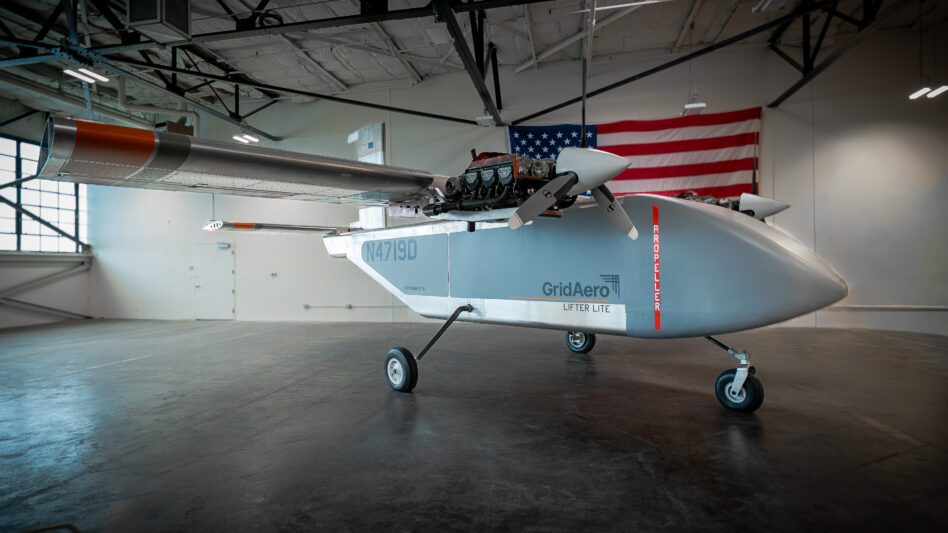
We’ve said it before, and we’ll say it again: Everyone loves a tiny plane.
On Monday, Grid Aero, a California-based startup building autonomous aircraft focused on logistics operations in contested environments, announced it raised $20M in a Series A co-led by Bison Ventures and Geodesic Capital to boost testing and production of its “pickup truck” of the skies.
Turns out investors find the unsexy stuff pretty sexy.
Tread lite-ly: Since emerging from stealth last August with $6M in seed funding, Grid Aero has moved quickly to roll out its Lifter Lite cargo aircraft.
- The aircraft is built to be modifiable and flexible, but CEO Arthur Dubois told Tectonic it has a range “broadly up to 4,000 nautical miles, designed to operate within the Pacific Theater,” and has a payload capacity of “thousands of pounds.”
- Right now, it’s in the prototype stage, but Dubois said they’re moving through ground testing and have plans to introduce an “iteration on the airframe” that’s focused on “rolling what we’ve learned from the first aircraft into a second one that’s much closer to the production version.”
Lotta love for logistics: Grid Aero’s focus on contested logistics is timely. The Pentagon set aside $9B for autonomous aircraft R&D, and last November, Pentagon CTO Emil Michael named it one of the DoD’s six Critical Technology Areas, making it a permanent line item in the NDAA.
For military planners looking at all of the logistics of a conflict in, say, the Pacific, a cheap, autonomous cargo aircraft like the one Grid Aero’s making could come in pretty handy. Right now, the Pentagon relies on a fleet of large and super-expensive aircraft (like the C-130, which can cost anywhere from $70M to $170M) to transport supplies to forward operating bases.
Grid Aero’s betting that the better approach is to create a distributed “autonomous air cargo network” of smaller unmanned aircraft to move things around in degraded environments without putting pricey aircraft and lives at risk.
“At the end of the summer, it really felt like the winds were shifting from logistics being on every warfighter’s lip to, all of a sudden, at the leadership level within the Department of War,” Dubois said. “There was a real awareness that the leadership is going to have to take the lead on pushing contested logistics well before the announcement of the Critical Technology Areas, and that was one reason we decided to go out and raise capital.”
Cargo cash: That new capital, which Dubois said gives Grid Aero “a little bit more security to make sure we’re getting the most out of this testing campaign,” will help the startup iterate on the prototype, build out the team, ramp up testing, and get the Lifter Lite into the hands of users, especially in the Indo-Pacific.
“We need to put [the Lifter Lite] through hours and hours of testing in situ, in real conditions, over long distances, and in denied environments that are representative of where this thing is going to go,” Dubois said. “The next year is really focused on the design effort across the airframe, the electronic hardware that sits in it, and the way we want to structure our software and autonomy capabilities.”
Ready for takeoff: With a fresh $20M in hand and contested logistics at the top of the Pentagon’s agenda, Grid Aero’s feeling good about their runway and where they’re headed.
“I think we hit the nail on the head with the design of our first aircraft, but it’s a prototype,” Dubois added. “This money, broadly, will be going into productization, deploying it into exercises, and demonstrating capabilities in customers’ backyards.”