Well, seems like the Dassault-Harmattan AI partnership is working out just fine.
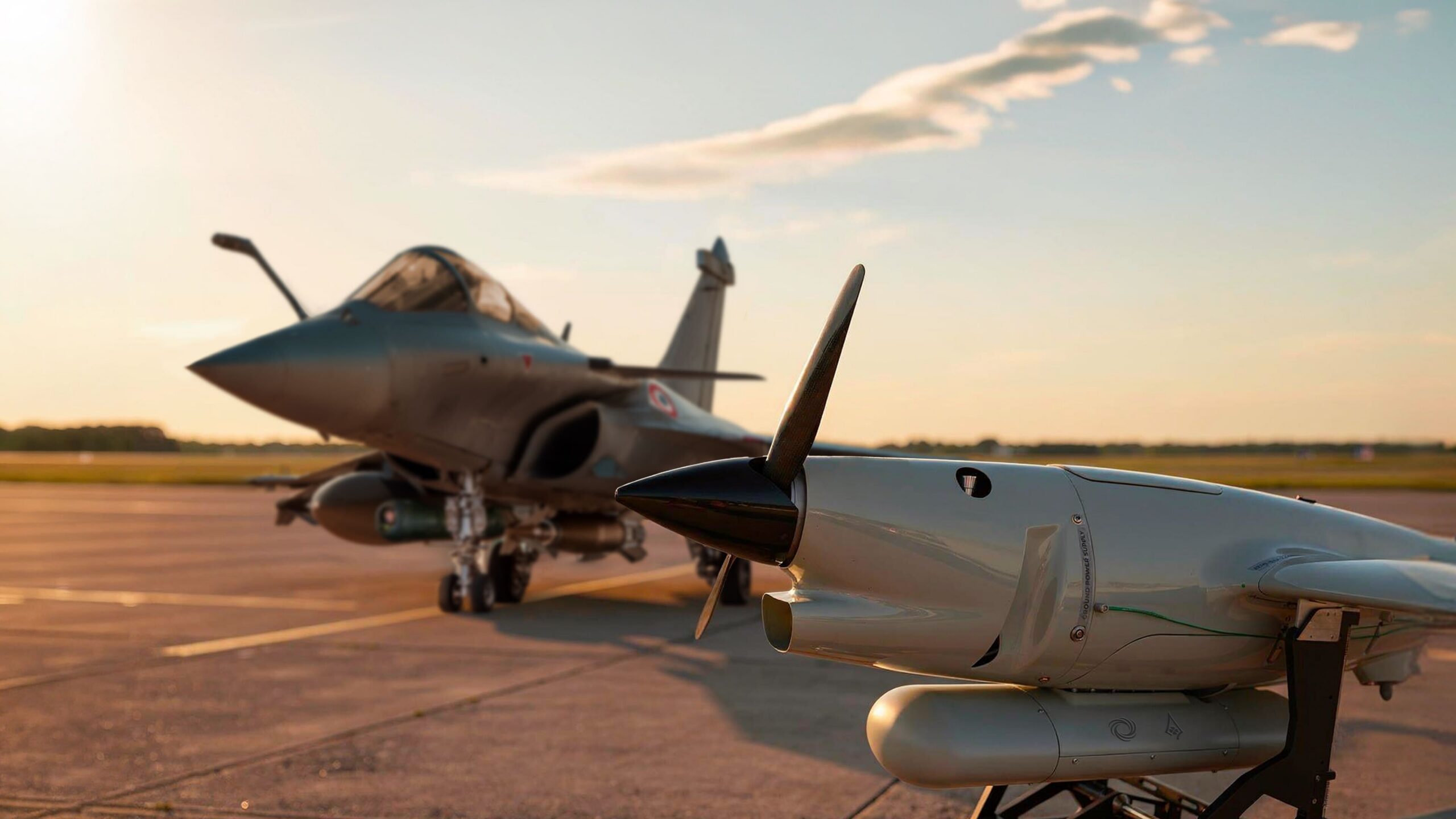
This morning, the Paris-based autonomy startup and the French aviation giant announced that they’ve teamed up to build—and successfully integrate and test—a new EW detection drone payload called NAMIB.
- Per the company, the payload can “be carried by tactical drones, including quadcopters, as well as by longer-endurance, fixed-winged unmanned aircraft.”
- NAMIB can detect, identify, and geolocate electromagnetic emissions, especially those coming from air defense systems.
And they’ve already tried it out. In a recent test, a drone (built with Harmattan partner Skyeton) equipped with NAMIB teamed up with a Rafale F4 fighter to take out a radar. The NAMIB-drone sneakily geolocated the air defense system from “dozens of kilometers away,” transmitted its location to the fighter in-air, and the jet simulated a strike at “meter-level precision,” Harmattan founder and CEO Mouad M’Ghari told Tectonic.
“We performed a full, simulated kill chain—with detection, sharing of information, and the strike of an air defense radar—with the Rafale F4,” M’Ghari said. “We were able to make that happen in less than six months [and have] an operational product already in the market.”
This is the first official joint project announced by the two companies since Dassault led the company’s $200M Series B back in January. The two companies are also collaborating on Dassault’s next-gen F5 fighter and UCAS (CCA equivalent).
This seems like a pretty good step in that direction, if you ask us.
New kids on the block: Harmattan was only founded back in April 2024, but in the past few years it’s grown into a pretty heavy hitter on the European defense tech scene. They make a few different flavors of autonomous systems, including:
- Gobi: A high-speed interceptor drone meant to target other small drones.
- Sonora: A cheap, mini quadcopter designed primarily for training and ISR.
- Sahara: A Synthetic Aperture Radar (SAR) system that the company has designed to be built onto Group 2 drones. The system corrects and refines SAR imagery onboard to (put simply) make images way better without external processing.
They’ve also built their own C2 system called Kalahari, which the company says has “embedded autonomy that enables intent-driven tasking, real-time decision support, and closed-loop execution across distributed unmanned systems.”
Cash money: And even though the company is only, like, toddler-aged, they’ve already scored some major contracts, including:
- A “multi-million euro” order for ISR drones by France back in 2025. Earlier this summer, the French MoD also placed a follow-on order for 5,000 more units.
- An order from the UK MoD for 3,000 autonomy systems.
- An agreement with the Kingdom of Morocco to develop “next-generation autonomous air defense capabilities at scale.”
Plus, there’s the money.
- In January, they raised that sweet, sweet $200M Series B led by Dassault at a $1.4B valuation.
- Prior to that, the company had raised $42M from investors including Atlantic and FirstMark.
Zap zap: When asked why they christened the Dassault partnership with an EW platform, M’Ghari said it was twofold. First, detecting EW is one of the most critical parts of modern warfare. And second, both Harmattan and Dassault already had existing EW capabilities they could build on to roll this out quickly.
“Electronic warfare is an extremely unique subdomain of defense, where very few players have an existing portfolio of systems,” M’Ghari said. “Since the very beginning of Harmattan, we have had these capabilities in-house… This was the easiest and fastest go-to-market for us.”
Plus, he said, by building on their existing platforms, they were able to create a “very sophisticated platform that usually would take years to develop” in less than six months.
“That’s really what’s most significant to us: The ability to develop such exquisite platforms and payloads in such a short amount of time while getting to these levels of specifications,” he said. “That’s something that is often talked about in defense—the ability to be more agile, to be faster. Usually, that also means developing less sophisticated systems. Here, we have an extremely sophisticated one that was developed with a fraction of the usual defense timelines.”
Next stop, French CCA. Allez les drones!