Well, the go-fast guys are back with some super-speedy contract news.
This morning, hypersonic aircraft startup Hermeus announced that it’s scored a $159M contract modification from the Defense Innovation Unit (DIU) to continue developing hypersonic airdraft and “demonstrate high-Mach flight and high-speed payload release.” The OG contract was awarded back in 2023 and now has a ceiling of $219M—one of the largest ever awarded by DIU, according to the company.
As part of the contract, the company will conduct a “series of intensive flight tests in 2026 and 2027” to prove its aircraft can maintain speed and performance while carrying and releasing heavy payloads. The company is also “partnering with the U.S. Air Force and U.S. Navy to execute this expanded scope.”
“What we’re doing is continuing to fly these aircraft, push the technical envelope, get into higher speed regimes, more complex operating environments, and then also begin to put things on the aircraft that would be militarily relevant,” Hermeus President (and soon-to-be CEO) Zach Shore told Tectonic.
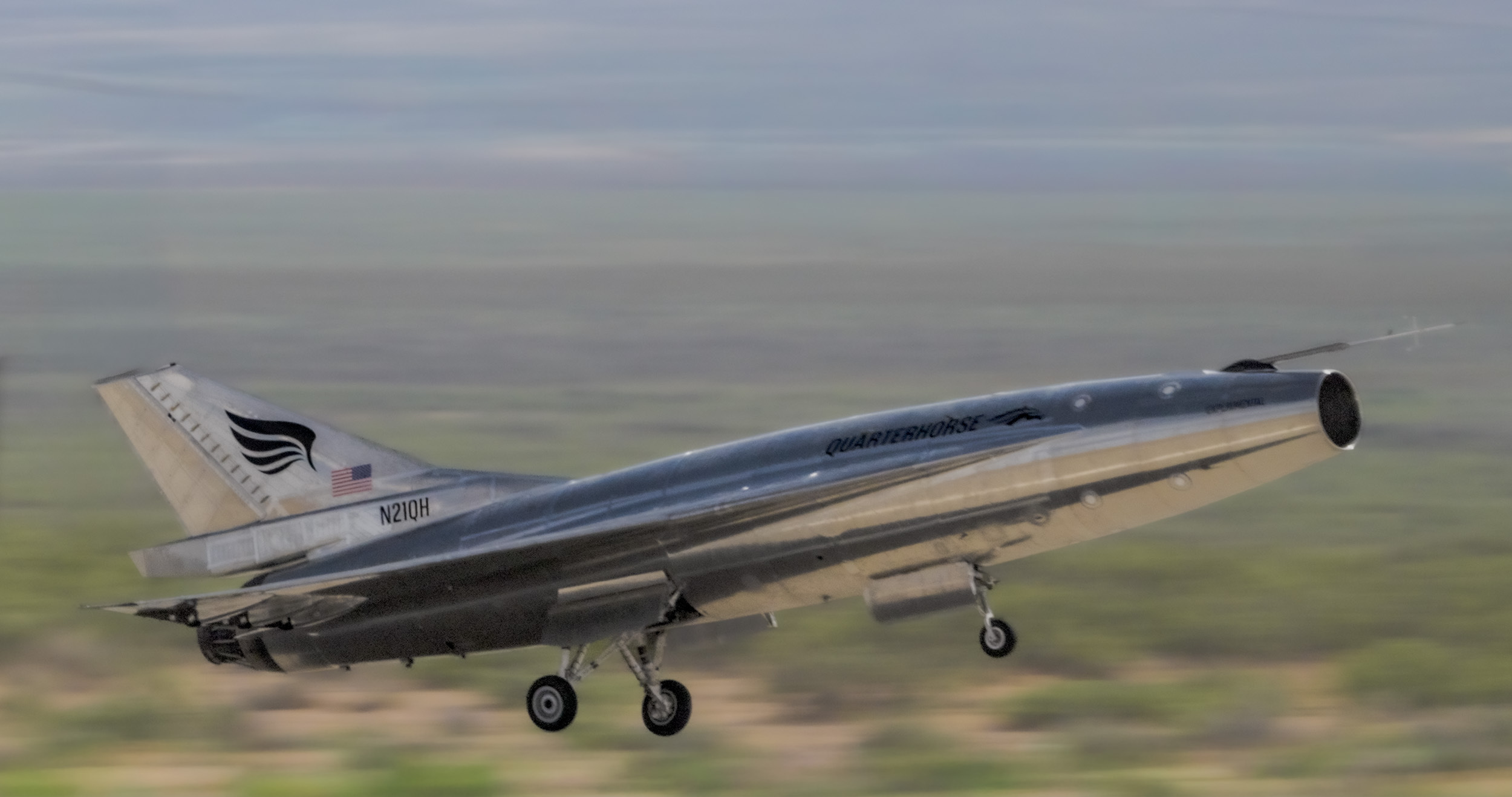
Good thing that Hermeus’ unscrewed Quarterhorse Mk 2.1 aircraft completed its first supersonic flight test (Mach 1.21) just last week.
Zoom zoom: If y’all read Tectonic, y’all know Hermeus.
The company was founded in Atlanta back in 2018 and, since then, has become a bit of a hot commodity.
- The startup—founded by AJ Piplica, Glenn Case, Michael Smayda, and Skyler Shuford—has raised nearly $550M in funding, most recently a $350M Series C at a $1B valuation. Pocket change.
- They’ve also scored $78.5M in government contracts, according to Obviant data.
- They’re backed by some of the biggest names in the game, including Khosla Ventures, Founders Fund, In-Q-Tel, RTX Ventures, and lots and lots of others.
- As part of that $350M Series C in April, they also opened a brand new HQ in El Segundo. All the cool kids go west.
Their goal—make plane go fast—seems pretty straightforward, but the way they’ve gone about it is interesting.
- Their aircraft series is called the Quarterhorse, which started out with the Quarterhorse Mk 0 for ground testing back in 2024.
- Last May, they completed successful flight testing for the first go-in-the-air version, the Mk 1.
- Now they’ve moved onto the Mk 2 series. The Mk 2.1 is the one that broke the sound barrier at White Sands last week; Mk 2.2 (which will push closer to Mach 2) is in production in Atlanta and will fly at speeds “well over supersonic” later this year, per Shore.
- Mk 2.3 (aiming for Mach 3) will be built with a new, fun, shiny steel (not aluminum) frame, and is expected to fly in the “first half of ’27,” Shore said.
Ultimately, the goal is to build the Quarterhorse Mk 3, which the company hopes will be the world’s fastest (fingers crossed, hypersonic) aircraft. For the record, the top spot is currently held by Lockheed’s SR-71 Blackbird, which notched flights over Mach 3.2.
Bigger and better: This expanded contract will be a big part of building out these new aircraft, flight testing, and getting those speeds up, Shore said.
- There will also be a lot of payload testing—the Quarterhorse can theoretically carry 12,000 pounds of payload. That could be anything from EW to the go boom stuff—anything “that could be useful in a conflict,” as Shore put it.
- They’ll also work on design changes like spike inlets (Google it, nerds) that will allow the aircraft to get up above Mach 1.6 or so. Things get hot and complicated up there.
And Shore is already thinking about life after this contract—and after DIU.
- Hermeus is “already very much engaged in transition discussions” (like, out of prototyping contracts), he said, including with the Air Force and the Navy.
- He also expects this contract to be expanded further. “The fact that DIU is signing a $159 million contract extension for us is indicative of the fact that there is going to be more…this is the beginning of a much longer curve, so long as we hold up our end of the bargain,” he said.
Cheap and cheerful: Ultimately, Shore sees Quarterhorse as a cheaper, mass-producible unmanned fighter—something that can match the payload and performance of the F15 or F35 without being quite so painful to lose.
“[For the future conflict] you need to be able to produce fighter jets like it’s World War Two,” he said. “We’re never gonna be able to reconstitute the F 35 that way. You could reconstitute our aircraft very quickly. They are very mass producible, and they’re giving you the same thrust, the same payload space.”