
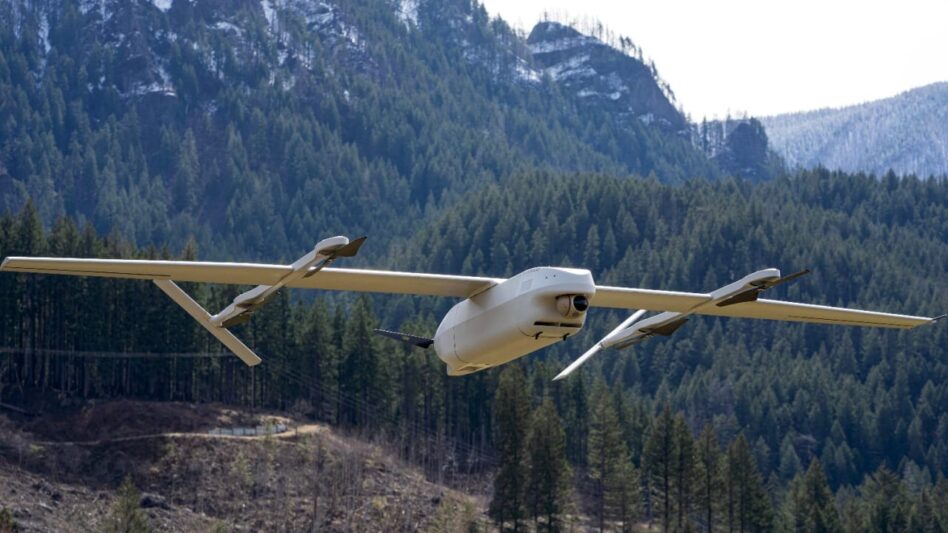
Well, we’re back with more Heven AeroTech news—and man, oh man, do the drone dollars keep on comin’. On Monday, the Israeli-American hydrogen-powered drone startup announced that it’s closed a whopping $100M Series B funding round led by their new friends at IonQ, valuing the company at $1B.
The Chinese Zodiac calendar officially says it’s the Year of the Snake, but we’re going to go ahead and say that 2025 has been the year of the defense tech unicorn.
Heven bound: We’ve covered Heven before, but for those new around here, here’s what the company’s up to.
- Heven was founded as Heven Drones in Israel in 2019 and set up its HQ in Miami. This September, it rebranded as Heven AeroTech and moved (again) to Northern Virginia to be closer to a certain five-sided building.
- Unlike most other drone companies that use batteries to power their flying friends, Heven has carved a niche in the hydrogen propulsion space. They say this gives their drones longer flight times and range.
- Their flagship drone, the Group 2/3-class Z1, has a 10-hour flight time and a 600-mile range. The Z1 was added to the DIU’s Blue UAS Cleared List with “Blue UAS Select” status last month. They’re also developing an extended-range UAV called the Raider.
- The company also has some pretty useful friends: Heven acquired VTOL drone company Zepher Flight Labs back in April, and also inked a partnership with Mach Industries to ramp up production at Mach’s Forge facility in California in March.
As if the whole hydrogen fuel cell propulsion thing wasn’t complicated enough, Heven has also leaped into the quantum game. Last week, they teamed up with quantum giant IonQ ($IONQ) to develop “quantum-enabled drones for national security applications.”
Through that partnership, IonQ’s quantum tech—including quantum computing, networking, sensing, and security technologies—will be built into Heven’s drones to boost “resilience, stealth, and operational performance in GPS-denied environments,” according to the companies.
Double-dipping: Turns out that partnership also came with a heck-ton of cash. Last week, Heven founder and CEO Ben Levinson told Tectonic that IonQ was also coming on board as an investor as part of a “much larger round,” but didn’t reveal the deets. Well, now we know he wasn’t bluffing—$100M and hitting unicorn status certainly falls in the “much larger” camp.
“As an investor, IonQ provides capital that accelerates our ability to scale US manufacturing and expand operational deployments with current customers,” Levinson told Tectonic. “As a technology partner, they bring quantum computing capabilities that will fundamentally transform how autonomous systems process sensor data, make tactical decisions, and operate in contested electromagnetic environments.”
Spending spree: Levinson said that the new moolah from IonQ and returning investors like Texas Venture Partners will go into three main areas:
- Accelerating Heven’s US manufacturing capacity
- Building out a new quantum engineering division by recruiting talent, funding R&D infrastructure, and increasing testing of quantum technologies. The quantum division is independent of IonQ, but “success depends on deep technical collaboration.”
- Expanding their integrations with existing customers and partners on programs “where hydrogen-powered platforms are already proving mission value,” including with “payload development, training infrastructure, and field support capabilities.”
Another motivation for the raise was to keep up with “escalating demand from US Special Operations Command, combatant commands, and allied forces,” according to a company release. That demand is primarily for their flagship Z1 platform, but “forward interest increasingly focuses on what quantum-enabled processing could mean for autonomous decision-making and sensor fusion in denied environments,” Levinson added.
Shooting high: Heven says it’s cracked the hydrogen propulsion challenge, but the company has its work cut out for it on the quantum front. “Quantum integration presents different complexity,” Levinson said. “Quantum processors require specific operating conditions—thermal management, vibration isolation, electromagnetic shielding—that don’t naturally align with tactical aviation environments.”
“Beyond hardware integration, there’s the software challenge,” he added. “The algorithms must be validated not just in lab environments but in contested operational scenarios.”
Despite the technical challenges ahead, having a quantum industry giant on the cap table and in the lab with them should help Heven on that front. An extra $100M doesn’t hurt either.