
In case you haven’t heard, there’s a bit of a legal drama happening in the defense tech world.
On August 4, publicly held drone company Red Cat Holdings ($RCAT) filed a lawsuit against drone company Vector Defense (and its co-founder and CTO George Matus) for stealing trade secrets under the Defend Trade Secrets Act.
Red Cat Holdings and its subsidiary, Teal Drones, allege that Matus quietly co-founded Vector while still working as CTO at Red Cat and stole the company’s trade secrets, relationships, and proprietary tech to build his own company.
Vector has not yet filed a formal legal response to the claims, but Vector CEO Andy Yakutia took to LinkedIn to say that his company believes the “claims brought by Red Cat in their recent lawsuit against us are without merit and, as such, Vector intends to vigorously defend itself in court.”
“We can take the heat—because that’s what we are built for,” he added. Famously good tactic, posting on social media about legal proceedings.
Back it up: First, a bit of context. Red Cat was originally founded in 1984 as Oravest International, Inc., and became Red Cat in 2019. The company began trading on NASDAQ in April 2021.
In September of that year, Red Cat finalized its acquisition of ISR drone company Teal Drones, which Matus founded in 2014 (at just 17 years old), and which in 2020 had been designated as one of five sUAS vendors trusted by the DoD. The Utah-based company said in 2021 that’s one of the main reasons why Red Cat snapped them up.
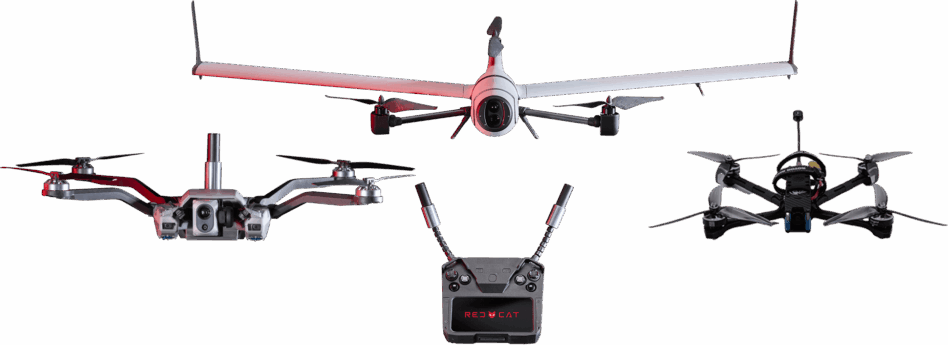
Red Cat’s full lineup now includes:
- Teal 2 – An ISR quadcopter, optimized for nighttime ops, modular payloads.
- Golden Eagle – Teal’s original ISR platform.
- Edge 130 Blue – A VTOL tricopter from FlightWave (also acquired by Red Cat) for medium-range ISR.
- ARACHNID™ – An ISR and precision-strike drone with low-cost, portable “sensor-to-shooter” systems.
- Black Widow – A next-gen ISR quadcopter from Teal.
Teal 2, Golden Eagle, and Edge 130 Blue are all Blue UAS-approved, meaning the DoD has given them the A-OK for operational use. Black Widow is currently in Blue UAS Refresh review.
The messy bit: According to SEC filings, Matus officially joined Red Cat as CEO of Teal Drones when the company acquired Teal in 2021. In 2023, according to his LinkedIn, he became CTO of Red Cat—a role his profile lists him as still having today. A NASDAQ article from June also still lists him as the company’s CTO, but Red Cat’s filing says he left in December 2024, and he has been removed from the company’s site.
Matus—alongside co-founders Andy Yakulis, Larsen Jensen, and Matty Long—announced that Vector was coming out of stealth back in May. (For what it’s worth, Matus’ LinkedIn lists him as starting at Vector as CTO and co-founder in December 2024.)
On July 28, the new startup unveiled its Hammer FPV, a “first-of-its-kind 10” long-range FPV with fiber optic integration. The tiny drone can “fly in any jammed environment completely radio silent with an explosive payload,” according to the company.
The case: According to Red Cat’s suit, Matus used proprietary and confidential information, tech, and relationships to build out Vector—all while working at Red Cat. The speedy-quick emergence of Vector, Red Cat implies, means he violated his employment agreement and non-solicitation clause, and that the speed of the company’s founding means he still had access to Teal’s “institutional memory.”
“Before his illegal plan unraveled, Matus implemented this plan with calculated precision, believing that through lies, sabotage, and subterfuge, he and his co-founders at Vector could outmaneuver Red Cat/Teal,” the companies say.
They frame Vector as “extraction and replication” of Teal and Red Cat, rather than a new company with a fresh idea.
And it gets worse: According to Law360 reporting, Red Cat says that Matus “[sabotaged] a major product development deal” and “misrepresented that Vector Defense had no plans to develop or sell drones.” The company says that Matus said it would actually be a boon for Red Cat, because Vector “would secure drones from them and other companies to use for its military teaching and training services.”
And as for the deal in question? Red Cat and Teal say that Matus tanked a deal with Croatian FPV drone company Orqa drones, which would have helped the company build out its FPV arsenal.
“Matus sabotaged the Orqa deal because…he did not want Orqa to enter into an exclusive long-term relationship with Red Cat/Teal nor for Red Cat/Teal to advance their design, development, manufacture, and sale of FPV drones,” the companies said. “Red Cat/Teal have come to learn that Vector, in fact, has attempted to engage in a relationship with Orqa, likely with Matus’s help.”
Red Cat and Teal are seeking a preliminary injunction and expedited discovery under the Defend Trade Secrets Act. Vector, for its part, has vowed to fight.
“While we are disappointed with Red Cat’s approach in this matter, we nevertheless remain committed to a path that allows both companies to concentrate on pursuing their missions, Yakulis wrote on LinkedIn. “Vector is a disruptor. And with that disruption comes opposition like this.”