
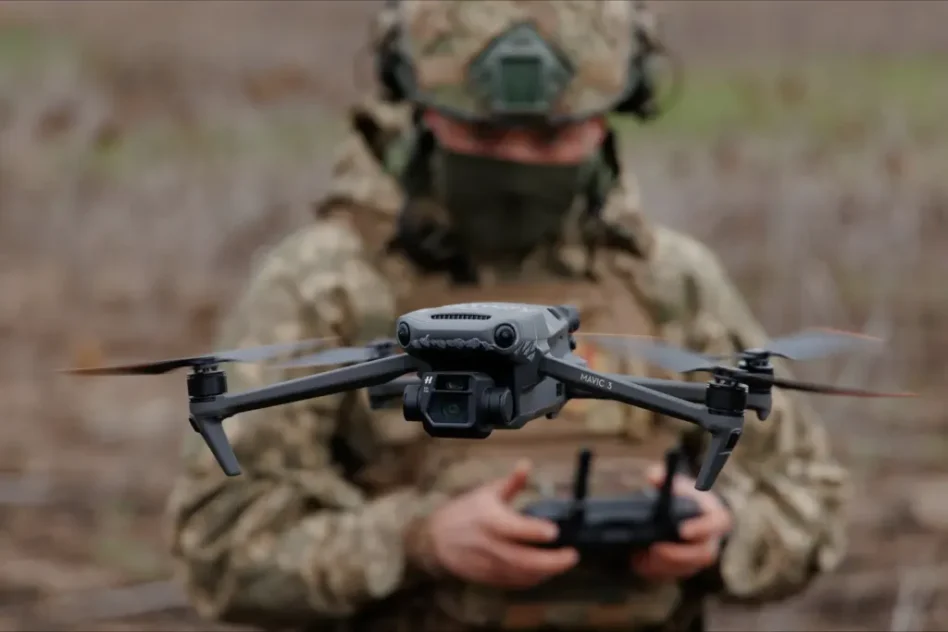
Once again, the Ukrainians are back to show us a thing or two about drone warfare.
Last Friday, the Ukrainian Ministry of Defense announced that all of its drone operations will soon be unified under a single operating system called Mission Control, which will basically act as a giant, data-driven eye-in-the-sky for how drones in Ukraine are being used.
The drone management platform will plug into Ukraine’s bespoke DELTA combat ecosystem, and operators will be able to input all sorts of data about drone missions (from weather conditions to hit rate, speed, launch type, and failures) using an easy-to-use interface, in real time. Mission Control will then analyze these piles of data to help optimize drone use.
Ukrainian Deputy Minister of Defense Yuriy Myronenko told Tectonic that this will show his very drone-fluent military what’s working, what isn’t, and where they should be investing further.
“We’ve now…wasted money on buying equipment that might not be effective,” he said. “We want to see the successful cases as well as the successful anomalies. We want to see what is, perhaps, unexpectedly successful so that we can scale it up as quickly as possible. And, of course, we want to verify data, verify it quickly…as much as possible, we wish to minimize the human factor in making these decisions.”
Plus, this will massively minimize manual reporting and paperwork. One step closer to Defense Minister Mykhailo Federov’s dream of a digitized and data-driven military.
No hands: We don’t need to tell you that Ukraine has been quite the trailblazer in terms of drone warfare.
- Unmanned and autonomous systems have allowed the country to hold out against Russia’s much larger, more “traditional” forces.
- According to Myronenko, the country produces about 4M drones per year. Yes, 4M. That’s everything from your traditional, small FPVs to larger aerial drones, USVs like the MAGURA, and unmanned ground vehicles.
- Foreign companies (including Anduril, Shield AI, Quantum Systems, Stark, and Helsing) have all tested or deployed drones in Ukraine, but super-quick and flexible domestic production makes competition pretty stiff.
Rack ‘n stack: Mission Control is not Ukraine’s first stab at tracking the efficacy of its drone forces.
Last summer, the MoD unveiled an “e-points” scheme called “Army of Drones Bonus” where units collect points for each Russian soldier killed or target eliminated.
- Fedorov, who introduced the scheme when he was Minister of Digital Transformation, announced yesterday that under the program, over “820,000 enemy targets [were] neutralized and 240,000 Russian troops eliminated” in 2025.
- The program also gave the MoD insight into which drones (and units) were most effective. Magyar’s Birds—the 414th Unmanned Strike Aviation Brigade—collected the most “e-points” last year.
Myronenko said that the success of the e-points program is part of what led them to develop Mission Control.
“This system…helped us see all of the successful uses and successful applications—what drone was used against what target, what was successful, what worked,” he said. “However, we also want to see what didn’t work, what failed, and how to improve that.”
Dig deeper: That’s the kind of insight Mission Control will provide.
- The system will encompass all kinds of assets—from FPVs to USVs—and they’re even working on getting deep strike assets in there, according to Myronenko. He expects the system to be fully rolled out in the next few months.
- The system will support units in planning, tracking, and reporting. Units will plug in mission type, weather conditions, what worked, what didn’t, what frequency they operated on, and what they hit—that then helps with future mission planning.
- Myronenko also said that this will help with the varied weather and geographic conditions along the approximately 1,000-kilometer-long contact line. The more data they have, the better units will know which drones and missions are best to deploy under different conditions.
BFFs: Plus, with millions of drones out there, a unified operating system is pretty much a necessity to avoid things like friendly fire, Myronenko said. The number of UAS, cUAS, electronic warfare, unmanned ground vehicles, and the like has all increased exponentially—with so much going on, individual units operating in silos, relying on human commanders with pen and paper, didn’t really work anymore.
“Before Mission Control existed, the primary problem for drone pilots and their units was fragmentation,” he said. “While this autonomy provided flexibility and helped achieve fire parity during the artillery support shortage of 2023, it didn’t scale well, and as the number of units and the variety of unmanned systems increased, the absence of command and control and management tools became a critical weakness.”
“Decision-making data was often delayed, incomplete, or inconsistent across units, limiting situational awareness, coordination, and the ability to translate tactical actions into coherent operation and strategic effects,” he added.
Looking outwards: Mission Control is a domestically built, open-API system, Myronenko said, specifically designed to work with DELTA. However, he said it’s not out of the realm of possibility that foreign allies could use the system.
“We’ve participated in NATO trainings now, and we understand that our system integrates with other systems,” he said. “In Spain last year, all drones did a training on DELTA. So now we are thinking about simplifying the path for our partners to use DELTA so that we can [support] each other.”