
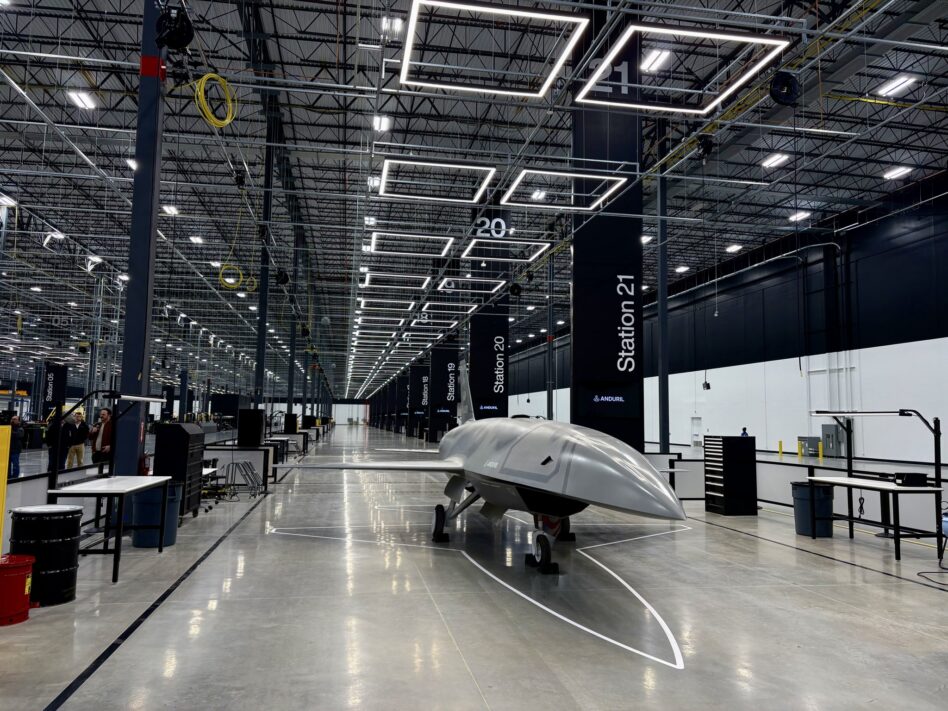
Anduril is thinking big. Like really, really big—and nothing says that quite like Arsenal-1.
Yesterday, Tectonic paid a visit to Anduril’s $1B, 5M square foot mega-factory just south of Columbus, Ohio, where the company (hard to call them a startup after a $20B Army contract) will kick off production of their Fury drone wingman in the coming days, with other technologies to follow.
Welcome to the Arsenal: Like most things Anduril, Arsenal-1—the first in a series of “hyperscale” factories they have in the works—comes with a lot of big numbers attached.
- Anduril is investing nearly $1B of its own cash to construct at least seven manufacturing facilities on the massive property (plus a few supporting buildings).
- The company says Arsenal-1 will ultimately employ 4,000 people within the decade, starting with 250 this year, and bring $2B in projected annual economic output.
- It’s also conveniently located next to a local airport with two 12,000-foot runways.
Blank space, baby: As for first impressions, stepping into Arsenal-1 feels weirdly…empty and— despite the products they’ll build there—not very autonomous. No robots, very little fixed infrastructure, and a whole lot of floor space.
But according to Anduril’s Head of Production, John Malone, that’s the whole point. The entire factory is designed for adaptability to demand, low tooling in the assembly process, and fast training for new hires.
“If we had decided to make a massive robot that installs the [Fury] wings, for example, it would be very hard for us to change it, ever,” Malone said on the tour. “Instead, we have maximum flexibility with the absence of monuments in the space. Everything on the line is easily movable, and all the utilities necessary are on cord rails above the floor stations.”
Shifty: The products Anduril will build at Arsenal-1 are designed around that flexible mass-manufacturability ethos. Even though Fury—Anduril’s autonomous fighter and entrant for the Air Force’s Collaborative Combat Aircraft program—will be the first product to roll off the line this summer, the company plans to start manufacturing a range of technologies there within the year, including:
- Barracuda, Anduril’s low-cost air-breathing cruise missiles that come in three sizes with increasing munition payloads and are in testing with Army DEVCOM AvMC. They’ll go into full-rate production of Barracudas at Arsenal-1 later this year.
- Roadrunner, their autonomous twin-jet VTOL, which has a high-explosive interceptor variant for ground-based air defense.
- And whatever other current and future products Anduril needs to scale manufacturing for.
“This is the philosophy you’ll see across Arsenal as it scales—fungible space and fungible workforce, where you can shift and move capacity based on demand,” he added.
ArsenalOS: Aside from all the design choices in the factory, Anduril’s also built software to help keep things moving on the line at Arsenal-1 and across their other facilities. The software, called ArsenalOS, aggregates everything from “product development all the way to servicing the aircraft in the field,” Malone said.
- On the factory floor, workers will have an ArsenalOS dashboard that “provides real-time data on leads on the line and if they’re on schedule, having downtime, quality defects on their vehicle, and any safety issues that have been reported.”
- It also integrates third-party software, including Palantir’s Foundry and Computer-Aided Design (CAD) platforms, Malone told Tectonic.
Big moves: What makes Arsenal-1 different from Anduril’s other factories across the country and world is, as co-founder and COO Matt Grimm told Tectonic in an interview at the factory, “just the pure scale.”
“When we started in Southern California, there was an obvious constraint in space—it’s very densely populated, packed, and has an obvious constraint of cost,” he said. “As we looked at full-rate production of very large systems, Fury included, and things like Menace, which is a shipping container-sized thing, and Titan [a next-gen intelligence ground station], you need a ton of space for that.”
“The next differentiating factor is that it’s a completely blank slate, so we’re able to design the buildings the way we want,” Grimm added. “That’s pretty unique for us, because in most of the places we go, we’re going into an existing building and trying to squeeze our way into how to best operate, but here, we have a blank slate to work with, and it’s pretty wild.”
Money talks: To address the big, green elephant in the room, Anduril is raising a shit-ton of money, and that cash will be “principally directed at the manufacturing and scaling side of things, but there are a couple of areas,” Grimm said. “One of them is just physical infrastructure. Buildings are expensive, but people are [also] expensive.”
The first close of that raise, he told Tectonic, “should probably be the end of this month, and then the subsequent closes—and herding the cats for all of that—takes a few months, so my guess is that the round will be fully closed by June or July.”
The numbers reported are “generally accurate,” which should give Anduril a hell of a lot of money to make Arsenal-1 the factory of their dreams.