
In case you missed it, earlier this month, Secretary of Defense Pete Hegseth issued a memo outlining his plan to make the Pentagon “an ‘AI-first’ warfighting force across all components, from front to back.”
San Francisco-based military AI startup Legion Intelligence is taking him up on that. Yesterday, the company launched a new tool called Centurion that aims to put generative AI in the hands of warfighters at the edge.
First in the door: The Big Tech giants—namely xAI, Google, and OpenAI—have inked some massive deals to integrate their generative AI platforms with the Pentagon’s own enterprise AI platform, GenAI.mil, but Legion, founded in 2022 as Yurt, was ahead of the curve in the military-specific AI wave.
The company was the first to operate on a secret network for the Pentagon and has rolled out proprietary secure AI platforms, including a purpose-built chatbot for USSOCOM called SOFChat. Legion was awarded a $16M contract for SOFChat in 2023 and snagged an extension last May.
SOFChat allows SOF users to:
- Access and search a cloud of organizational docs and data.
- Chat with a bot and ask questions about “organizational knowledge.”
- Generate written content—emails, reports, and the like—using the org’s knowledge.
- Automate workflows and reduce annoying administrative tasks.
Edgelord: Centurion is a bit edgier.
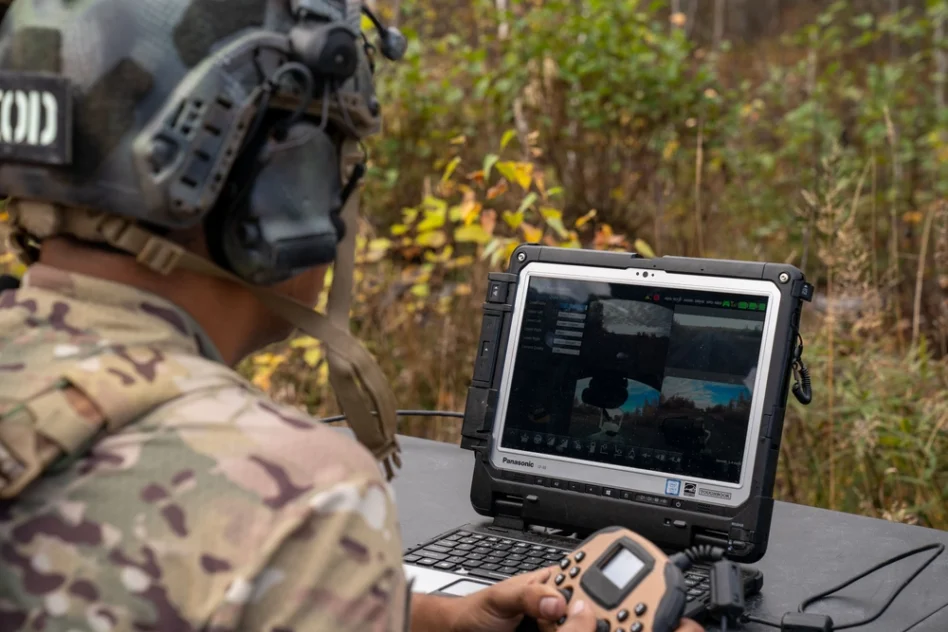
Put simply, it’s an integrated hardware and software package designed to extend Legion’s platform “into a field-deployable capability” in offline and degraded environments.
- According to the company, “Centurion nodes can operate independently when disconnected, form a mesh to scale agent-driven workflows across multiple nodes, and synchronize with cloud environments.”
- That means that, for example, a user operating in Denied, Degraded, Intermittent, and Limited (DDIL) environments can access the platform offline and use its swarms of agents to handle tasks like intelligence and targeting analysis, command and control, and logistics in parallel before syncing up with a broader network when connectivity returns.
- The company also uses encryption, audit logging, and super-strict access controls to ensure that data doesn’t cross classification levels and has implemented guardrails to prevent hallucinations. That’s probably smart, given the missions SOCOM carries out.
Now, Legion didn’t train an AI model itself: The platform is built to be an “enabling technology” for other models to operate in DDIL environments and on highly secure, air-gapped networks, CEO and Co-Founder Ben Van Roo told Tectonic. “For example, Palantir is a big system of record. We sit across systems of record, stitch them together, and make them useful with lots of different models.”
Given that USSOCOM has deployed Legion’s software enterprise-wide, users have clearly found it pretty handy, and Centurion takes it out of the office and into the field.
“We’ve done targeting analysis [with users] that usually takes a couple of guys an entire weekend take 10 minutes, so the scale starts to be pretty large,” Van Roo said. “We just tested it in different environments with the Army, and it’s a pretty darn real capability.”
“A lot of companies we see are plugging chat assistants on top of software, and that’s great and valuable, but if you believe that agentic work is going to drastically increase in the Department of War, you have to orient yourself with that vision,” he added. “That’s what we’ve done, and Centurion is the most operational manifestation of that.”