
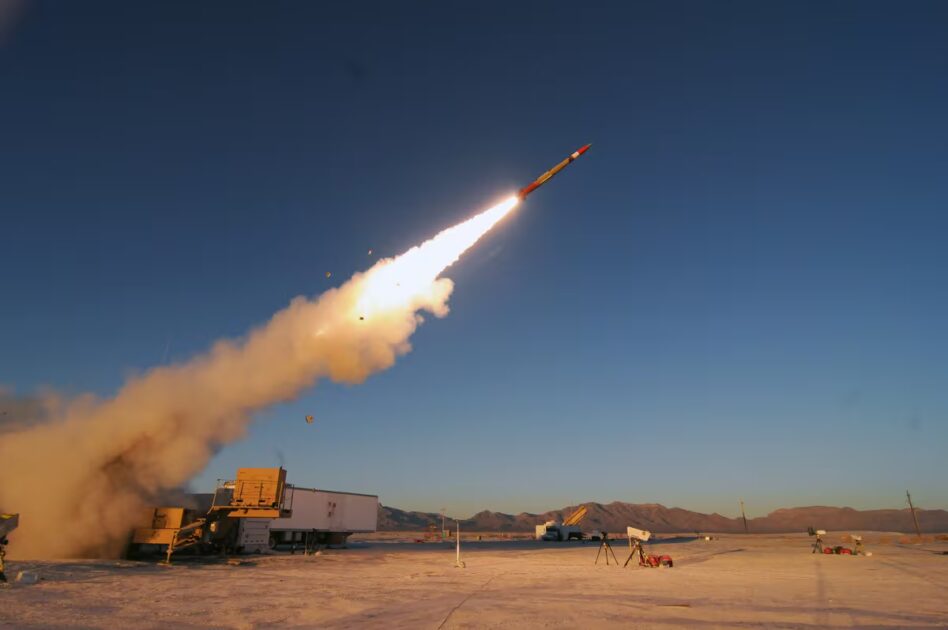
There are three certainties in life: death, taxes, and champagne popping at Lockheed Martin HQ.
On Monday, the Pentagon gave the mega-prime good reason for celebration, announcing an agreement to boost annual production of the ever-popular Lockheed-made PAC-3 MSE missile interceptors from 600 to 2,000 over the next seven years under a new acquisition model.
It ain’t no secret that it’s been a big few years for missile interceptors, and it pays to be the one supplying the best of ‘em. Lucky for Lockheed, they also make the even more pricey and sought-after THAAD interceptors.
Missile madness: Patriot production—and missile production more broadly—has been a big pain point for the Pentagon for a while.
The situation hasn’t been helped by some serious supply chain bottlenecks, soaring demand from combatant commands (we hear you, INDOPACOM), or the US sending them out around the world like Oprah (we hear you, Bridge Colby).
But there’s a good reason Patriots, the most advanced PAC-3 Missile Segment Enhancement (MSE) variant, have been such a hot commodity since they were first rolled out in 2015.
- Patriots boast a $1.1B per-battery and $4M per-missile price tag, but are one of the few air defense systems capable of reliably taking down ballistic missile threats. That’s made the demand for them pretty damn high in Ukraine—which has potentially fired over 1,000 of them to date—and elsewhere.
- Over the past decade, the Pentagon has bought nearly 270 MSE missiles per year on average, but that number has shot up in recent years. Lockheed says it delivered a record 620 of ‘em last year after a 20 percent year-over-year production increase.
- Last September, Lockheed inked a $9.8B contract to supply 1,970 PAC-3 MSE missiles to the DoD, the largest order on record.
Boosting the boom: Clearly, the DoD thinks that ain’t enough, and Lockheed is taking note.
Under the new deal and acquisition structure, which the Pentagon says “delivers long-term demand certainty, incentivizing industrial investment to increase production, cut lead times, drive supply chain management efficiencies, while reducing upfront government facilitization and capacity investments” (say that five times fast), Lockheed will ramp up annual production to 2,000 PAC-3 MSEs over the next seven years.
Those interceptors, according to Lockheed, will be delivered to the US and the 17 allied countries they supply with PAC-3s.
Fired up: Even though Lockheed is expected to foot the bill for the capital investments required to expand capacity and hit those numbers, the world’s largest defense contractor is feeling pretty good about the deal.
“This first-of-its-kind approach builds on years of advocacy and collaboration to bring commercial practices to major acquisition programs,” CEO Jim Taiclet said in a statement. “We will create unprecedented capacity for PAC-3 MSE production, delivering at the speed our nation and allies demand while providing value for taxpayers and our shareholders.”
The Pentagon’s acquisition boss is fired up, too.
“This framework agreement marks a fundamental shift in how we rapidly expand munitions production and magazine depth,” Under Secretary of Defense for Acquisition and Sustainment Michael Duffey said. “Lockheed Martin’s willingness to help pioneer this transformative acquisition model is a win-win for the taxpayer, our national security, and the rebuilding of the industrial base needed for the Arsenal of Freedom.”
When Secretary of Defense Pete Hegseth told industry leaders that the Pentagon would award contractors bigger and longer awards for “proven systems” back in November, we’re guessing this is what he meant.