
Are you feeling the reindustrialize vibes yet? Well, you should be, because investors certainly are.
Yesterday, advanced manufacturing startup Machina Labs closed a $124M Series C to build its first large-scale “intelligent factory.” The idea is to use AI-powered robots to rethink how everything from car parts to drone and missile airframes are made.
The robo-dojo: You might be thinking, is metal really a thing that needs to be revamped? To California-based Machina Labs, the answer is a resounding yes.
“The problem with traditional manufacturing is that every time you have to build a product, you have to build a factory for it,” Machine Labs CEO Edward Mehr told Tectonic. “Software has grown like crazy in the past couple of decades, but hardware still moves at a pretty stale pace.”
That’s where Machina Labs and its army of robots come in.
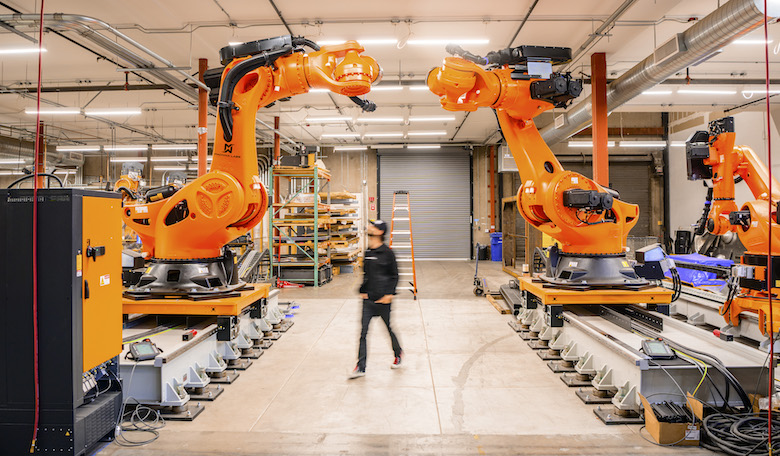
- Their proprietary RoboCraftsman manufacturing cells autonomously handle loading, metal forming, scanning, trimming, and drilling to turn digital designs into production-grade metal parts.
- Each RoboCraftsman has two robotic arms that integrate multiple manufacturing operations within a single containerized cell.
- The flexible platform can be updated like software to add new tools and workflows based on customer demands and the unique needs of different metal parts, whether that’s a missile structure, fuel tank, or drone airframe.
Primetime: To start, Machina Labs is focused on defense, and they’ve already caught the attention of the big dogs. Lockheed Martin’s venture arm participated in their Series C, and Mehr confirmed that the mega-prime is a customer (but wouldn’t say which program they’re working on).
“In our work with an aerospace prime right now, the time it took to get to the first product was five times faster than what was traditionally possible,” he said. “We can easily scale that up and down—not only can we get the product faster, but we can scale to production with the addition of a cell.”
Defense currently brings in about 70 percent of the company’s revenue, but “defense is seasonal at the end of the day,” Mehr said. “In the next few years, we’ll get to a point where most of our revenue comes from commercial, but if a conflict arises, we can easily turn commercial factories into defense factories because it’s the same system.”
Given that Toyota’s venture arm backed them in the Series C, they also seem to have their eyes on the auto industry.
Factory of the future: Machina Labs currently has two factories in California, but this new “intelligent factory” will be on a whole different level.
- The company is planning a 200,000-square-foot facility that will be home to 50 RoboCraftsmen and able to produce thousands of components and structures for defense customers.
- The team is looking outside of California for their new factory—Texas, New Mexico, and Alabama are all on the table.
Rethinking reindustrialize: Easy to say after raising $124M, but Mehr feels pretty confident about the future of the company.
“With robotics and artificial intelligence, for the first time, we can basically replicate what a human artist, a human craftsman, does at scale,” he said. “You can have robots, in our case, form sheet metal parts the same way a craftsman hammers and shapes a sheet metal into shape for a sculpture.”
“We think it’s the next generation of reindustrialization,” he added. “Instead of kind of going back to the factories we had in the ‘50s and ‘60s, we need to move towards factories that can be flexible, that can be easily deployed.”