
If you thought the unmanned surface vessel world couldn’t get any busier, well, think again.
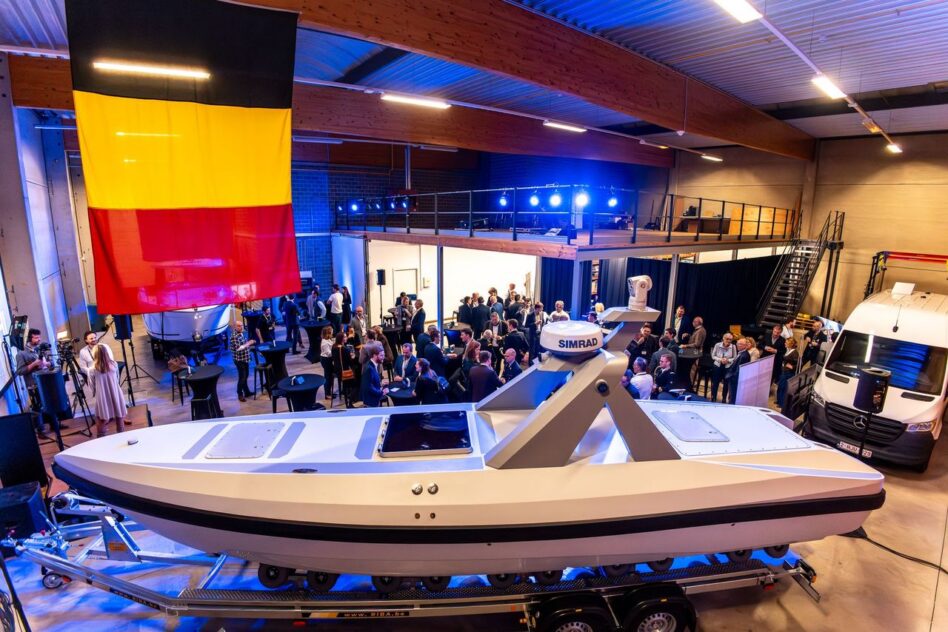
This morning, Belgian maritime autonomy startup MAHI unveiled a 27-foot high-speed USV called the Alpha-8, designed as a demonstration vessel for its autonomy stack in exercises and training with the Belgian Navy, at least to start.
Fishy business: MAHI, in case you’ve been paying closer attention to Belgium’s chocolate than its defense scene, has been in the maritime autonomy game for a while, at least in defense tech terms.
- The company got its start in 2015, when a group of engineers set out to build an autonomous, solar-powered vessel capable of collecting real-time ocean data during a transatlantic crossing.
- In 2022, after seven years of building the autonomy stack from scratch in their free time, MAHI’s USV—then called Project Mahi—became the first to cross the Atlantic using only solar power, traveling more than 4,300 nautical miles from Spain to Martinique in six months.
- Since then, they’ve been focused on honing their maritime autonomy hardware and software stack, called MAHI Sense, increasingly with an eye toward defense applications.
- They’ve also partnered with some familiar names in the USV scene, including California-based Seasats, and provided the autonomy tech for a special-purpose USV for the British Navy, designed with the UK MoD’s Defence Science and Technology Laboratory (DSTL).
All about autonomy: Despite Alpha-8’s roll-out, MAHI is more focused on the autonomy side of the house than shipbuilding.
The USV “serves as a specialized demonstration platform for defense applications” for “real-world trials with navies,” MAHI’s co-founder and CEO Pieter-Jan Note told Tectonic. “By testing in complex, high-speed environments, MAHI allows end-users to refine autonomous concepts of operation.”
Need for speed: Alpha-8, which began development last November with Belgian powerboat-maker Bernico, is built for speed:
- It’s 8.3 meters long (roughly 27 feet) and features a 370-horsepower engine that can propel the USV to a top speed of around 50 knots.
- It’s powered by MAHI’s onboard autonomy hardware and software computing system, MAHI Sense, which connects to almost all third‑party maritime equipment, as well as their own remote operation and mission control technology.
- Payloads haven’t been integrated yet, but there’s “plenty of space available” for whatever the Belgian Navy might want to load it up with, according to Note.
- It’ll hit the water in the next few months, when it’ll start undergoing trials with the Belgian Navy ahead of participating in NATO’s REPMUS exercise.
The Alpha-8 is a model for future USVs MAHI might produce on their own, but in the near-term, it’s “really intended to validate our own autonomy technology and bring that to the next level,” Note said. “At the same time, it serves as a real touch-point, not PowerPoint, with the end customers.”
When MAHI showed it off to the Belgian Navy leadership at an unveiling last week, “They already asked, ‘What’s the price? Can we buy it?’” he added. “If we get into those discussions, then we’ll partner with the boatbuilder to deliver the USV to the Belgian Navy.”
MAHI’s taking things step-by-step, but their sovereignty-minded buyers aren’t. Given that the Commander of the Belgian Navy said “the cooperation between MAHI and the Belgium Navy is real, ongoing, and driven by operational needs” at its unveiling, the Alpha-8 could be the next drone boat to hit the market in Europe.