Clearly, being on both Army Next-Gen Command and Control (NGC2) prototyping teams isn’t enough for Rune.
Yesterday, the AI-powered logistics and sustainment startup announced that it was tapped for the Marine Corps’ Project Dynamis, the service’s push to accelerate the modernization of its C2 contribution to the Pentagon-wide Combined Joint All-Domain C2 (CJADC2) within the Navy’s Project Overmatch.
At this rate, on the frontline logistics front, Rune’s risking running out of worlds to conquer.
Race to integrate: To back things up, Project Dynamis—announced last September—is the Marine Corps’ service-level command-and-control integration and modernization initiative, developed in partnership with Project Overmatch and built around Palantir’s Maven Smart System. In turn, Overmatch, the Navy’s contribution to CJADC2, is designed to connect manned and unmanned platforms, sensors, weapons, commanders, and other warfighting functions into a more resilient and data-centric maritime joint tactical network.
Dynamis is broken up into three core pillars:
- Assured C2, focused on adopting a common data fabric, decentralized mesh networking, and the integration of command-and-control of autonomous systems.
- Battlespace Awareness, focused on accelerating AI-enabled battle management C2 for all-domain awareness, ISR/counter-ISR, targeting, and rapid crisis response.
- C-C5ISRT, focused on countering adversary C2, awareness, and targeting through EW, spoofing and jamming, and edge AI capabilities. (Seriously guys, how many Cs can we keep adding to that.)
Crystal ball: Now that that’s out of the way, back to Rune. The new contract with the Marine Corps Warfighting Lab—building off a pilot contract awarded last September—brings predictive logistics into the USMC’s Marine Air-Ground Task Force Command and Control (MAGTF C2) system, designed to integrate comms, intel, and sensors from air and ground domains to clear up the battle management picture. Rune couldn’t disclose the contract value.
Logistics, while famously unsexy, is a pretty important part of that whole effort, and Rune’s TyrOS predictive logistics is emerging as a pretty handy tool to bring that paper-and-pencil work into the AI era.
- TyrOS, built to operate on everything from low-connectivity edge devices to the command level, uses predictive AI and tons of data to track and move gear, fuel, food, and parts around more quickly across domains than legacy sustainment systems.
- Rune recently rolled out a frontline AI agent inside TyrOS called Saga, designed around sustaining and restoring a force to combat effectiveness (reconstitution), which the Marine Corps is also getting its hands on through Dynamis.
“The beauty of things like Dynamis and NGC2 is that logistics has to be an integrated part of command and control and executing mission command—we can’t think about whether an operation is feasible or infeasible, or how we command and control an operation, without understanding logistics as an integrated part of that,” Rune CEO David Tuttle told Tectonic. “So, credit to the Marine Corps for recognizing this early in Dynamis’ life, we can’t do all these really cool things on the pointy end with weapon systems and new capabilities without understanding the sustainment of them.”
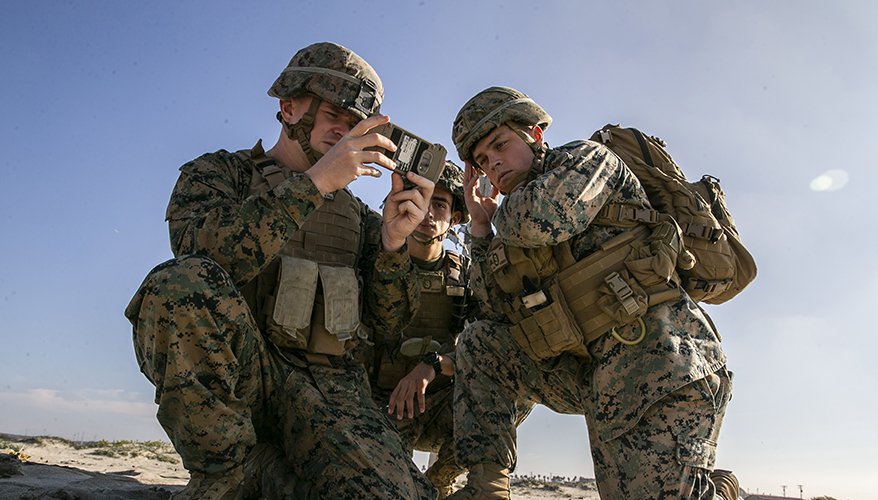
At the edge: With Project Dynamis, Rune will deploy TyrOS onto “mobile devices at the low tactical level,” according to Tuttle, and that work has already kicked off. Dynamis is built around agile development events, called serials, and Rune already took part in the seventh iteration.
If a lot of that sounds similar to the Army’s Ivy Sting (4th Infantry Division) and Lightning Surge (25th ID) NGC2 exercises, you’d be right, but the force structure differences—particularly the Army’s heavy mechanized divisions and the littoral and expeditionary nature of the Marine Corps—make the logistics needs slightly different.
“As Dynamis got up to speed, it was like, ‘Oh, this is really awesome, this mirrors some of the C2 modernization happening on the Army side with NGC2,” Tuttle said. “This is not a scientifically precise number, this is a Dave Tuttle number, but I think it’s probably 80 percent commonality there—we’re still worried about how we track commodities inventory and distributing those commodities across the battlefield, and track personnel, maintenance and readiness levels, and real-time expenditures of munitions.”
TyrOS is flexible and can be customized for different use-cases, but given that the “80 percent solution” is in high demand these days, that’s a pretty good starting point for Rune.