
If you’ve taken a look at the summer events calendar and are worried about how hostile drones could throw a wrench into all of the FIFA World Cup and America 250 festivities, you’re not alone. The big players in public safety are, too, and they’re making some money moves to make sure it all goes smoothly.
Yesterday, Motorola Solutions snapped up Israeli-American drone-takeover company D-Fend Solutions for a cool $1.5B, adding a key C-UAS capability to its broader public safety portfolio of products.
Taking over: D-Fend’s drone-downing tech is designed less for the battlefield and more for places where drones falling out of the sky or blowing up mid-air isn’t really an option (think stadiums, urban areas, and airports).
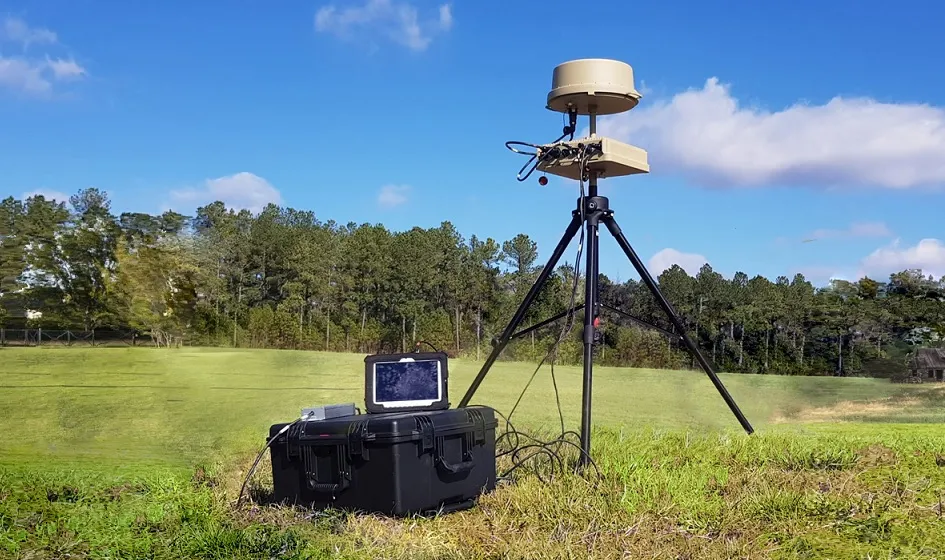
Their RF-cyber “takeover” systems detect small drones via their radio signals, “hacks” them, and lands them instead of jamming or kinetic defeats. Their product lineup includes:
- EnforceAir, D-Fend’s OG product, which identifies, locates, and commandeers rogue drones;
- EnforceAir 2, which builds on the first version, but with a more compact package that has better Size, Weight, and Power (SWaP), portability, and performance;
- EnforceAir UX, the user interface and airspace-management tablet software for EnforceAir and EnforceAir 2;
- And EnforceAir PLUS, an amped up version of their other platforms that offers more adaptability to radio frequencies, jamming, an optional radar detection add-on to extend coverage, and an AI-integrated target fusion system that “merges cyber and radar data.”
“Cyber takeover enables the operator to define and execute the drone’s behavior upon mitigation,” the company’s president, Yaniv Benbenisti, told Tectonic last year. “This approach ensures continuity of airspace operations, protects bystanders, and minimizes disruption.”
That takeover tactic has proven pretty popular: D-Fend’s won contracts with the US military, the Department of Homeland Security, and a range of commercial customers vulnerable to the drone threat.
- According to Motorola’s release, D-Fend’s systems are deployed in 30 countries, and their revenue has grown over 50 percent over the last three years, with expected 2026 revenues of $185M.
Full-stack: For Motorola, the deal makes a lot of sense—they already have deep roots in the public safety space, and snapping up a company that specializes in countering drones in places where flying robots dropping out of the sky is, well, less than ideal fits cleanly into their broader command layer. They also got a pretty good deal for it, buying D-Fend at an 8X revenue multiple in a time where counter-drone companies are raking it in.
- Motorola makes widely deployed command center software for militaries and public safety agencies (which 60 percent of North America’s public safety answering points (PSAP) use), along with a range of communications and video security systems.
- Last year, they snapped up a familiar name in the military comms world, buying drone and comms networking company Silvus for $4.4B.
- They also teamed up with public safety-focused drone company BRINC and drone detection company SkySafe last year to integrate Drone as First Responder (DFR) and detection capabilities into its 911 command center platform, CommandCentral.
They also got a pretty good deal for it, buying D-Fend at an 8X revenue multiple in a time where counter-drone companies are raking it in.
By buying D-Fend, Motorola’s goal is to pretty much create a full-stack counter-drone system focused on homeland security that integrates detection, comms, their operator command layer, and, now, a way to take them out of the sky without causing too much chaos.
That should be music to the ears of everyone from FIFA to public safety agencies and the US military, which, ICYMI, has been dealing with a lot of rogue drones buzzing around installations lately.