
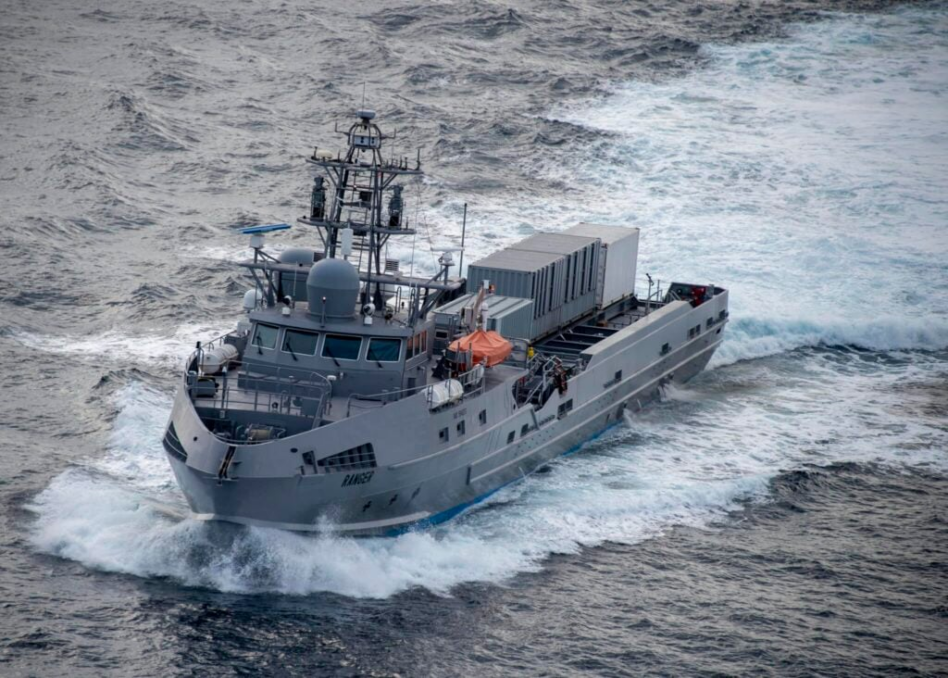
Pour one out for MASC.
Yesterday, less than a year after announcing it, the US Navy cancelled the Modular Attack Surface Craft (MASC) program—originally designed as a prototyping competition to field medium unmanned surface vessels (MUSVs)—in favor of a “regular and recurring marketplace” for mid-sized drone boats.
Reactions to the shift in the USV world were, in a word, polarized.
MASC off: Before we get into the spicy takes, here’s a refresher on the short-lived MASC program:
- After hosting an industry day the month prior, the Navy launched the MASC program last July, seeking “proposals for innovative, commercial technologies that accelerate attainment of [MUSVs],” with the intent to issue prototype projects and, after a three-phase competition, an OTA contract to the winner (or winners).
- In a statement to Tectonic at the time, the DIU (whose advisors worked closely with the Navy’s unmanned systems program office on the solicitation) said MASC would “[build] on the momentum from the rapid integration and demonstrated potential of sUSVs into fleet operations,” since “MUSVs offer additional payload capacity, variety, and resilience to realize distributed maritime operations objectives.”
- A number of USV companies—including Saronic, HavocAI, Blue Water Autonomy, Sea Machines, Anduril, and the UK’s Kraken—were in the mix for MASC, and the Navy had already whittled the pool down to three at the time of its cancellation.
On the market: The logic behind killing MASC, according to the Navy’s Program Acquisition Executive for Robotic and Autonomous Systems (PAE RAS), Rebecca Gassler, is that mature-enough MUSVs are already on the market without MASC’s prototyping push.
“It’s our new approach to accelerate this autonomous capability to the fleet as part of the Golden Fleet,” Gassler told reporters yesterday. “Our goal is to create a regular and recurring marketplace, not just for the MUSV, but for other classes of vessels as well.”
“We are harnessing the talent and ingenuity of the American tech sector by launching a market competition for the Medium Unmanned Surface Vessel (MUSV) Family of Systems,” Navy Secretary John Phelan added in a post on X. “This new approach will leverage private investment and accelerate the delivery of real capabilities to the Fleet.”
The new “regular and recurring marketplace” for MUSVs, as Gassler called it, seeks “proposals for technically mature solutions that satisfy the vessel and autonomy performance requirements” in the solicitation, and “for those solutions to complete an MUSV autonomy and vessel performance test by the end of fiscal year 2026.”
Mixing up MASC: It also changes some requirements—a sore subject for companies that have spent the better part of the past year developing MUSVs designed for MASC:
- It requests MUSVs capable of traveling 2,500 nautical miles at 25 knots while carrying a 25-ton load on the payload deck in Sea State 4, an 11-ton reduction from the MASC payload requirement.
- MUSVs should be fully autonomous in both day and night operations in varying weather conditions in sea state 5 “with a wide range of speeds and headings and survivable through sea state 7.”
- It requires them to be able to restrict “all Radio Frequency (RF) emissions when commanded while continuing to autonomously operate” and have a “perception system for autonomy has a passive mode with no RF emissions.”
MASCuerade: The payload—and thus speed and range—part was a big pain point for companies building MUSVs for the old MASC requirements, and, as expected, some were pretty ticked off by the shift.
“It’s hypocritical because they just did a massive requirements change—the requirements for this solicitation are very different than the requirements that they had in the MASC solicitation,” one USV exec in the mix for MASC told Tectonic on the condition of anonymity. ”We have a ship under construction because the Navy selected us. We went through a three-phase competitive process with over 100 companies…We moved out to build, and then over the last couple of months, [the Navy] kind of stalled.”
“It’s gonna cost, minimum, months, and low tens of millions of dollars, and the Navy’s literally gonna get the opposite of what they’re asking for,” they added. “They’re asking for speed and [a] ready product. Instead, they’re gonna get slower, and they’re gonna get something we had to change to meet their new f*cking idea of the month.”
Investors who have backed the companies building for MASC were also not thrilled. “The Navy’s like, ‘Go faster, we’ve got to reindustrialize,’ and then for them to pull this, it’s really gross,” one VC, who also spoke on the condition of anonymity so they could speak freely, told Tectonic. “The primes, like our friends at HII and elsewhere, they’re just laughing their heads off because of this mess…[and] the Navy, once again, gets what it asked for.”
Behind the scenes: Several people Tectonic spoke to pointed to Anduril—which launched its own MUSV program and bid for MASC in partnership with South Korean shipbuilder Hyundai Heavy Industries last November—as pushing for the shift. One went so far as to say, “Anduril lost [in the MASC competition], and this is almost entirely driven by Anduril.”
Anduril declined to comment on their role in MASC’s cancellation and the requirements changes.
Market moves: Not everyone was annoyed by the Navy’s move, however.
“The shift to an MUSV marketplace is the right move to accelerate capability to the Fleet,” HavocAI CEO Paul Lwin told Tectonic. “It creates a competitive environment where the best solutions can be built, integrated, and fielded quickly, ensuring the Navy gets the right capability at the right price and at the right time.”
Long story short, things are pretty heated in the ever-busy world of medium-sized drone boats.