
The US has a nuclear waste problem. A startup has an idea on how to fix it—and give all the power-hungry hardware the Pentagon loves a next-gen energy supply.
Yesterday, Project Omega emerged from stealth with $12M in funding to scale up its nuclear waste recycling technology and accelerate the development of a battery-sized nuclear power source capable of powering everything from soldier-borne electronics to drones and sensors.
News of the raise was first reported by Axios.
Trash to treasure: Put simply, the US has a shit-ton (technical term) of spent nuclear fuel laying around. According to the GAO, more than 90,000 tons of nuclear waste from commercial nuclear power plants, accumulated over decades of operation, are stored at more than 100 sites across the country.
That spent fuel, the government’s trash, contains more than 90 percent of its inherent energy. Project Omega wants to turn it into treasure.
New life: Most legacy nuclear recycling technology uses a “very dirty, aqueous water-based process,” Project Omega CEO Staff Sheehan told Tectonic. “We simplify that process by using molten salts, which are higher temperature, but also easier to clean up.”
There are two parts to the startup’s technology:
- The isotope source, which emits the radiation. Project Omega uses safer alpha and beta radiation, instead of the more hazardous gamma radiation (the one that turned Bruce Banner into the Hulk).
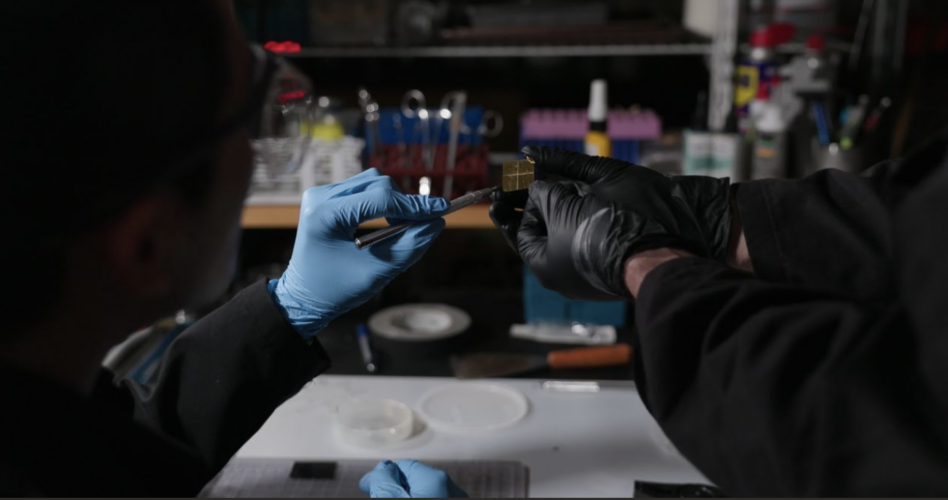
- The semiconductor, which absorbs the radiation and stores it as a power source. “You can think of a lot of the work that we do as something similar to what you’d see in a semiconductor fab,” Sheehan said.
And, according to him, they’re coming out of stealth because “we have a working product, we actually have something to show the world.”
“People call them nuclear batteries, but we don’t use that term, especially with defense customers, because a battery runs out and you recharge it,” Sheehan said. “They’re really power sources that change the way you think about small electronics.”
- Project Omega’s first offering—still under development—is designed to slot into existing electronic platforms the way a small battery does.
“All of a sudden, the limiting factor in your electronics is the processor or some other piece of the chip, if not the power source,” he added. “We can have electronics that live as long as we need them to live, or as long as the other parts will support them to live.”
That tech caught the early attention of the Department of Energy’s Pacific Northwest National Laboratory (PNNL), which has worked with the startup for the past few months to speed up development.
“We send our device to them, and they incorporate nuclear materials into the devices,” Sheehan said. “That’s kind of that’s how we’ve been able to accomplish this milestone so quickly.”
Power play: Coming out of stealth, Project Omega has its eyes on defense, aiming to provide a power source for radars, sensors, drones, and other small battery-powered electronics.
“Sensors and detectors are kind of the low-hanging fruit application, but another one that I actually like a lot is edge compute,” Sheehan said. “You can have, essentially, an edge compute node powered by a radioactive power source—it’s all on-chip and it’s all integrated. You can run AI at the edge [without] worrying about running out of battery.”
Because they use alpha and beta radiation, the company says their power source (remember: not a battery, guys) can also be used in wearables.
- “They can be close to a person, and not cause any more radiation hazard than you would have on an airplane,” Sheehan said. “It also decouples the need for AA batteries for different electronics on the warfighter and reduces the weight they need to carry.”
Fuel funds: Those potential applications, paired with the Pentagon and DOE’s push to accelerate resilient nuclear power supplies, have investors excited. With $12M in seed funding, led by Starship Ventures, Project Omega’s focused on getting the tech ready for customers, but that’s far from a walk in the park.
“One of the challenges with building the type of recycling technology that we are is that it’s never been done before,” Sheehan said. “In order to scale that technology, we need to do a lot of development work, and we are using this money to help scale that technology.”