Well, looks like Saildrone’s $37M BPA from last summer is getting put to good use.
Yesterday, the sailboat-drone company announced that it’s won a $15.5M contract with the US Coast Guard (USCG) to deploy 16 Saildrone Voyager vessels in the Great Lakes and off the US Northeast coast.
“We’re augmenting the Coast Guard because they’ve got…95,000 miles of border line,” Saildrone President John Mustin told Tectonic. “They just don’t have enough people or enough vessels to be where they need to be all the time…. With autonomy, we can supplement what they’re doing. I like to think of this as transitioning from a reactive enforcement to a proactive security, persistent awareness that drives more efficient reaction.”
Turns out CENTCOM ain’t the only place where maritime autonomy is all the rage these days, folks.
Ahoy, matey: Saildrone is old hat around here, so we’ll run through the context real quick.
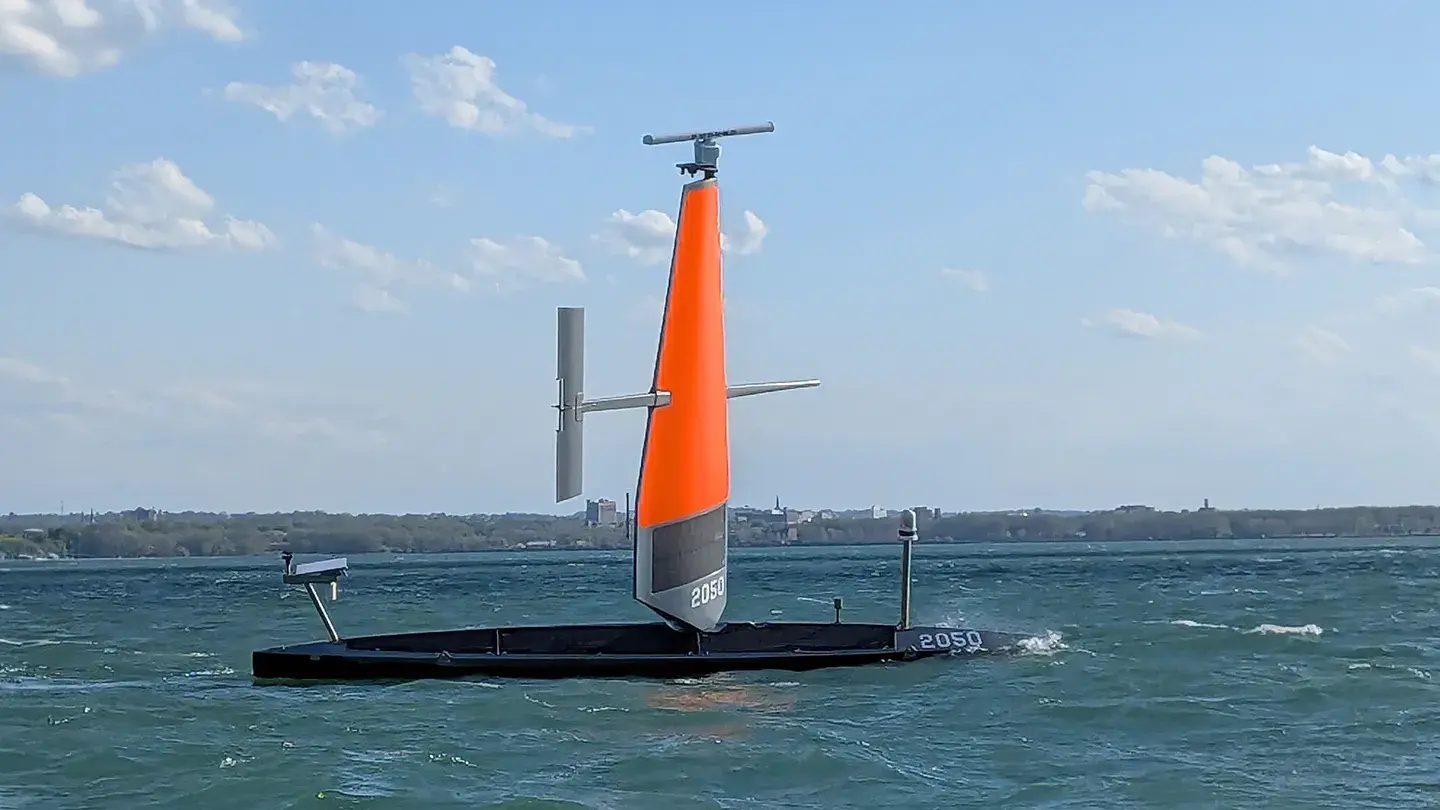
The company was founded back in 2012 and builds wind- and solar-powered sailboat-like drone boats (get it?). The vessels can operate in GPS-denied environments, stay at sea for oodles and oodles of time (100+ days in the case of Voyager, per Mustin) and carry out everything from ISR to the good ol’ bang-bang stuff.
- Saildrone actually started out in climate and oceanographic research—the super-low noise profile of the boats means they’re good for monitoring things like fish populations. They’re also good for sneaking up on vessels and people.
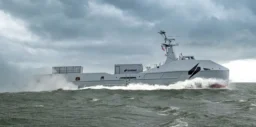
- The USVs come in a few different flavors: The 23-foot Explorer, 33-foot Voyager, and 65-foot Surveyor. Last month, they also unveiled a big ol’ 250-ton, engine-powered drone boat called Spectre, built with Lockheed Martin.
- All of these vessels are chock-full of high-powered radar and cameras that can cover thousands of square miles every day at a “fraction of the cost” of crewed boats.
- They’re also working with Lockheed to build weapons systems onto Surveyor and Spectre.
Out at sea: And they’re, like, actually doing work with the military.
- 20 of its Voyager vessels are Operation Southern Spear, an anti-narcotics operation in the Gulf of Mexico led by JIATF-S and NAVSOUTH.
- Voyagers are also deployed as part of the US Navy’s Task Force 59 (T59) in the Middle East, and were part of NATO’s Task Force X exercise in the Baltic Sea in June.
Mustin said that the Voyager has been a huge hit, in particular, because it’s the “workhorse of [their fleet].”
“We just find that the form factor at 10 meters is appealing because it allows us to to transit in a standard container,” he added. “We can disassemble it and ship it around the world and then launch and recover very quickly.”
Go fish: The good news is, this ain’t Saildrone’s first rodeo in the Great Lakes or with the Coast Guard.
- The company worked with the US Geological Survey in the Great Lakes from ’22-25, Mustin said. That was less “tracking smuggling” and more “mapping fish populations and the arrival of invasive species,” but they’re familiar with the territory.
- They’ve worked with the Coast Guard since about 2023 in the SE and SW US on counter-narcotics and trafficking operations. They’re also v good at spotting illegal fishing.
Fresh water: This new contract with USCG will be split between the Great Lakes and the Northeast (like, in the not-so-friendly-sea-state Atlantic) and expand the company’s work on “supporting counter-drug and migrant interdictions, safety of life at sea (SOLAS) missions, and efforts to combat illegal, unreported, and unregulated (IUU) fishing,” according to the company.
- Six Voyagers will deploy in the Great Lakes—they’ve got four out there right now, with another two heading to Lakes Huron and Ontario later in the summer.
- Ten will operate off the Northeast coast. Six are already operational, with another four set to head out to sea in the coming “weeks and months,” per the company.
- All of the vessels will be kitted out with the company’s standard “maritime domain awareness package,” Mustin said. That includes a 200-watt radar, electro-optical infrared-enabled cameras, and a super-snazzy automatic identification system (AIS). That lets organizations like the Coast Guard see both dark vessels and those that are broadcasting.
“There just aren’t enough people or enough crewed vessels to be everywhere the Coast Guard wants to be, and so we allow them now to get to locations that are either remote or to cover down on areas that are vast and to be persistent,” Mustin said.
Times tables: The idea of the whole shebang is that Saildrone helps USCG—a comparatively small force with, like, a pretty huge mandate, especially given the administration’s focus on Western Hemisphere operations—multiply their capabilities without needing a ton of exquisite vessels or highly-trained operators.
“[Users] love this technology because they just say, ‘Oh my gosh, it’s like, I’ve got eyes and ears in locations where we previously didn’t have visibility,’” Mustin said. “It’s hard to put a price tag on that, but I can tell you, we operate at very, very affordable value relative to the cost of a crude vessel.”
“Our vessels don’t get seasick and…they’re not subject to crew rest,” he added. “They don’t need smoke breaks. They just operate around the clock. It’s such a wonderful supplement to what they’re doing.”