By the look of things, it’s going to be a busy, busy week out in National Harbor.
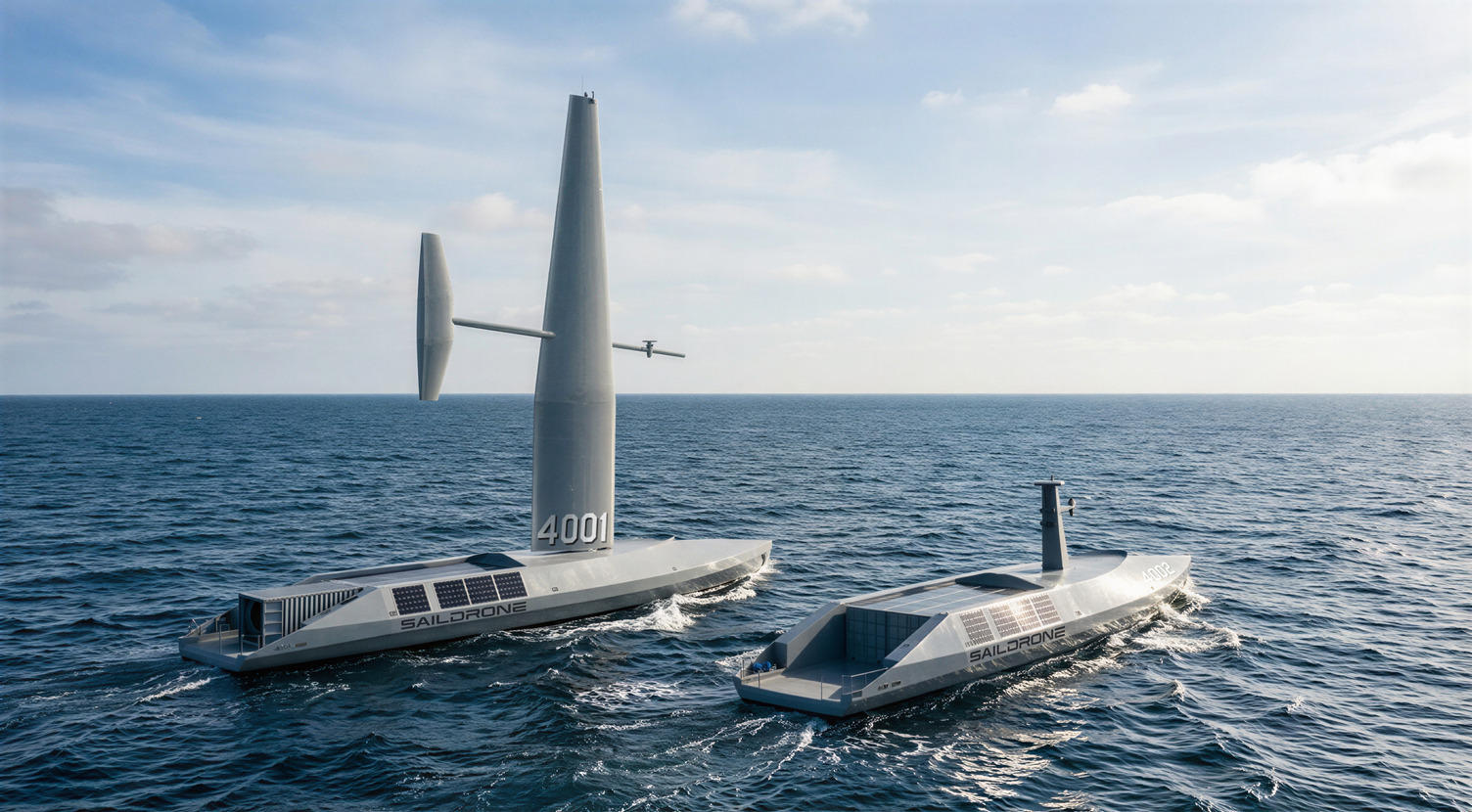
This morning, USV darling Saildrone announced at Sea-Air-Space that they’re building a new, 52-meter (170-foot) USV called Spectre, the “largest, fastest, and most capable Saildrone platform to date,” according to the company.
The big ol’ drone boat is “optimized for anti-submarine warfare (ASW) operations, a mission set that demands extreme endurance and an ultra-quiet acoustic signature,” Saildrone said in a statement. Luckily, that’s exactly what the company’s signature wing and sailboat-like design provide.
“Spectre is the result of 25 years of continually pushing the boundaries of what’s possible,” Saildrone CEO Richard Jenkins said in a statement. “Spectre is not a craft hurriedly readied to meet a particular RFP, but diligently evolved over multiple years to meet the operational requirements of our customers and fill critical capability gaps in the ASW domain.”
Well, looks like the whole MASC debacle hasn’t totally quashed the MUSV craze—at least not for now.
Out at sea: Saildrone was founded all the way back in the before times of 2012. For most of its existence, the company has focused on building wind- and solar-powered vessels (with motor assist for when things get tricky).
- Their USVs look a lot like sailboats—hence the name—and are designed to go on uber-long journeys and operate in GPS-denied environments.
- To date, the long-endurance drone boats have come in a few different flavors: The 23-foot Explorer, 33-foot Voyager, and 65-foot Surveyor.
- Each vessel is kitted out with tons of high-powered radar and cameras that can cover thousands of square miles every day at a “fraction of the cost” of crewed boats.
- And when they say long-endurance, they mean it. Explorer can stay at sea for up to a year, according to the company, and Surveyor has operated continuously for up to 26 days on Navy exercises.
Go boom: The company—which has raised about $250M—actually started out doing climate and oceanographic research, but has since proved mighty popular among the pew-pew crowd.
- 20 of its Voyager vessels are part of Operation Southern Spear, an anti-narcotics operation in the Gulf of Mexico led by JIATF-S and NAVSOUTH.
- Voyagers are also deployed as part of the US Navy’s Task Force 59 (T59) in the Middle East, and were part of NATO’s Task Force X exercise in the Baltic Sea in June. In total, the company has won about $125M in USG contracts, according to Obviant data.
- Back in October, the company scored a $50M investment from Lockheed Martin to build bigger, motor-powered (sail-assisted) boats and plug a bunch of the prime’s weapons systems onto them.
In case it hasn’t clicked—Spectre is that bigger, badder, weapons-loaded USV Lockheed and Saildrone promised to build together.
- The vessel will weigh 250 tons and travel at speeds of up to 30 knots.
- Spectre can use the Saildrone wing for super-sneaky low-acoustic-footprint missions, but also was “designed to operate without the wing for kinetic strike roles, which require higher sprint speeds and low-profile stealth operations.”
- The drone boat has dual electric and diesel propulsion. The electric side of things can enable near-silent speeds of up to 12 knots, then “5,000 horsepower of Caterpillar diesel engines [can] propel the vessel up to 27 knots with full fuel and a 25,000 kg payload.”
- Speaking of payload—the whole thing has a “concealed payload deck” that can carry two 40-foot containers or up to five 20-foot containers (or a mix of the two). Total payload capacity is 70 tons.
- And it’s still got that Saildrone range—Spectre can travel “3,280 nautical miles in flat water and 2,790 nm range in Sea State 4.”
The whole thing will be built from aluminum out of Fincantieri shipyards in Wisconsin, which will be able to churn out five Spectres a year.
“Spectre represents a transformative step forward for naval surface warfare. Its endurance, payload flexibility, and seamless integration with advanced missile and sonar systems will give the US Navy a persistent, low observable USV that can deliver on a spectrum of maritime missions,” said Paul Lemmo, vice president and general manager, sensors, effectors, and mission systems at Lockheed Martin, said in a statement.
Rendercore: And this ain’t just a render—while the full-size boat is still in the design phase, a 1/7th-scale model of the USV has been tested in Denmark and “verified propulsive power requirements and seakeeping in conditions up to full speed in Sea State 5.” The design has also been approved in principle as a high-speed naval craft by ABS.
Construction of Spectre will begin “shortly,” according to the company, with sea trials planned for early 2027.
Guess if you want to build big and move fast, it still sometimes helps to team up with the primes.