Well, guys, the moment you’ve all been waiting for (or, at least, that some of you have been waiting for) has finally arrived.
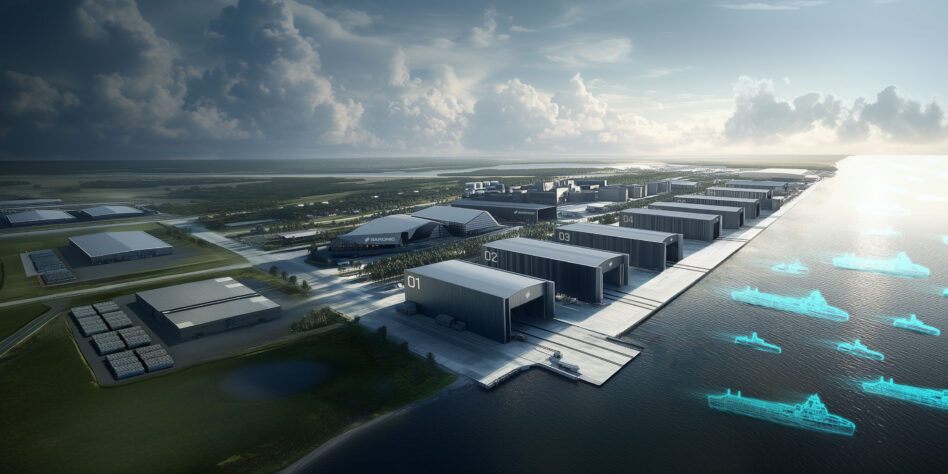
This morning, autonomous surface vessel (ASV) hotshot (and newly-minted member of Iran’s shit list) Saronic announced that it’s officially picked Brownsville, TX, as the site for its futuristic shipyard, Port Alpha. Saronic CEO Dino Mavrookas told reporters, including Tectonic, that the company will start construction on the greenfield site this year, with operations set to kick off in 2028.
The first phase of the project—850 acres—will have up to 150,000 gross tons of shipbuilding capacity and the ability to produce vessels up to 850 feet long.
“Just phase one alone will make this the largest shipyard in the United States,” Mavrookas said. “We will 1.5X the shipbuilding capacity in the United States in just phase one, with the ability to take that all the way up to…2 million gross tons of capacity over the life of the project.”
For context: Plans for the port were first announced when Saronic raised its $600M Series C early last year.
Zoom zoom: If you read Tectonic (or have been on CENTCOM’s X feed lately), you’ll be familiar with Saronic. The drone boat company was founded out of 8VC’s Build program back in 2022 and has been on a hell of a run since.
- The company has raised a total of $2.59B, most recently a $1.75B Series D at a $9.25B valuation. Pocket change, really.
- In December 2025, Saronic announced that it had been awarded a $392M Other Transaction Agreement (OTA) to supply the US Navy with a bunch of its 24-foot-long Corsair ASVs. Guess we now know where at least a few of those went.
- Last spring, the company snapped up Louisiana-based Gulf Craft shipbuilders, then said they’d invest about $300M in building out the shipyard last December. That’s where they’ve been churning out their larger frame vessels.
Speaking of larger vessels—while Corsair is kinda Saronic’s flagship (and the boat that gets the most airtime), that’s not all they’re building.
- Their vessels range from the bitty six-foot Spyglass up to the 60-foot Cipher and 180-foot Marauder. Those big boys were unveiled after the Gulf Craft acquisition.
- At the end of May, the company announced that they’d officially launched their first Marauder out of Franklin. They’re now able to produce 20 a year there, per Mavrookas, and are looking to scale up further.
- Worth noting that in May, the US Navy also tapped Saronic as one of seven companies to carry out at-sea demonstrations for the (ever so slightly controversial) MUSV marketplace.
Big ups: Mavrookas says the goal of Port Alpha is to keep on scaling up—and move into commercial shipbuilding alongside defense.
- Phase one will have the capacity to build ships up to 850 feet long; phase two will bump up to 1200 feet.
- Phase one will be 850 acres of manufacturing space. At full capacity, the shipyard will cover 4,000 acres with up to 2 million gross tons of capacity—one of the largest shipyards in the world, per Mavrookas.
- Mavrookas also said they plan to create 10,000 jobs over the next ten years and invest more than $3B in the project.
Jump in, the water’s fine: And why Brownsville? Mavrookas said it came down to about four factors: Land access, deep water access, an available workforce, and Texas’ willingness “to help [them] cut through that red tape [and] start building again.”
- It helps that Brownsville (and the Texas university system) have a massive shipbuilding legacy. “We’re very very bullish on the workforce in Brownsville,” Mavrookas said.
Shopping mall: Now, a big part of Port Alpha—and a big shift for Saronic in the coming years—is the push towards commercial shipbuilding. In case you hadn’t noticed, to date Saronic has been very heavily defense. But the US lacks shipbuilding capacity on all fronts—not just for the Navy.
“From a commercial perspective, we’re looking at how do you build container ships again? How do you build roll-on, roll-off vessels? How do you build tankers? How do you build icebreakers? How do you build all of these things in the United States at scale?” Mavrookas said. “These are absolutely critical, not just for the commercial market, but they’re actually critical for national security.”
- These ships will be both unmanned and manned—new territory for Saronic. However, Mavrookas said that, for the manned ships, they will “incorporate all of the technology that we’re building to make [them] more efficient and then de-man them as we move into the future.”
Plus, by building commercial, Saronic can make the economics of producing military vessels at scale work.
“The commercial variant to this yard is very much just as critical to national security as the straight defense element,” Mavrookas said. “I would argue that you actually have to open up the commercial market if you’re going to drive down costs and give scale to the defense market over a long period of time.”
“If you don’t rebuild on the commercial side, you’re actually not rebuilding the supply chain and the workforce,” he added. “[You’re not] taking advantage of economies of scale and driving down price and unit cost on the defense side, and that’s what we think we can do with this yard.”