
If anyone thought the hype for maritime would fade, what with the whole “potential extended ground war in Iran” thing, think again.
This morning, autonomous maritime giant Saronic announced that it’s raised a $1.75B Series D—yes, billion with a “B”—at a $9.25B post-money valuation. Again, yes, that’s all with a “B”.
The round was led by Kleiner Perkins with participation from new investors including Advent International, Bessemer Venture Partners, DFJ Growth, BAM Elevate, as well as existing investors including 8VC, Caffeinated Capital, Andreessen Horowitz, Elad Gil, and Franklin Templeton.
“We’re seeing…a real shift in demand to unmanned systems,” Saronic CEO Dino Mavrookas told reporters before the announcement. “Unmanned systems that can be delivered at scale, unmanned systems that can operate continuously in the maritime environment, an unmanned system that can offer risk reduction, deliver real capability in dangerous environments, [all] while keeping sailors out of harm’s way.”
The money, he added, will “accelerate the production and the deliveries of our vessels around the world, and accelerate into even larger vessels, new products, and ultimately reshape the entire shipbuilding industry.”
Small potatoes, really.
Build, baby, build: Saronic should be no stranger to Tectonic readers. The company—founded back in 2022 out of 8VC’s build program—has had quite the year, to put it mildly.
- Back in December, the company announced that it had been awarded a $392M Other Transaction Agreement (OTA) to supply the US Navy with an undisclosed number of its 24-foot-long Corsair ASVs.
- Also in December, Saronic said it would invest $300M in its Franklin, Louisiana shipyard, which they set up after acquiring LA-based Gulf Craft last spring.
- In total, the company has raised a whopping $2.35B—pocket change, really. Most recently, they raised a $600M Series C at a $4B valuation last February.
So, how the heck have they been able to raise all this cash?
For starters, Saronic is very careful to point out that its vessels are all autonomous—not just unmanned. “When you talk about building at scale, you need the autonomy to support that and operate in the numbers needed,” Mavrookas said. “This is not a one-to-one remote control boat. This is true maritime autonomy in which Saronic is the market and industry leader.”
Tiny little boat no more: And the company ain’t just playing the tiny little boat game these days, either. Their vessels now range from the teeny-tiny six-foot Spyglass all the way up to the 60-foot Cipher and 180-foot Marauder, which they unveiled as part of the Gulf Craft acquisition.
- Mavrookas said that the company has done the hull flip on its first two Marauders out of Franklin—meaning they’re fully constructed, form-wise, but the bells and whistles need to be added. Mavrookas told Tectonic late last year that the company would be able to build 20 of them by 2027.
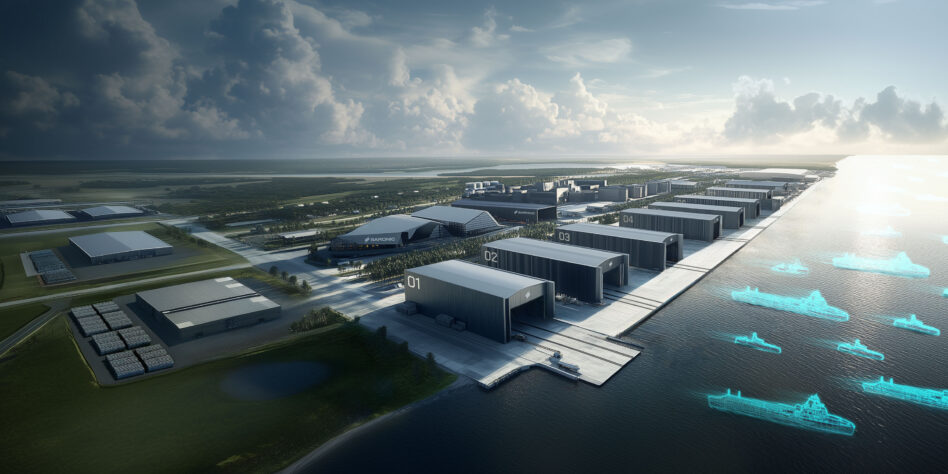
- To build these big boy vessels, Saronic says it’s building 300,000 square feet of new production capacity in Louisiana while also building its futuristic shipyard—Port Alpha.
- The port-of-the-future was first announced alongside that $600M raise; The company says it will invest about $5M in building the facility.
- Mavrookas told Tectonic last year that they expect the port to come online in 2026; However, yesterday, he said that they’re still in the midst of a nationwide search to decide where to build it.
Nuts and bolts: It sounds like a lot of this $1.75B will go to making those mega-manufacturing dreams a reality.
- Right now, the company has a facility in Austin that Mavrookas told Tectonic will soon be able to churn out up to 2,000 Corsairs per year (right now they’re at around 1,000). Good news for that Navy contract.
- They’re also going to invest simultaneously in that Franklin buildout (300,000 square feet of manufacturing space) and finally building Port Alpha.
- Once built, Mavrookas says the Port will “10X the capacity of our Franklin location and…really unlock rates of ship building that we haven’t seen since World War Two.”
Plus, the company said in a statement that it will “use the capital to explore solutions that address the full spectrum of challenges in the maritime domain, including those at the intersection of surface and subsurface.” Cross-domain. Nice.
MASC off: Given all the drama around the MASC-to-MUSV transition from last week, we asked Mavrookas if that would change what they’re building, especially down in Louisiana. TL;DR, he seemed pretty unruffled and keen on the whole “marketplace” idea.
“We’re investing ahead of contract to build the best capabilities that are applicable to a wide range of customers across both defense and commercial markets, and we’re delivering those capabilities in the quantities needed across the board,” Mavrookas said. “So for us, it doesn’t change anything.”
Lucky, that.