
Shipbuilding is so back, baby.
Less than a week after announcing a whopping $300M investment in its Louisiana shipyard, Texas-based autonomous shipbuilder Saronic revealed yesterday that it’s won a $392M Other Transaction Agreement (OTA) to supply the Navy with an undisclosed number of unmanned surface vessels.
Talk about demand signal.
Making a splash: The $392M contract was first reported by DefenseScoop back in August, though details were sparse. The product service code information was labeled as “small craft,” and Saronic manufactures a few vessels—the Spyglass, Cutlass, and Corsair—that fit into that category.
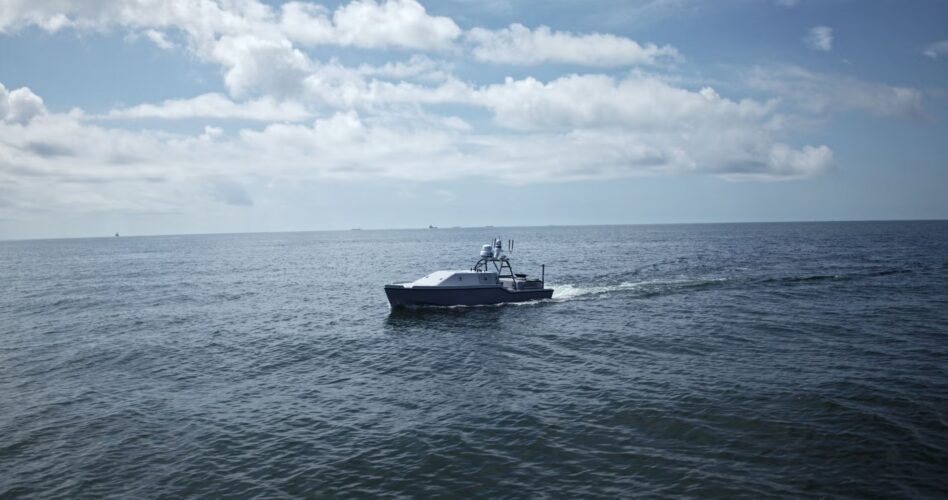
According to Saronic’s announcement, the Navy production contract is focused on the company’s flagship vessel, the Corsair:
- It’s 24 feet long, has a top speed of 35 knots, a range of over 1,000 nautical miles, and a payload capacity of roughly 1,000 pounds.
- Like Saronic’s other autonomous surface vessels (ASVs), it can operate autonomously alone or in a swarm.
- It’s manufactured at Saronic’s facility in Austin, where CEO Dino Mavrookas recently told Tectonic they have the capacity to build 400-500 per year and are opening a new production line to ramp up to 2,000.
Phelan’s a fan: At the Reagan National Defense Forum, Navy Secretary John Phelan told reporters that the prototype OTA was awarded through the DIU, and the Navy moved toward a full production contract soon after. Nearly $200M of the $392M was immediately put on contract.
“The Navy isn’t admiring problems from the sidelines; we’re moving at war-footing speed,” Phelan wrote on X. “With Saronic, we went from prototype to production in under a year. That’s rapid innovation, real competition, and combat power in sailors’ and Marines’ hands, not on powerpoints.”
Speed run: OTAs offer Pentagon customers more flexibility than standard Federal Acquisition Regulation-based acquisitions. Those speedy contracts, like Saronic’s, are Phelan’s favored approach to getting shit done—fast—and are likely how the Navy will make future USV buys, he told reporters.
“We’ve eliminated layers that allow us to test faster, iterate quicker, and get things contracted—which is what we were able to do here with Saronic at this particular junction,” Phelan said. “This is exactly the kind of rapid prototyping discipline, scaling, and responsible stewardship we need to maintain naval dominance as we transition to a hybrid manned-unmanned fleet.”
Big moves: Even with a big Navy contract in hand, Saronic is definitely not resting on its laurels.
- Last week, the company announced a whopping $300M investment in its shipyard in Franklin, Louisiana, where it’s adding more than 300,000 square feet of new capacity to produce the 180-foot-long Marauder ASV.
- Two Marauders are under construction in Franklin now, with the first expected to be in the water by the end of the year. At full capacity, Mavrookas told Tectonic they’ll be able to build 20 of them in 2027.
- Saronic is planning even bigger moves with a futuristic shipyard they’re calling Port Alpha, where they say they’ll invest an eye-watering $5B to scale up to commercial-scale unmanned vessels. Although a site hasn’t been announced, Mavrookas said Port Alpha is expected to come online in 2026.
Hybrid hype: Given the Navy’s big push to build out a hybrid fleet of manned and unmanned vessels, amplified by America’s shipbuilding woes and potential naval conflict in the Indo-Pacific fast approaching, it’s safe to bet that Saronic’s big contract is far from the last.
“Warfighters deserve today’s tech, not yesterday’s timelines,” Phelan said at the Reagan National Defense Forum. “We are iterating faster, testing in the field, getting real feedback, and investing in game-changing capabilities with war-footing speed.”
Golden Fleet, here we come.