
Laissez les bons temps rouler in maritime autonomy world.
Yesterday, California-based USV startup Seasats announced that it closed a $20M Series A led by Konvoy Ventures, with participation from Shield Capital, Techstars, and others. That fresh capital brings their total funding to over $40M, and as CEO Mike Flanigan told Tectonic, it’s all about scaling production and “moving faster.”
Fishy business: We’ve covered Seasats before, but as a refresher, the startup has made a splash in the unmanned surface vessel space, especially with their ever-popular flagship Lightfish mini-USV.
- In October, they snagged a $89M ceiling SBIR Phase III IDIQ with the Navy to deliver its Lightfish USVs to the Marine Corps.
- And last month, they were awarded a joint $24M contract with the Navy and Marines under the APFIT program to ramp up production of the Lightfish and R&D for their other USVs.
Catch of the day: Clearly, the Navy, Marines, and foreign customers (which include the Philippines, Japan, and Australia) have taken a liking to what Seasats has to offer, and lucky for them, the startup keeps putting more on the table:
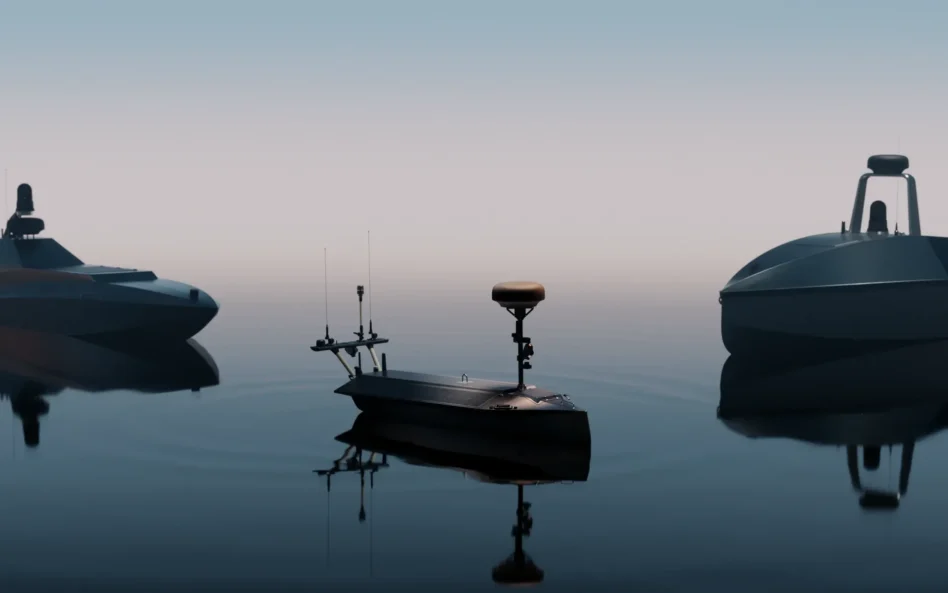
- Lightfish: An 11-foot-long, 3-foot-wide lightweight USV designed primarily for maritime ISR and sensing. Despite its small size and low cost (around $250,000), the solar- and backup generator-powered Lightfish can be at sea for up to six months in Sea State 6+, highlighted by a 7,500-mile trans-Pacific voyage from San Diego to Japan last year.
- Quickfish: Rolled out in October, the 17-foot-long and 1,600-pound Quickfish is the bigger, speedier sibling of the Lightfish, designed as an “interceptor USV.” It can reach over 35 knots, is powered by both hybrid-electric and combustion engines, and has a roughly $500,000 price tag.
- Heavyfish: Seasats’ latest and greatest USV (at least in terms of size), coming in at 9,000 lbs with a 1,000 lb payload capacity and top speed of 12 knots. It’s still in development but expected to be in the water later this year.
Just keep swimming: After gaining some serious traction with customers in the past few months (especially the Navy’s unmanned systems-focused Task Force 66, which seems to love launching the Lightfish from every corner of the world), Seasats wanted to keep its foot on the gas with the raise and scale production.
“This is a fast-moving space, and the problems that people around the world are trying to solve are not exactly waiting; they’re not patient,” CEO Mike Flanigan told Tectonic. “Funding helps us move faster and do a lot of things a lot quicker. Maritime is quite competitive right now, and there are a lot of people vying for space, so it made sense to do the raise.”
“Scale is kind of the name of the game,” he added. “We need to be able to deploy USVs rapidly and in enough numbers to make a difference.”
Plenty of fish in the sea, as the saying goes.