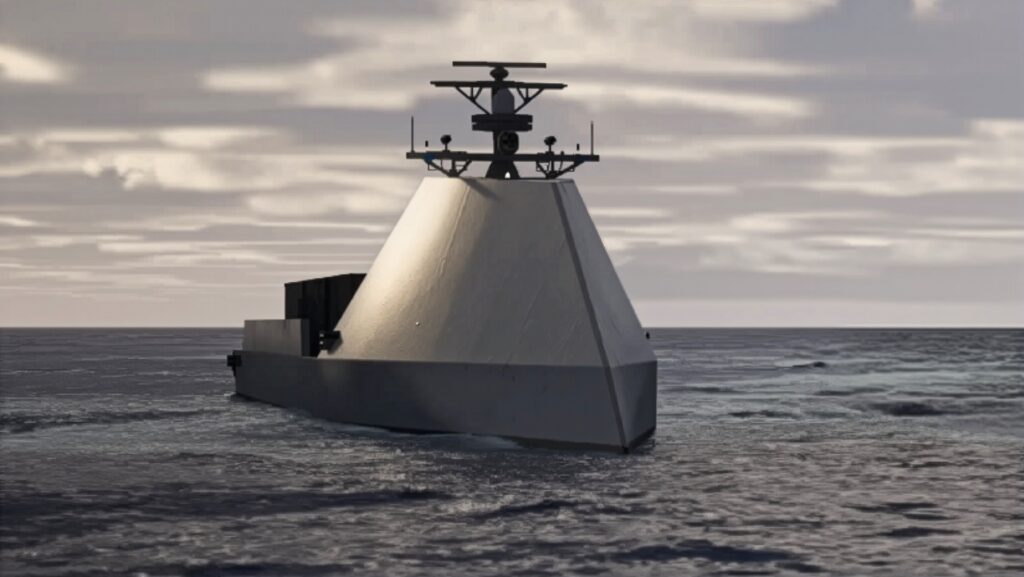
If you work in the ever-growing unmanned surface vessel (USV) world and are worrying about scale, you might want to look away. On Tuesday, shipbuilding giant Huntington Ingalls Industries (HII) announced a new family of ROMULUS USVs—and that the fleet’s flagship is already under construction. Looks like the primes were paying attention to Saronic’s $392M Navy OTA and got a little jealous.
Big fish: HII is America’s largest military shipbuilder, making everything from nuclear submarines to aircraft carriers, destroyers, and amphibious ships. They’ve also been in the maritime autonomy game for a few years, buying Kongsberg’s Hydroid UUV for $350M in 2020 and spinning it off as their in-house REMUS UUVs, which have been sold to over 30 countries.
Like the twin brothers of Roman legend, HII said in a statement that REMUS and ROMULUS will be paired together, which they say “significantly extends undersea reach, closing anti-submarine warfare sensing gaps and keeping manned platforms at a safer standoff distance.”
Old school, new tech: Here’s a bit about HII’s newfangled ROMULUS USV family:
- It’s built on a commercial-standard hull for repeatable and fast production.
- Its modular design is meant to support teaming across domains for c-UAS, ISR, strike operations, and the UUV and UAV launch and recovery missions.
- The flagship vessel, ROMULUS 190, is (you guessed it) 190 feet long and will have a 2,500 nautical mile range.
- It runs on HII’s Odyssey Autonomous Control System (ACS) software suite, which was launched in 2022.
Friends with the new kids: The Odyssey ACS software is built on an open architecture to allow speedy integration of payloads, sensors, and third-party software. According to HII, it’s been deployed on more than 35 USV platforms with over 6,000 operational hours across the DoD’s sea-based services and allied navies.
But don’t worry, startup friends, the Odyssey software guiding ROMULUS won’t be a solo mission. They’re teaming up with Shield AI, Applied Intuition, and C3 AI to integrate a bit of startup spice into the fleet and enhance “autonomy, object classification, and lifecycle sustainment.”
HII’s partnership with Shield AI runs a bit deeper than ROMULUS: They also announced on Tuesday that the startup’s Hivemind autonomy software will be used on new platforms “across every environment.”
David and Goliath: Most USV startups are thinking smaller than 190 feet, but ROMULUS will face off against some competition from new entrants like Blue Water Autonomy. The Boston-based startup came out of stealth in April and just raised a $50M Series A to put a 150-foot vessel prototype in the water by next year.
While the mega-primes like HII are hoping that size still matters, USV young guns like BWA, Saronic, and Havoc AI are betting that the startup-friendly zeitgeist, cost advantage, and desire for fresh blood in the Pentagon will be their calling card when contract time comes.