
If anyone was hoping that 2026 was going to be a bit chiller in defense tech land than 2025, well, shit luck for you.
Yesterday, flight autonomy company Skyryse announced that it’s raised a whopping $300M Series C, bringing its valuation to $1.15B. (Unicorn status, baby!)
The round was led by Autopilot Ventures and Fidelity Management & Research Company, with participation from investors including the Qatar Investment Authority, Durable Capital Partners, ArrowMark Partners, Rokos Capital Management, and others.
“This is a group [of investors] that understands deep-tech timelines – aviation, autonomy, and certification do not reward short-term thinking, and our investors and supporters know that it takes discipline and a relentless focus to create world-changing technology,” Skyryse CEO Mark Groden told Tectonic.
The company says it will use the funding to “complete FAA certification” and deploy SkyOS, its autonomy stack, “on additional aircraft.” Plus, it looks like more autonomous helicopters are coming soon to a theater near you—a chunk of this funding, according to Skyryse, will be used to deploy SkyOS across the world’s supply of everyone’s favorite helicopter—the Black Hawk.
FWIW, the US alone has over 2,100 active-duty Black Hawks. Sounds like someone is going to be busy.
Fly-by-wire: Since it was founded in 2016 (everyone’s favorite year, apparently), Skyryse has, put simply, not effed around.
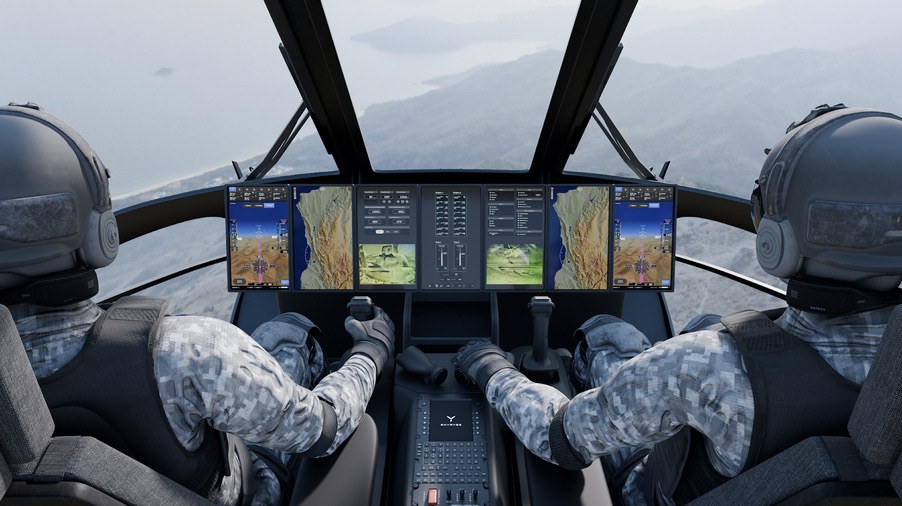
The company’s flagship product is its SkyOS flight control system, which basically makes flying something as easy as tapping on a screen and swiveling a joystick. The company says the “universal operating system for flight” was developed within a year of founding.
- SkyOS is a single-lever, single-screen interface that replaces hundreds of mechanical and pilot-managed inputs. Typically, it’s retrofitted on human-operated aircraft.
- The whole system is fly-by-wire with autonomous capabilities—meaning it can be flown autonomously or with a human pilot in the loop.
- The software handles stabilization, navigation, and emergency responses, and can take off, land, and hover autonomously.
“SkyOS is the world’s first operating system for flight – and by that, we mean we’re leveraging automation to reimagine how all aircraft are flown, whether with two pilots, one pilot, or no pilots,” Groden said. “Instead of layering automation on top of legacy systems and mechanical controls, we’re replacing the core flight control architecture with a unified approach.”
Even it out: While the company says SkyOS is aircraft-agnostic, Skyryse’s bread and butter is helicopters. In case you haven’t had the good fortune of flying one of those bad boys, they’re not simple—especially not when you’re trying to make them all “look-ma-no-hands.”
- Unlike a fixed-wing aircraft, helicopters are inherently unstable—they require near-constant micro-corrections to stay level.
- That’s hard for humans—and even harder for software. Plus, that’s not to mention all the nasty aerodynamics and crappy flight conditions helicopters are often operating in.
- SkyOS can handle all of this—either with a human in the loop or not. That’s especially useful in particularly icky or comms-denied conditions—pilots can essentially hand off control to SkyOS. The company says the “intelligent, integrated system…gives pilots greater control by simplifying the management of any aircraft during standard flight operations, inclement weather, and emergencies.”
For now, Groden said that they’re air-focused, but that SkyOS is capable of operating in other domains.
“Aviation is our focus for right now,” he said. “The industry desperately needs modern technology and automation systems like SkyOS… [but] we’ve had a number of customers approach us asking to support ground and maritime-based applications for which our system is more than capable.”
High flying: In December of last year, the company completed a semi-autonomous flight of a Black Hawk with SkyOS—after a 91-day integration period, the helicopter completed “automated pickup, automated hover, and automated setdown with the swipe of a finger.” The pilot also used SkyOS’ single control stick to carry out “precision flight maneuvers.”
- SkyOS has also been integrated on a kitted-out Robinson R66 (called Skyryse One) and a Cirrus SR-22 (the company’s first airplane).
- The company has also signed agreements to integrate SkyOS on aircraft, including Pilatus PC-12s, Bell 407s, Airbus H-125 and H-130 helicopters.
- The company also teamed up with the US Army last summer to make helicopters “more capable, easier to fly, and optionally-piloted.”
Groden said that it surprised the team how easy it was to build SkyOS onto the superman of helicopters.
“From the outside looking in, a lot of people might think because the Black Hawk is a significantly larger helicopter, that it’d be more difficult for our automation system, but it was actually easier than a smaller helicopter like the R66,” he said. “Starting with a small helicopter is the hardest aircraft category in all of aviation. Everything else is downhill from here.”
On the books: As for that FAA certification? Well, sounds like the company is already well on its way—according to yesterday’s release, “The FAA granted final design approval for SkyOS’ flight control computers, confirming the FAA’s acceptance of Skyryse’s complete, aircraft-agnostic system architecture and leaving only formal flight verification before certification,” and flight testing has begun.
“With the team’s continued support and ongoing collaboration, we’re confident that we have the resources and support necessary to complete certification in the coming quarters,” Groden said. “At this stage, only validation, verification, and flight and ground testing remain before full certification.”
And based on its investors (looking at you, Qatar), it sounds a whole heck of a lot like the company might be inking some more international contracts abroad soon, too.