
Well, god damn. When we said the Ukrainians were coming, we didn’t necessarily think it would be directly to the US stock market, but here we are.
This morning, Ukrainian UAV software company Swarmer officially IPO’d on the NASDAQ as $SWMR. The company—which builds the software brain that allows drones to operate as a swarm—is seeking $15M with the IPO (3,000,000 shares at an initial price of $5 apiece).
“[We’re listing] on NASDAQ to raise more funds so that we can build product faster, integrate with more cool hardware, and hopefully make the biggest impact we can make on the battlefield as fast as possible,” Alex Fink, co-founder and US CEO of Swarmer, told Tectonic.
The listing comes about six months after the company raised a $15M Series A led by Florida-based Broadband Capital Investments, and about a month after Erik Prince joined the company as non-executive chairman. Yes, that Erik Prince—the Blackwater one.
The in-crowd: In case you missed it, there are, like, a shit-ton of drones on the battlefield in Ukraine. At last check, the country produces and uses about 4M drones a year and, ideally, they all need to coordinate and speak with each other.
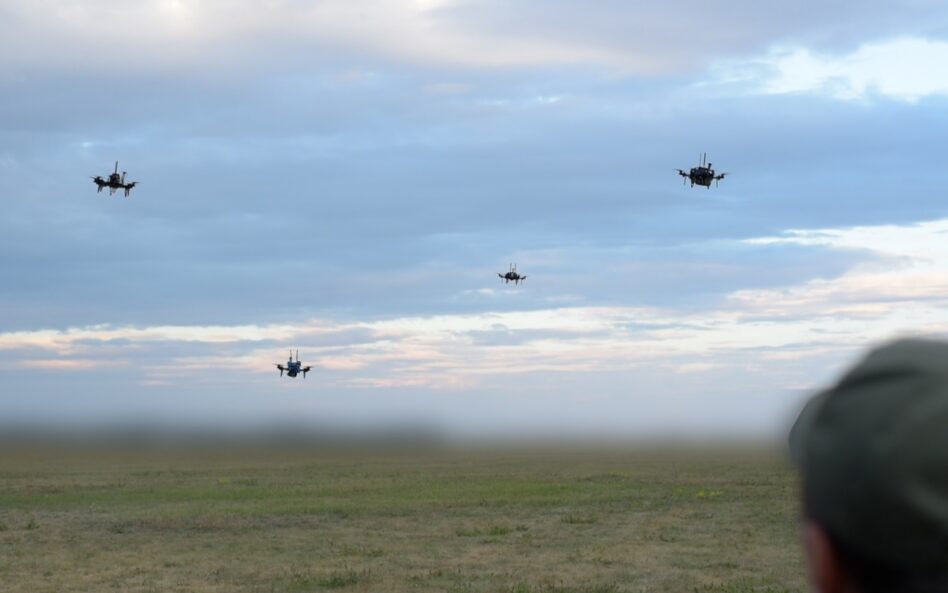
That’s where Swarmer comes in. The company builds software that enables “groups of drones to execute missions autonomously, translating human-defined objectives into coordinated action.”
- The company was founded back in 2023 by Fink and Serhii Kupriienko in Kyiv, Ukraine.
- In September 2024, the team raised a $2.7M seed round, then a $15M Series A in September 2025.
- Sales in 2025 were $309,920, down from $329,410 in 2024. However, they’ve got a $16.3M backlog for software licenses and an additional $16.8M in expected revenue by early 2028, according to the company’s S-1.
- They’ve flown over 100,000 combat missions in Ukraine, also according to the S-1.
“What differentiates Swarmer is not only its architecture, but the depth of operational data informing it…these missions generate continuous streams of telemetry, sensor data and operational feedback, which are used to refine performance, increase resilience and accelerate learning,” Prince said in his letter to prospective stockholders in the S-1. “The result is a battle-tested asset that acts as a force multiplier, allowing one operator to control many hardware platforms in real time.”
Mesh networking: The company makes a few different products that give operators that one-to-many superpower Prince is talking about.
- Styx: Swarmer’s flagship swarm management software, which coordinates recon and strike drones, even in areas with limited comms. Styx lets drones coordinate among themselves, task, and adapt to changing conditions.
- MINAS: A module for collaborative autonomy, designed especially for denied environments.
- Trident OS: The company’s UAV operating system layer. This helps with secure data storage, streaming, and status updates, which makes the swarms reliable.
Fink told us that the company maintains a very narrow definition of what swarming actually is—if a whole pack of drones is relying on a single leader that could get jammed or knocked out by an interceptor, that doesn’t count.
“We think it’s only swarming if every single member of the group is a completely independent decision maker,” he said. “The group cannot have a leader because then it has a single point of failure.”
And while the company’s bread and butter is small, FPV-style drones, Fink and Kupriienko have both told Tectonic that the goal is to be able to work with pretty much anything.
“Our goal is to be able to work with any hardware out there and to support any battlefield management system or command and control system above us,” Fink said.
Early birds: If you’re sitting there thinking, “Wait, isn’t this a super-duper early IPO?”—don’t worry, we had the same question.
Fink said that the push to go public was led by the lead investor in their Series A—Broadband Capital Investments—which has done this with several portfolio companies before. Plus, it gave them a well-trodden path to capital, which can be in short supply in Ukraine.
“In my experience, it seems like there is a lot of good tech and a shortage of capital in Ukraine, and in the US, you could argue that the opposite is true…we think that this might be a possibility that other Ukrainian companies might want to take advantage of,” he said.
There are some pain-in-the-butt parts of an IPO (like, the whole transparency thing), but Fink said that’s outweighed by the benefits.
“We are accepting a little bit more overhead in terms of compliance, reporting, [and] transparency. We think some of that is good, because more transparency actually makes you more disciplined and makes you do things the right way,” he said. “But…the upside is we will be more visible.” That, he added, should help with things like contracts.
Red, white, and blue: Speaking of contracts—when we asked Fink what the company’s US strategy was, he said it was twofold: Work with the military to understand what operators really need in terms of autonomy and swarming, and work with companies to integrate Swarmer’s software directly onto their platforms.
“We’re talking to users to generate demand, and then we’re talking to the buyers to actually close deals with them,” Fink said. “Right now, the drone dominance program is probably the best example of a relatively quick path to productization that goes much faster than normal procurement.”
And it sounds like the company is not locking itself into any sort of monogamous relationship, drone dominance-wise.
“We have really good relationships with several of [the finalists], he added. “Being the hardware agnostic software company that we are, we might have multiple shots on goals.”
Always good to play the field.