
Well, we’re running with a bit of a theme today. Can someone let us know why everyone is raising pretty much the exact same amount of money on the exact same day?
Yesterday, German interceptor hotshot TYTAN announced that it’s raised a €30M Series A led by Armira and NATO Innovation Fund (NIF), with support from existing investors Visionaries Club, OTB Ventures, Lakestar, Magnetic, D3, and 10x Group.
(Worth noting that everyone on the cap table is from across the pond.)
TYTAN CEO Balazs Nagy told Tectonic that the cash money will enable his team to scale production of their autonomous air defense systems, expand their product portfolio, and deliver on contracts with the German and Ukrainian Armed Forces.
“Our goal—our goal from the beginning—is to provide an end-to-end solution to the customer and to the end user,” he said. That means exploring new products, expanding production, and—importantly—working with operators to learn what they need.
“In Ukraine, in Germany, we are testing, improving, and we are never giving up,” he added. “But, of course, this is a lot of work. What we have to do now is scale up production and manufacturing.”
Along with the funding, former NATO General Chris Badia will join the company’s board, and former CycloTech and Roketsan executive Tahsin Kart will join as Co-CEO.
Salad days: TYTAN was founded by Nagy and CTO Batuhan Yumurtaci back in 2023, spun out of a student project at the Technical University of Munich. The idea was to build cheap, autonomous interceptors that were a better match for things like Shaheds than, say, a multi-million-dollar missile.
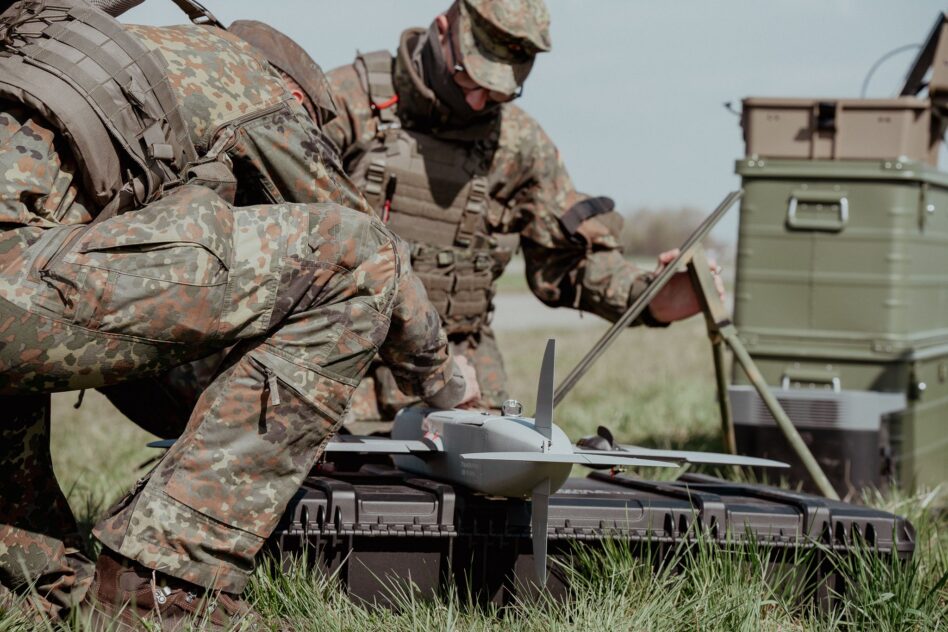
The result? A 3D-printed interceptor drone that’s about three feet long, has a takeoff weight of about 5kg, and looks a lot like a mini-missile.
- The interceptor can travel at speeds up to 250 km/h and has a range of up to 15 km.
- It can carry a payload (like, say, a warhead) of about 1kg.
- The system runs on AI-powered software that makes the interceptor “fully autonomous” and can plug into other C2 and operating systems.
- The drone is designed to be cheap—like in the single thousands of dollars cheap. Good news when you’re going up against drones that cost no more than $100K.
“What we are doing is [building a] fully autonomous system from detection to neutralization,” Nagy said. “We are focused on the fixed-wing targets you see every day in Ukraine, [and that] you can see also on the border in Poland.”
Scale up: But that interceptor is just the start, according to Nagy. The goal is all-European, all-autonomous air defense that can protect a whole range of drones and other aerial threats.
With this cash, he said, they’ll “[extend] their product portfolio to different kinds of threats and uncrewed and unmanned systems.
“Everything is based on the same core technology, he added, “But we are extending our portfolio and expertise in air defense, [especially in] software-defined air defense.”
And even with the OG interceptor, TYTAN already has, like, real customers.
- The startup reportedly has a “multi-million” Euro contract with the German Armed Forces focused on base protection.
- They’ve got an interceptor contract with the Ukrainian Armed Forces.
- Last fall, the company partnered with Dedrone by Axon to integrate the cUAS giant’s sensors and detection tech onto TYTAN’s interceptors, and last month they announced a partnership with defense giants Hensoldt and KNDS.
At the start of the year, TYTAN also announced that they were moving into a new facility that has the capacity to produce up to 3,000 interceptor drones a month.
Looks like that money is already going to good use.