Strap on your life jackets, kids. We’re headed out to sea.
Yesterday, “ocean company” (we’ll explain) Ulysses announced that it’s raised a $38M Series A led by Andreessen Horowitz’s (a16z) American Dynamism fund, with participation from Booz Allen Ventures and Harpoon Ventures, bringing total funding to $46M (with an earlier, unannounced $8M seed).
The startup—which builds a range of unmanned surface and subsurface vessels—says it will use the funding to “scale production of its Mako autonomous underwater vehicle, advance its Leviathan autonomous surface vessel and Kraken launch-and-recovery system from prototype to production, expand the team, and invest in next-generation product development.”
Helps if you’ve got one of the biggest funds in the game backing you while you try and do all that.
“For us to be backed by a tier one [fund] like that gives us even more credibility,” Co-Founder and CEO Akhil Voorakkara told Tectonic. “We’re already in the water. We’re already actually doing the stuff. But then to have a fund like that, putting their full faith and belief [in us]…it really shows we’re putting our money where our mouth is, and we’re actually out here doing things.”
Walk into a bar: Voorakkara says he and his co-founders—three Irishmen and a Scot—essentially founded Ulysses in San Francisco in 2023 because of how unknown (and inaccessible) the ocean remains.
“It was a really interesting problem where, if you look at what’s happened on land, in the air, and in space, and how accessible they’ve become, and how relatively easy it is to work in those domains now… the same has not happened for the ocean,” he said.
The team— Voorakkara, Will O’Brien (President), Jamie Wedderburn (CTO and the Scot), and Colm O’Brien (COO)—set out to do what low-cost launch and drones have done for space exploration and air warfare, respectively.
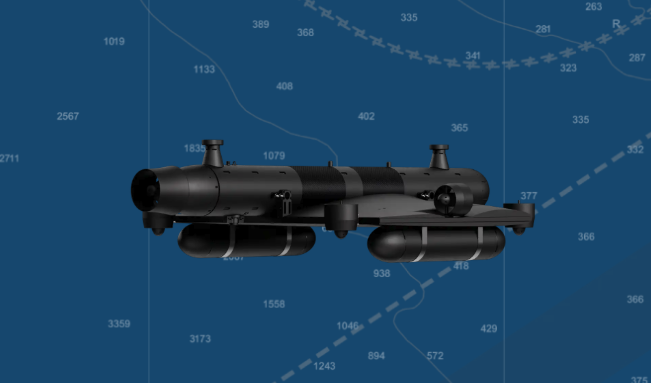
- The solution they landed on centers around a mini-torpedo-like UUV called Mako, which has 72-hour endurance, a 5,000-foot depth rating, and up to 200 lb payload capacity. Cost-wise, it starts from around $50K, and even fully kitted out (like with sensors and things that go boom) is an order of magnitude cheaper than solutions built by companies like HII and L3 Harris, Voorakkara said.
- They’ve also built a USV “mothership” called Leviathan, designed to carry and launch Makos. The drone boat is about 35 feet long, has a 1,200-mile range, can stay at sea for up to six months, and is expected to enter full production this year. Voorakkara also says they’re hoping to have fully autonomous Leviathan-Mako operations by the end of the year.
- Then there’s the whole “how do we recover Mako” part of the system. That’s called Kraken, an “autonomous launch, recovery, and recharge system that enables fully remote execution of missions from deployment to retrieval with zero human intervention.” Kraken is currently in testing.
Going green: Interestingly, Ulysses (and Mako) didn’t start out doing defense-y things—Voorakkara and his team started out on the climate research and critical infrastructure side of the dual-use coin.
- The company has already generated over $5M in revenue “across government, commercial, and scientific partners, and currently operates across defense, ocean science, and commercial survey missions.”
- They worked with customers, including “[state-level] governments in Australia, the Great Barrier Reef Foundation, The Nature Conservancy, the Virginia Institute of Marine Science, Mote Marine Laboratory, and the Florida Department of Environmental Protection,” which Voorakkara said gave them the reps to make sure the platform actually worked.
Zoom and boom: But when they were approached by the US Navy (he said they’ve got an ONR contract and have sold units to the service), they realized that Mako could do a lot more than figure out what was happening to reefs and deep-sea rigs.
- Mako is, like, the definition of modular. It’s heavy-lift capable and “can carry huge payloads, deploy nets, install infrastructure, [but] then you can reconfigure it to…just carry sensors and be a long-range ISR vehicle,” Voorakkara said.
- You can also “reconfigure it and…put kinetics on it,” he added. “The same vehicle will deliver those payloads.”
- Think of it as built-your-own-subsea-adventure—basically, whatever you need Mako to do, it can be configured to do.
“The same robots that do the subsea survey [and] maintenance inspection are the same robots that can protect critical infrastructure, the same robots that can be everywhere all at once and supervise maritime borders and stop illegal fishing, drug trafficking, [or] human trafficking,” Voorakkara said. “It’s the exact same platform, just applied differently.”
Switch it up: And the handy thing is, you can configure and change the UUV to communicate and run in all sorts of different ways for different missions.
- It can be fully autonomous, controlled remotely, or controlled with a tether and controller.
- When Voorakkara says autonomous, he means that Mako can keep on keeping on mission, even if comms are lost. “You just program the mission in, hit go, and it’ll go,” he said.
- Plus, there are all sorts of optional add-ons. “Do you want sat comms? We have plug-and-play modules for that,” he said. “Do you want a long-range radio? We have plug-and-play modules for that. Do you want acoustic comms that work underwater? We have plug-and-play modules for that.”
Big ups: From here, the plan is to scale. Right now, the team is about 16 people, and they can churn out 350 Mako units a year out of their 15,000 square foot facility in San Francisco.
Voorakkara wants to scale that to 50 people and “four digit” capacity with a new production facility they’re “planning to bring online in the very near future.”