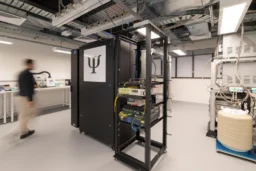
Well, gosh darn. Our friends across the pond really are having quite the month.
This morning, UK-based Valarian—which is building “the sovereign infrastructure layer for high-consequence operations and AI-driven systems”—announced that it’s raised a $50M Series A led by New Enterprise Associates (NEA).
- Lightbank, XTX Ventures, Litquidity Ventures, Sequel, as well as angel investors Gokul Rajaram and Nikesh Arora, also participated in the round.
- The investment marks US-based NEA’s first defense-slash-dual-use investment in Europe.
“We’re really, really excited to partner with [NEA],” Valarian founder and CEO Max Buchan told Tectonic. “They’re an amazing investor, [and we’ve got] a lot of other really, really great folks coming to the cap table. Extremely exciting times. We were just…in a mad hiring push at the moment.”
To that end—Buchan said that most of the money will go towards hiring, especially of engineers. Let’s go, nerds.
Block it off: We’ve covered Valarian before, but here’s a bit of a refresher. The UK-based company lives on the backend, nuts-and-bolts side of things, but exists within a much bigger hot-button issue: data sovereignty.
- The company was founded back in 2019 to build secure data infrastructure and ring-fenced systems for governments, defense customers, and other companies that don’t want their stuff getting out.
- Their flagship software is called ACRA (Architecture for Compartmentalised, Resilient Applications), which basically seals data and compute within strict mission-specific compartments, logs everything (for audits, y’all), and is deployable in all sorts of environments—on premises, in the cloud, and even at the edge.
- By way of example: If a company (or government) wants to take advantage of the compute of something like AWS or GCP, but wants to keep things nice and safe, they can use Valarian and ACRA as a protection layer.
“We call it a walled garden,” Buchan said. “You can deploy…your database [with] different classifications of data. You can then deploy a model. You can deploy a communication system or a computer vision system, and then that becomes an abstraction, and then you can still deploy it and get the compute power of AWS or GCP.”
Big bucks: Initially, the company kicked things off pretty squarely on the defense and government side of things, but has actually gone more commercial in the past year or so.
- Buchan said they went from zero in total contract revenue (TCV) to $43M in the first quarter of FY26. He expects they’ll do “well over $100M” this year.
- A big part of that push has been shifting from B2G (business to government) sales to what Buchan called B2B2G sales (business to business to government sales). That means selling the data sovereignty layer to companies already selling into the government, speeding up the adoption process.
- At the beginning of the year, he added, 90 percent% of their sales were to defense and government. Now that’s down to 60-40, and Buchan expects it to drop to 50-50 by the end of the year. Most of their traction is in EMEA—including the Gulf.
- They’ve also had a lot of growth in the US, especially with the rise of LLMs. People, it turns out, want control over their data.
While Buchan couldn’t tell us who, exactly, their customers are (they like to keep that “close to the chest”), he said they’ve worked with everyone from a “large mortar company that is very global all the way to…some of the large-scale financial institutions.”
Scale up: This new cash money will continue to throw fuel on the fire of that deal growth, and also help the team (and their footprint) expand.
- Valarian expects to open up a second UK office and go on a mega hiring push—mostly engineers.
- They also plan to open a new international office in the next twelve months.
- Right now, the focus is on honing the current stack, but eventually, Buchan said, they could partner with compute hardware companies to be the “default abstraction layer above the chip.”
But right now, they’re just making sure their current stack is as good as possible.
“Our biggest blocker is velocity of product release,” Buchan said. “The big index is toward growing engineering massively…We’re super heads-down on the technical side right now.”