
Well, solid rocket motors (SRMs) are certainly having a moment.
Yesterday afternoon, SRM production startup X-Bow Systems announced a $13.9M joint investment with the US Army to “design, prototype, and test an advanced manufactured SRM for the standard-range Guided Multiple Launch Rocket System (GMLRS),” which is produced by Lockheed Martin.
The joint investment is facilitated by the Office of Strategic Capital on behalf of the Office of the Under Secretary of Defense for Research and Engineering (OUSD(R&E)) as an Advanced Manufacturing Pathfinder project, similar to what Ursa Major won late last year. These projects seek to “establish an alternative supply source and strengthen the solid rocket motor industrial base” and help the Army “to secure a robust and reliable supply of critical munitions.”
Go boom: We’ve talked about SRMs a few times in recent weeks. But for those who haven’t been following along, here’s a bit of a refresher.
The long and short of it is, the US has an SRM problem: We need lots of these powerful little motors to power everything from HIMARS, to Javelins, to Stingers, to AMRAAMs and GMLRS. But we simply don’t have enough of them—or enough companies making them.
- Historically, two primes (L3Harris and Northrop Grumman) have dominated SRM production, but global demand has surged (cough, Ukraine, Yemen, and Gaza, cough).
- Last year, Aerojet Rocketdyne—purchased by L3Harris in 2023—reported it was thousands of rocket motors behind schedule. RTX has also said that the SRM shortage will limit its missile production.
- DoD leadership has identified SRMs as the “bottleneck” holding up missile delivery.
Lots of new companies have jumped into the SRM ring as of late.
- Anduril officially opened its massive SRM facility in Mississippi earlier this month, which it says will serve its own needs, as well as those of primes.
- Ursa Major said last week that it had successfully tested its SRM on BAE’s APKWS guided missile.
- Startups like Firehawk and X-Bow have introduced modern manufacturing techniques to a rather stodgy industry that hasn’t changed much since, like, WWII.
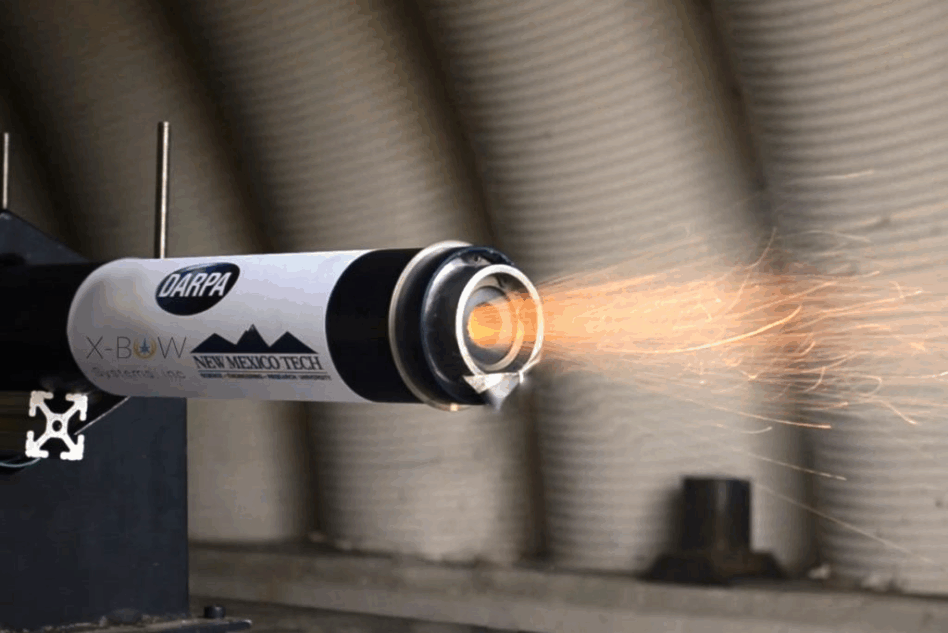
Setting up shop: X-Bow was founded in New Mexico in 2016 to shake up the SRM industry. The company applies advanced manufacturing techniques—including 3D-printing, a patented propellant, and additive manufacturing—to solid rocket motor production.
- The company provides, essentially, an end-to-end energetics service: they design, manufacture, test, and even launch systems loaded with their SRMs.
- In 2023, they were awarded a $17.8M contract with AFRL to demo additive manufacturing for SRMs.
- In October 2024, they were awarded a $64M contract to develop hypersonic SRMs for the Army and Navy.
- In 2024, they were also awarded prototype contracts to build Mk 72 and Mk 104 standard missile rocket motors for the Navy, as well as a $60M contract to modernize the Navy’s SRM production.
They’ve got some heavy-hitting backers. In 2024, the company raised a $70M Series B with participation from Razor’s Edge Ventures, Lockheed, and Boeing, among others. Then, in May of this year, they closed that Series B at $105M with additional support from Lockheed.
Lockheed and X-Bow have also officially formed a strategic partnership.
Making advances: X-Bow CEO Jason Hundley told Tectonic via email that what set his company apart for the Army was their “advanced manufacturing demo featuring our [advanced-manufactured solid-propellant] (AMSP) technology.” He says that OSC received 15-20 proposals, and that “X-Bow won based on [the] merits of [their] proposal.”
We asked Hundley if this kind of investment ($13.9M) could actually make a major difference in US SRM supply, or whether this was more of a pilot, proof-of-concept type thing. He said it was the latter. However, the prototyping project will culminate in a static-fire demo of the Lockheed-made GMLRS using the X-Bow SRM—which, if successful, could lead to broader production.
At the end of the day, X-Bow’s move into full-scale SRM production for the Lockheed missile system will “depend on the qualification requirements desired by Lockheed and the US Army,” Hundley said. “That would also gate the timing.”