You know what they say: When it rains, it pours. And it turns out that holds true whether it’s a thunderstorm or a Firestorm. (Bada-bing!)
Fresh off an $82M Series B last week, the 3D-printed drone and mobile manufacturing hotshot announced in an exclusive release to Tectonic this morning that it has secured a $30M APFIT contract (boostable to $50M) to deliver drones and the containerized microfactories that print them to the Indo-Pacific.
So far, about $26M has been obligated across 5 task orders, according to the company.
On fire: The APFIT contract is the latest dub for the San Diego-based startup.
Since it was founded in 2022, Firestorm has been awarded a $100M IDIQ with the Air Force, a STRATFI award for its UAS last March, and an $18M ceiling SBIR Phase II for its drone-printing xCell microfactories last November.
(AP)FITs the bill: First, a bit about APFIT. The program—full name “Accelerate the Procurement and Fielding of Innovative Technologies”—was introduced way, way back in the prehistoric year of 2022 to help small businesses bridge the infamous “valley of death” by accelerating the procurement and fielding of maturing defense tech.
- The program has awarded—in total—over $1.4B in contracts ranging from $10M to $50M to over 75 non-traditional contractors.
- Back in December, the Pentagon announced over $400M in APFIT contracts using FY26 funds, but didn’t release names of the companies in this batch of projects.
- Over the past few months, the winners have slowly revealed themselves, including Darkhive, which snagged a $49.7M contract (the largest APFIT award to date), and Seasats, which secured $25M for USVs.
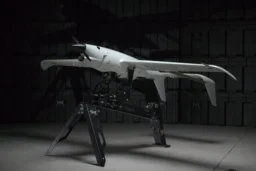
Heading East: Firestorm’s $30M award under the program funds the delivery of five xCell mobile manufacturing units (the company’s additive manufacturing microfactories), more than 200 Tempest drones, and operator training to an undisclosed customer in the Indo-Pacific.
- Firestorm’s Tempest UAV has a range of 400 miles, six-hour endurance, and a ten-pound payload capacity. It can be easily configured for ISR or one-way attack missions.
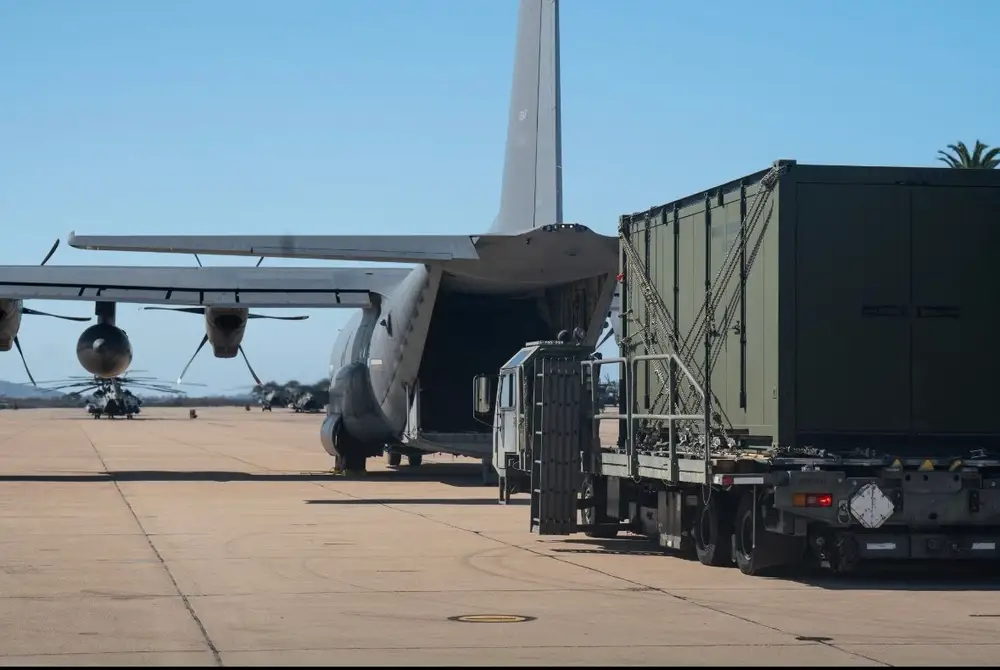
- The drones are cool, but the startup’s main pitch is xCell, a drone mini-factory in two shipping containers. It can operate off-grid and be transported on a trailer, airlifted in a C-17 or C-130, sling-loaded with a CH-47 Chinook chopper, or moved by sea.
So far, about $26M of the award has been obligated, and according to the company, deliveries—the first outside of the continental US for Firestorm—have already begun.
Travel time: One reason Firestorm—and the Pentagon (at least theoretically)—is so focused on the Pacific is because the contested logistics challenges are very real, especially if there were, like, a war. Putting UAS manufacturing within the INDOPACOM Area of Responsibility (AOR) helps solve that.
“The Indo-Pacific has what military strategists call ‘the tyranny of distance,’” Firestorm co-founder and Chief Growth Officer Chad McCoy told Tectonic. “If, god forbid, things go kinetic against an adversary like China, we know that they have a large quantity of long-range weapons, which are going to make it very difficult to freely move from [the continental US] and Hawaii and Guam into the first island chain.”
“We think we’re a unique solution for INDOPACOM—it’s a really hard problem, and there’s not a lot of solutions in the theater,” he added. “[The technology] provides assurances that when the lights go off and the blockade happens—if it happens—the machine doesn’t stop.”
The fix is in: While printing drones where the action could happen is a big help on the contested logistics front, xCell’s other main benefit is repairing drones already in theater.
According to McCoy, that’s gotten a lot of interest from customers.
“We’re seeing that [printing] repair parts is probably a bigger market than just doing drones,” he said. “It’s not as sexy as air vehicles that go boom…but when we differentiated the business with xCell, it allowed us to focus on repair parts for our birds [and other birds] when they break.”
That’s clearly been a winning message throughout the APFIT award—Firestorm has already pretty much hit the $30M mark on the contract, so don’t be surprised if the Pentagon looks to take it closer to the $50M ceiling before too long.
Good thing, too, with that infamous Davidson Window closing in.