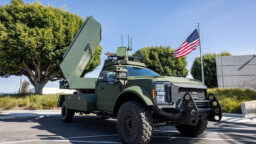
The energy around directed energy keeps amping up. (Again, forgive us.)
Late last week, the Pentagon’s Army-led counter-drone Joint Interagency Task Force 401 (JIATF-401) announced five military bases selected for a directed-energy counter-UAS pilot program, focused on deploying directed-energy tech, including “high-energy lasers” and “high-powered microwave systems,” to defend the airspace from the ever-present drone threat.
Swarm scaries: With a constant flood of footage coming in from Ukraine and the Middle East, it’s no secret that small, cheap drones have become central to how wars are fought on battlefields abroad. But their proliferation and commercial availability raise the risk of the drone threat coming home.
The thought of an Operation Spiderweb-esque attack on US military critical infrastructure and assets on US soil has made bolstering base defense a top priority for the Pentagon and Congress alike, and for good reason.
- In March, a swarm of 12-15 drones repeatedly hovered around Barksdale Air Force Base in Louisiana—home to the Air Force’s long-range B-52 bombers—for over a week, triggering a shelter-in-place order and investigation.
- Also in March, officials detected several drones flying over Fort McNair, the Army base in DC where Secretary of State Marco Rubio and Defense Secretary Pete Hegseth both live.
- With the FIFA World Cup and celebrations around America’s 250th birthday this year, the concerns aren’t going away anytime soon.
Pew pew: For drone defense on US soil, especially around personnel and civilian infrastructure, directed energy has been touted as both a more cost-effective and safer option than, ya know, mini-missiles.
The Pentagon has rushed to roll the tech out ASAP, starting with five bases under JIATF-401’s pilot program. The lucky winners are:
- Fort Huachuca, AZ, home to the Army Intelligence Center of Excellence;
- Fort Bliss, TX, the second-largest Army installation by land area and home to the 32nd Army Air and Missile Defense Command.
- Naval Base Kitsap, WA, home port for several of the Navy’s subs and aircraft carriers;
- Grand Forks AFB, ND, where the 319th Reconnaissance Wing, which operates the RQ-4B Global Hawk ISR drone, is stationed;
- And last but not least, Whiteman AFB, MO, home to the B-2 Spirit stealth bomber fleet.
The tech that’ll be sent to these five bases by the end of the year includes “high-energy lasers and high-powered microwave systems,” according to the Pentagon’s announcement, which gives us a solid hint of what exactly that could be.
- AV’s LOCUST laser weapon, which recently passed a “thorough safety assessment” with the FAA and JIATF-401, as first reported by Tectonic, is a solid candidate for the laser.
- AV declined to confirm LOCUST’s deployment, but shared a not-so-subtle post alluding to it. The Pentagon also referenced the DoD-FAA safety demonstration of LOCUST in their pilot program announcement, highlighting that it doesn’t “pose undue risk to passenger aircraft.”
- The high-powered microwave is likely Epirus’ Leonidas HPM, a vehicle-mounted system that fries drone components from the inside, ideally causing them to fall out of the sky en masse. Epirus similarly couldn’t comment on whether Leonidas was included in the program.
“Countering unlawful and adversarial drone activity is a homeland defense imperative,” JIATF-401 Director and Army Brig. Gen. Matt Ross said in the statement. “There is no ‘silver bullet’ to address this challenge, and this pilot program integrates cutting-edge technology into the department’s broader counter-drone toolkit.”