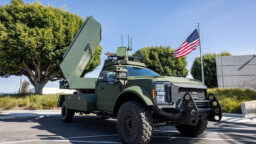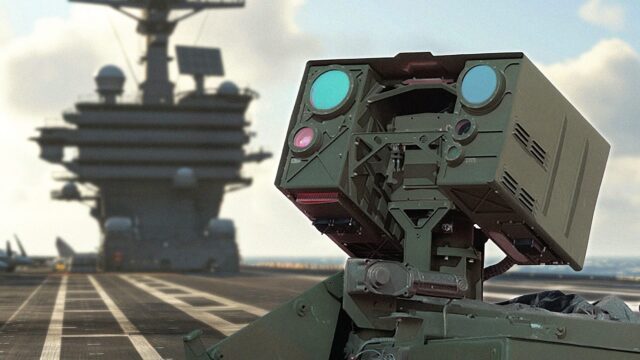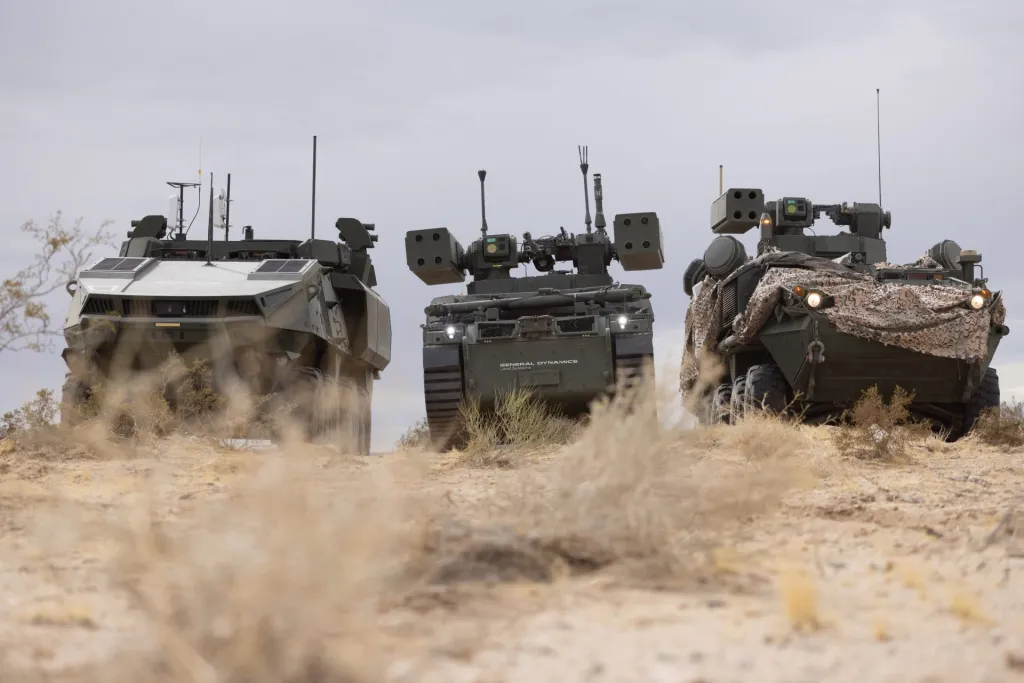
By now (unless you’ve been living in a cave for the past few years), you’re probably well aware that the US military is going all-in on autonomous vehicles. And if you read Tectonic, you’ll know that there are a whole lot of companies making them.
When those many thousands of autonomous vehicles are fielded, each with its own operating system, one of the biggest challenges will be managing the logistics for them to function as a coordinated fleet.
Luckily, Rune thinks it has the answer.
This morning, in an exclusive release to Tectonic, the logistics and sustainment software startup unveiled its Autonomy Development Kit (ADK), designed to collate all of the logistics for autonomous vehicles—from vehicle telemetry data like fuel or battery level, faults, and readiness, to vehicle class, cargo capacity, and demand—and optimize their operability through its flagship TyrOS logistics AI platform.
“All of these autonomy providers have made incredible autonomous systems, and some of them are quite frankly mind-blowing,” Rune’s Head of Growth, Kyle Haire, told Tectonic. “What they have not built is the sustainment orchestration layer to tie them all together to operate as a holistic system.”
Doing the dirty work: By getting all of that info into an AI platform that can already handle and process logistics and sustainment for a wide range of mission sets, Rune’s goal with the ADK is to make the burden of managing and tasking autonomous vehicles as unmanned as the systems themselves.
One size fits all: The ADK is built into Rune’s TyrOS platform, which aims to help logisticians and users get critical kit—gear, fuel, food, and parts—where it needs to be more efficiently by using AI and a whole bunch of data to preemptively predict future needs and allocate resources accordingly. The ADK is the “natural progression” of TyrOS, making it “the sustainment orchestration layer that everybody should tie into,” Haire said.
Here’s how it works:
- The ADK, according to Rune co-founder and CTO Peter Goldsborough, is a “well-defined set of Application Programming Interfaces (APIs), documentation, sample code, and optional software libraries.”
- An autonomous vehicle operator can register a vehicle—ground, air, sea, or sub-sea—on the ADK, which plugs the characteristics (like cargo capacity, vehicle type, or cargo class) and telemetry (fuel/battery, location info, vehicle health) into TyrOS so it can be integrated into the broader logistics picture and tasked more efficiently.
- It’s designed to be open and vehicle-agnostic (including manned vehicles), so systems “can be tasked and utilized at a larger scale with other providers,” Haire said.
- It also plugs into Palantir’s Maven Smart System—the C2 backbone for much of the Marine Corps and Army’s battle management.
Partner up: Rune’s work as the logistics and sustainment layer on both Army Next-Generation Command and Control (NGC2) prototyping teams and the Marine Corps’ Project Dynamis C2 modernization initiative makes, in Rune’s telling, plugging into the ADK almost a necessity for vehicle providers working on those efforts.
- Rune’s also relying on their partners to make the ADK as effective as possible. On the telemetry front, Shift5—a predictive vehicle maintenance startup and partner on Anduril’s NGC2 team—is a good example of that symbiotic relationship.
- Earlier this year, CEO Toby Magsig told Tectonic that Shift5 was added to the Anduril squad after showing “both Rune and Anduril how we could expose the data pulsing through our nation’s warfighting systems,” which “unlocks exactly what Rune needs to do its job better in near-real time.”
- With the ADK, that telemetry data—along with a wide range of other vehicle information—can get plugged into TyrOS and into its broader logistics AI capabilities.
According to Haire, Rune’s ADK has been integrated with a maritime autonomy partner, tested with the Army’s 1st Cavalry Division, and is set to be integrated into Rune’s work on the NGC2 exercises with the Army and the Marines’ Project Dynamis.
Like Palantir’s Maven, “when a platform becomes the way work gets coordinated, the companies that plug into it earlier come out ahead,” Goldsborough said. “We expect the same pattern to play out for TyrOS in logistics autonomy.”
“The platforms are fielded. TyrOS is fielded. The ADK is in the market,” he added. “The work ahead is bringing more of the autonomous fleet under one orchestration layer.”