Take a quick look around the defense startup scene, and you’ll notice that pretty much every company bills its tech as “tested in Ukraine.” Far fewer can say that they’re trusted in Ukraine. Forterra actually can.
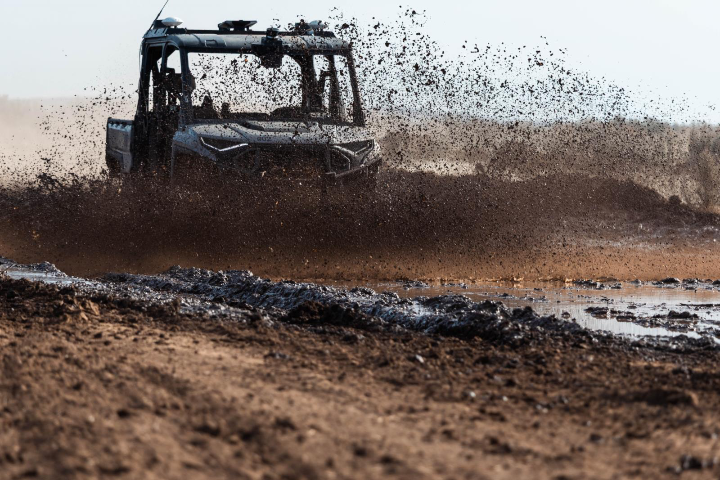
Yesterday, the ground autonomy startup revealed that it has sent over 100 Lancer autonomous ground vehicles (AGVs)—based on the Polaris Ranger 1500 ATV—to the front lines in Ukraine, where they’ve been used “across more than 1,100 missions,” including logistics and casualty evacuations (CASEVAC).
That deployment was funded through a broader $114M US Army contract awarded in March 2025, the service and Forterra disclosed to Tectonic.
- The contract “included much more than just Lancers,” according to Sergeant Major Corey Wilkens, who leads the Army’s Sandhills Project, an autonomous vehicle development program. “Forterra was a prime agreement holder delivering a range of capabilities that included 105 Lancers, though the cost of those machines was approximately 1/3 of the total award cost.”
- As for the “much more than Lancers” part, that includes “a range of unmanned systems ranging from various sizes of UAS to engineer equipment such as bulldozers,” though only the Lancers were sent to Ukraine.
Rise of the robots: Forterra, for the Tectonic regulars, needs no introduction. The $1B startup has been stacking up wins on some major programs—including a $92M production contract with Oshkosh for the Marine Corps’ Remotely Operated Ground Unit for Expeditionary Fires (ROGUE-Fires) system last month—but this one is different.
- Forterra’s Lancer AGVs are based on the Polaris Ranger 1500 heavy-duty Utility Terrain Vehicle (UTV) and kitted out with their AutoDrive autonomy stack and Vektor comms system, designed for degraded and jammed environments (like Ukraine).
- On the battlefield in Ukraine, the vehicles have traveled more than 2,500 miles across more than 1,100 missions, carrying nearly 800,000 pounds of total weight in logistics missions and completing close to 100 CASEVAC operations.
- They’ve also been used in “a couple other missions,” Forterra’s VP of Defense Pat Acox told Tectonic, but couldn’t say more to maintain Ukrainian operational security.
- “The bottom line is that this UGV for logistics and just maintaining our defense is the most important UGV in Ukraine,” one Ukrainian soldier told TechCrunch. “It’s fucking fantastic, and we are dying to get more.”
Test your mettle: That performance wasn’t a given. The electronic warfare-saturated, ever-evolving Ukrainian battlefield has seen more than a few well-capitalized American and European autonomous systems startups stumble—often quite publicly—but “it was the right thing to do and the right place to be,” Acox said.
“From our perspective, we went into it [thinking], ‘This thing might face some real adversity, like, it might not actually work. Are we going to go double down and continue to press through to make sure operations succeed?’” he added. “Internally, the answer was not only yes, but ‘F’ yes. It was a great opportunity to look into the mirror and say, ‘Hey, we think we’re real—how real are we?’”
Mission critical: For Forterra and the Army, the deployment helps validate the technology, but it also shows how fast emerging companies can move to deliver it to the battlefield. According to Acox, the Lancers were manufactured and delivered in under six months, including 40 days of integration time.
For vehicles designed to help evacuate casualties from the front, that contracting and delivery speed translates to lives saved.
“We talk a lot about the defense industrial base and the need to energize it and scale it up, and one of the things that’s exciting about this is how this happened and seeing the operational impacts,” Acox said. “The big thing was CASEVACs—we’re up to like 88 at this point, so from an effects basis, I know there’s at least 88 lives we’ve actually saved and preserved [through] the speed of energizing the industrial base. Six months to get 105 vehicles out the door and into operations.”
- A few Lancers have been destroyed by drone strikes in Ukraine, but to him, those are “badges of honor”—the fact that a vehicle was hit but unmanned means many more lives were saved.
From Saronic’s USV rescue in the Strait of Hormuz to Forterra’s AGVs in Ukraine, it’s been quite the month for life-saving autonomy, and we’re willing to bet this is just the start. After all, sending robots into the most dangerous missions in place of humans is the whole point.