In case you haven’t had a keen eye trained on Ukraine this summer, deep strike is quite the hot topic right now.
Basically, companies like Fire Point have shown that lower-cost, autonomous deep strike weapons (like, with ranges well above 200 kilometers) can inflict oodles of damage deep in adversarial territory—especially when you train them at something combustible like a Russian oil depot. And that’s at a fraction of the cost of exquisite, legacy long-range-strike systems.
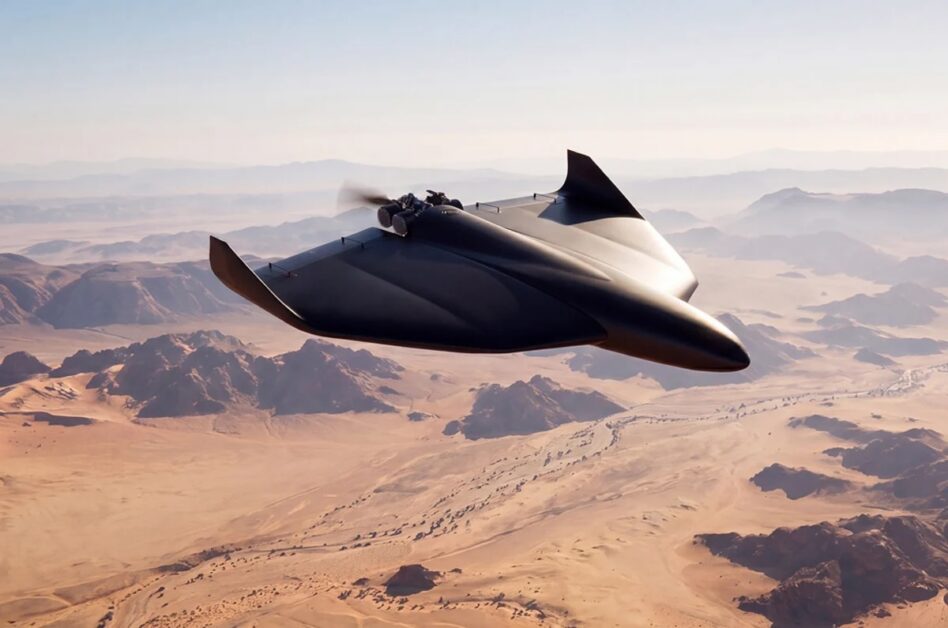
Well, if you haven’t been paying attention, it seems that at least one French defense darling was. This morning, Harmattan AI unveiled a new deep-strike drone it’s calling IRIFI, designed “to conduct deep-strike missions at ranges of up to 2,000 km (1,240 mi).”
- The company says it will be able to “carry out an authorized mission from end to end without any human control during execution,” and navigate without GPS/GNSS.
“Deep precision strike is…a huge area of focus for NATO right now,” Harmattan co-founder and CEO Mouad M’Ghari told Tectonic. “There is currently a gap between the Shahed-type, mass-produced, cheap, low-probability-of-kill systems, and the highly precise long-range Tomahawks or Storm Shadows that are extremely expensive and produced at a small scale, but very precise and powerful.”
“[We came up with the idea] of simply taking a classical architecture, something similar to the Shahed, putting a lot of cameras into it and some compute power in order to make it fly low, be more survivable, avoid threats, and be way more precise—up to the meter—in terms of precision to the target,” he added. “That’s why we’re entering this market.”
M’Ghari said that IRIFI is in early development and that they expect to get it into production by the end of 2027. Morocco is the first customer for the system, and the country is committing to the product “very early in its development, and will contribute significantly in its definition.”
- Harmattan signed a strategic partnership with the Kingdom of Morocco back in June.
Oui oui: Now, Harmattan has been making some pretty serious moves out of Paris in the last few years. For those who haven’t been paying attention:
- The company was only founded back in April 2024, but since then has raised about $242M—most recently a $200M Series B at a $1.4B valuation led by French defense giant Dassault Aviation.
- They kicked things off squarely on the drone side of things, and make a bunch of different platforms, including a high-speed interceptor called Gobi, a cheap quadcopter called Sonora, and a Synthetic Aperture Radar (SAR) drone payload called Sahara.
- They also teamed up with Dassault to build an EW detection drone payload called NAMIB earlier this summer.
Racks on racks: And they’ve proven pretty popular across Europe. They’ve scored:
- A “multi-million euro” order for ISR drones by France back in 2025. Earlier this summer, the French MoD also placed a follow-on order for 5,000 more units.
- An order from the UK MoD for 3,000 autonomy systems.
- An agreement with the Kingdom of Morocco to develop “next-generation autonomous air defense capabilities at scale.”
It’s still early days for IRIFI, but here’s what we know about it:
- As M’Ghari said, it’ll look a lot like a Shahed, but equipped with more compute. It will use “an undisclosed payload, mobile canisterized launcher and an attritable architecture intended for rapid and agile deployment at scale,” per the company.
- He told Tectonic that the company will develop the drone pretty much end-to-end in-house. “We will do all of the avionics, all of the electronics, all of the mechanical engineering…[and] we will also do all of the embedded software and the embedded AI.”
- Navigation, interceptor avoidance features, and terminal guidance algorithms will also all be built by Harmattan.
- Manufacturing will kick off in Morocco, and then “likely” move to the US, per M’Ghari. Initially, the company’s goal is to produce 5,000-10,000 of these bad boys per year, then push upwards.
“We already see a very strong demand signal for even more than this, so we are currently looking at scaling this up,” M’Ghari added.