Strap in, nerds. Everything really is computer.
Yesterday, the Office of the Under Secretary of War for Research and Engineering (OUSW(R&E)) announced a total of $350M in awards and programs to “strengthen U.S. leadership in quantum computing capabilities that support national security.”
- That includes a $150M capital loan commitment to PsiQuantum to “enhance the company’s advanced manufacturing and prototyping capabilities in the United States.”
- The remaining $200M is going to DARPA’s Quantum Benchmarking Initiative (QBI) to advance four companies—Atom Computing, Diraq, IBM, and IonQ—to stage C of the program. (That’s DARPA’s effort to see if anyone, like, can actually build a quantum computer.)
With these awards, the Pentagon also says it will push the Department’s “innovation ecosystem” toward finding “mission-relevant” applications for quantum computing and these quantum computers.
- The bet is that quantum tech will drive leaps and bounds in fields such as chemistry, materials science, and physics, which, in turn, will “enable the development of next-generation weapons, platforms, and other critical capabilities that are more lethal, cost-effective, and manufacturable.”
Bits and pieces: Now, for those of us who pretend to understand what the whole quantum thing is but actually don’t, here’s a bit of a refresher: Quantum computing is basically regular computing on steroids, using the weird and wacky laws of quantum physics to solve problems that would take even the world’s most powerful supercomputers an absurdly long time to crack.
- Normal computers—like the laptop you’re reading this on—use bits, which are either 0 or 1. Everything they do, from sending an email to running a missile defense system, ultimately comes down to processing those 0s and 1s.
- Quantum computers use something called qubits, which can be 0, 1, or a combination of both at the same time. That’s thanks to a quantum phenomenon called superposition.
- Qubits can also be linked together through something called entanglement, meaning their quantum states become connected, even when they’re physically separated.
- By exploiting these quantum properties, quantum computers can manipulate a huge number of possible states simultaneously—and, with the right algorithms, use interference to zero in on useful answers.
Try it out: Think of it like trying to find the right key on an enormous key ring. A classical computer might have to test the keys one by one. A quantum computer can basically try all the keys at the same time.
- For some particularly gnarly problems—like simulating molecules, developing new materials, or cracking certain kinds of encryption—quantum computers could do in hours what would take a classical supercomputer thousands (or potentially millions) of years.
Codebreakers: Now, if you’re sitting there like woah, Tectonic has lost the plot, just hold on. This is all super relevant to defense.
Beyond materials development, quantum computing could help the US (and allied nations) with:
- Comms and code-breaking: Most military comms nowadays rely on codes that normal computers have a tough time cracking. Quantum computers could break these codes pretty easily. And quantum-safe comms and encryption would be basically unhackable.
- Logistics: We talk a lot about how tricky military logistics and planning are—quantum computers are pretty good at solving these huge, sticky, complex problems.
- Navigation: Quantum sensors can measure teeny-tiny tiny changes in motion, gravity, or magnetic fields. This can be helpful for navigation in GPS-denied or jammed environments.
- Sensing: Quantum sensors can also—using that hypersensitivity—detect hard-to-track objects like stealth aircraft, deep-sea submarines, or hypersonic missiles.
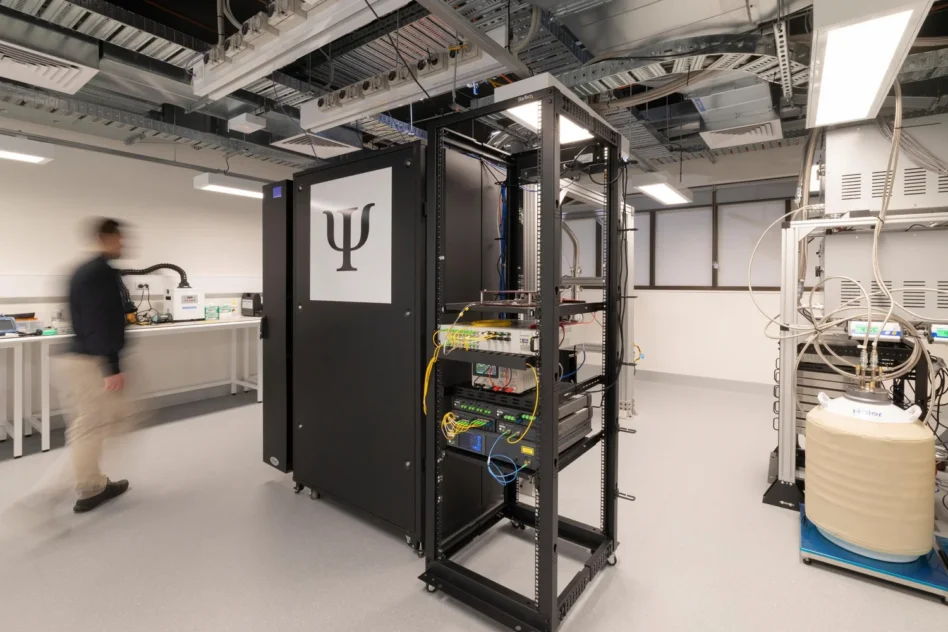
Use what ya got: Now, to bring it back to PsiQuantum—the Palo Alto-based company is pretty interesting because it’s (kinda, sorta) applying the whole COTS thing to quantum.
- The company (founded back in 2015) is trying to build the world’s first large-scale, commercially useful quantum computer.
- Unlike competitors that use superconducting circuits or trapped atoms, PsiQuantum uses photons (particles of light) as qubits.
- Crucially, its chips can be manufactured using existing semiconductor production techniques—making them potentially easier to produce at scale.
- The company’s ultimate goal is to build a million-qubit quantum computer—which would be able to tackle all those thorny problems we outlined above.
And they’re not just funded by the DoD—the company has raised a total pot of $1.66B at a $7B valuation, per PitchBook data.
- Most recently, they raised a $1B (yes, billion with a B) Series E led by Baillie Gifford, Transform Investments, Temasek Holdings, and BlackRock back in September 2025.
- They’ve also scored about $308M in DoD contracts and commitments, including about $33M with AFRL and a $125M deal with DARPA under the Quantum Benchmarking Initiative last summer.
Make it work: Now, as for those four other companies—Atom Computing, Diraq, IBM, and IonQ. That cool cool $200M will fund their run through Stage C of DARPA’s QBI. That’s the final, and most rigorous, phase of the program.
- Worth noting, PsiQuantum moved on to Stage C last summer. Hence the $125M award.
- In this phase, DARPA will actually start testing the companies’ hardware and prototypes.
- Each company will need to prove that their computer can, like, actually be built at scale—not just a one-off.
- The ultimate goal is to validate the tech and—critically—determine whether these systems can reach utility scale (meaning the value of their computational output exceeds the cost it takes to build and run them) by 2033.
“Funding the development of fault-tolerant quantum computing is a national security imperative,” Peter B. Zuckerman, senior managing director at OSC, said in a Pentagon statement. “We must scale this critical technology to secure our technological edge and deny adversaries a decisive strategic advantage.”