Now, we may spend a lot of time around here talking about robots, and humans, and the interactions between humans and robots, but we don’t spend a heck of a lot of time talking about, well, the buildings and structures where all of these humans and robots live and work.
Well, today we will.
In case you missed it, last week, robotic construction startup ICON announced that it’s raised a $200M Series D co-led by Baillie Gifford and BlackRock.
- Put simply, the company uses giant 3D-printers and robots to construct buildings faster than traditional methods.
- While their pitch is that they can use these robots to build houses (in the midst of a US housing crisis), a significant chunk of this funding will also go towards building out their military and public sector business (called Prime).
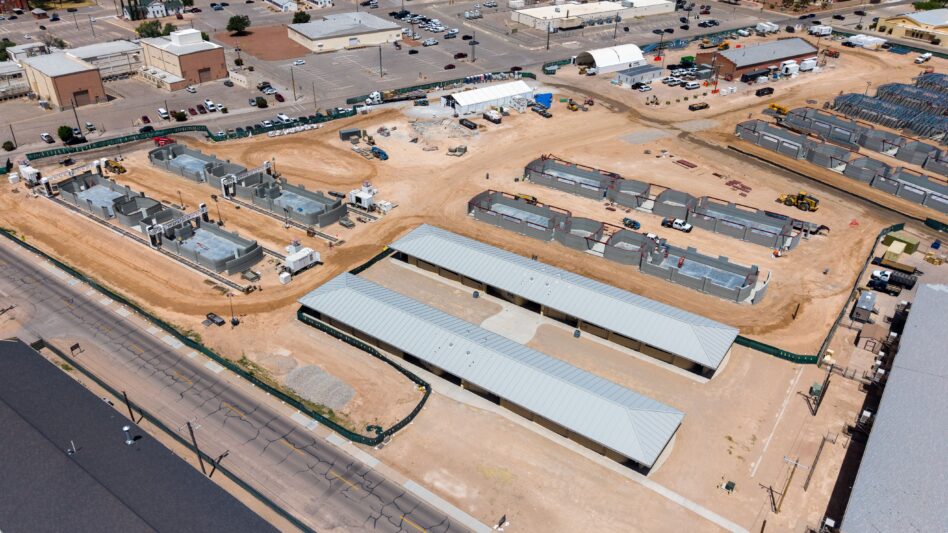
- The company is already printing barracks for the Army—the plan is to scale that all the way up.
“This is going to allow us to replicate our relationship with the Army with other services. The fact that we’re finishing up 10 barracks in nine months [is] unbelievable,” ICON Prime President Will Hurd told Tectonic.
“[This funding] is also is going to help us move faster on developing a truly expeditionary robot,” he added. “One that can go into the first island chain and print something using local materials as you’re trying to project force in difficult places at multiple times.”
Sounds handy.
Build up: Now, ICON definitely did not start out as a defense-focused company. The construction tech start-up was founded back in 2017 in Austin and set out to use giant robotic 3D printers to build houses.
- Pretty soon, however, the company realized that their robots would be pretty useful for the US military, which needs barracks, housing, and offices for the hundreds of thousands of people it employs.
Uncle Sam: The company launched a dedicated public sector business (ICON Prime) back in April 2026—but they’ve already notched quite a few wins on the whole government business side of things.
- They’ve scored $360M+ in government contracts as of April 2026, including a massive barracks project at Fort Bliss, TX.
- Under that $62.8M Fort Bliss project, ICON built 10 military barracks accommodating up to 560 soldiers in just 58 days (though it did take about 9 months, per Hurd, for full delivery).
- Over the course of the project, the Army said that ICON achieved 4x faster construction and 9.3% lower cost per square foot than traditional Army construction benchmarks. Pretty dang good, for a robot.
- They’re also working with the US Army at Fort Polk (in Louisiana) to build 3D-printed barracks and other structures. The initial OTA was worth $67M, with a potential contract value of $201M. Hurd said this project will ultimately comprise about 96 structures—initial occupancy of the first eight structures is expected for summer 2027.
Rinse and repeat: From here, the plan is to use (at least some of) this funding to replicate this model elsewhere.
- Hurd said the company is “doing similar things with Air Force [and] Marines…and the Navy projects focused on how to bring this kind of innovation into the field.”
- They’re also working to build “truly expeditionary robots” that could be deployed somewhere like, say, the first island chain to build structures (quickly) there.
“If we get into a war with China and you’re having an F-35 land on an atoll in a random place, you got to have a place for it to land,” Hurd said. “You may have to have a place for it to be sheltered. You may have to have a communications depot…all of the things you have in an actual war. [Having] an autonomous robot that is able to [build] that using materials that are readily available is the real difference.”
“You don’t need to worry about the supply chain of getting the materials you need to build,” he added.
To the moon and back: Interestingly—especially for those of our readers who are also Payload fans—a lot of this money will also go towards building robots that can eventually build military and government structures in space. Like, we’re talking buildings on the moon.
- The company is already on a $60M contract with NASA to “develop space-based construction systems capable of building humanity’s first-ever structures on the lunar surface.”
- Hurd broke that down for us—basically, they’re building versions of their 3D printing construction robots that can use materials local, to, well, space (read: lunar regolith) to build everything from “a landing pad [to a] road to shielding for power or a habitat.”
“You scoop up the lunar regolith…you get it to a certain temperature…and you build it into a ceramic that has two times the strength of concrete,” he explained.
They’ve demo’d the tech on Earth—the next step is to test it out on the moon. After all, why stay earth-bound when you’re a whole $200M richer?