Looks like the whole reindustrialize wave ain’t over just yet.
This morning, robotics-for-manufacturing startup Aformic announced in an exclusive release to Tectonic that it’s raised a $6.95M seed round led by Veteran Ventures Capital.
- Other investors in the round included ff Venture Capital, Red Beard Ventures, and Mana Ventures.
- VVC made the investment out of its $60M Fund II (we broke the news on the fund’s close back in August).
- And one interesting thing to note here—this ain’t no pre-revenue seed. Aformic says it had $10M in revenue last year, and plans to pretty much double that this year.
Aformic CEO Michal Fiuk told Tectonic that from here, the plan is to scale up production of—and customers for—its in-factory intralogistics (stuff-carrying) robots, especially with the military and defense customers.
- They’re also going to work on building new products, including ultra-heavy-lift robots and robots that can tug things around.
“Aformic’s got just about everything: proven robots, proprietary software, and deep industrial expertise,” VVC Founder and Managing Partner Derren Burrell told Tectonic. “That’s kind of that. Now, we really want to continue to help them open up the doors in the defense area.”
Making connections: If you’re sitting there like, what the heck is an intralogistic—fret not.
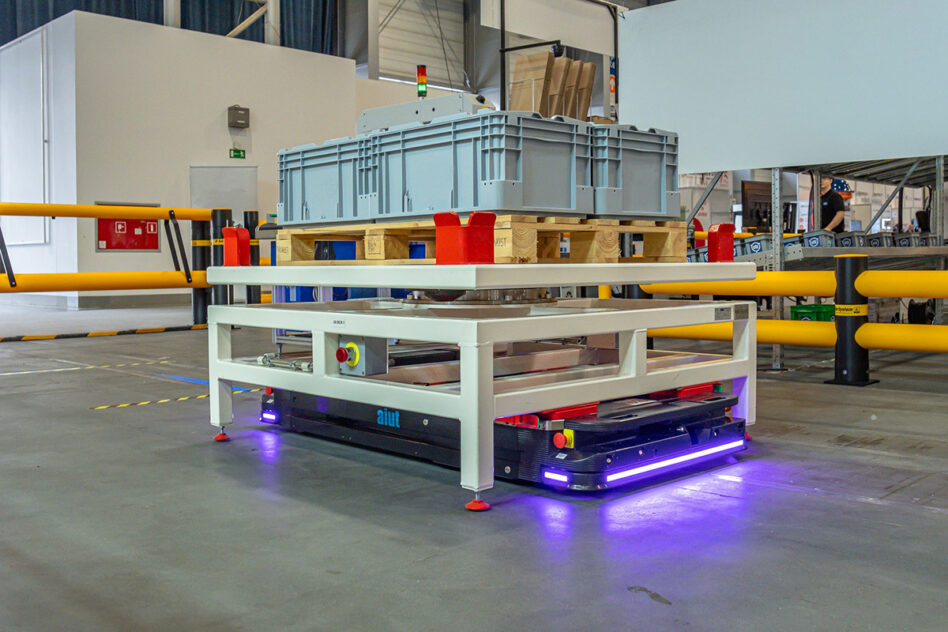
Put very simply, Aformic builds small-ish robots that are really good at taking things where they need to go, as well as the software that tells them how and when to get there.
- They have a few different models, ranging from small, low-profile robots that scoot underneath carts and racks to move materials around, to autonomous forklifts that can lift and stack pallets, to heavy-duty platforms able to haul loads up to six metric tons.
- The idea is to pass the annoying (and time-consuming, and sometimes dangerous) work of, well, moving stuff around a factory to robots so humans can focus on the more specialized stuff. Worth noting—some research estimates that material handling accounts for roughly a quarter of employees at a typical manufacturing facility.
- Aformic has also built an orchestration layer called Qursor, which essentially acts as the brains of the operation—assigning tasks to robots, planning their routes, coordinating traffic, and integrating with existing factory systems to make sure the right materials get to the right places at the right times.
- To illustrate how the system works, Fiuk asked us to think of a large automotive plant—robots (powered by Qursor) carry smaller components from line to line and, ultimately, to full car assembly so that humans can actually focus on building the damn things. This applies to things like missiles, too.
“[We help companies] manufacture hardware more rapidly at better scale, and ultimately at better quality against their performance milestones than they may be able to do without the level of automation we bring,” Fiuk explained. “We’re helping our partners leverage their team members in ways they wouldn’t be able to if they’re moving those goods.”
- Plus, because the robots are software-driven, you can optimize production lines by basically rerouting them, without having to change the whole machine setup.
- “We often see higher throughput because it’s just a more efficient process where you’re moving exactly the goods you need to, and getting exactly the next component in that assembly process when it’s needed,” he added.
Boom or bust: Now, you might be sitting there wondering what the heck all of this has to do with us here in defense tech land. Well, while Aformic is making a true dual-use play (heavy industries like automotive are a big thing for them), defense comprises a significant part of the company’s business.
- The company already has “multiple robots” working in “Tier 1 defense OEMs” (Fiuk couldn’t tell us who, exactly) and defense accounts for a little under 20 percent of the company’s business, per Fiuk.
- But with this new cash in hand (and VVC’s heavily government- and military-flavored network), the plan is to push this further, both direct to government and with producers.
- As Burrell pointed out, the Army is spending billions trying to upgrade its depots—the bet here is that these tiny logistics robots can help the military do that without having to build new factories from the ground up. “This seems to be the fastest and cheapest way to make a plant more productive without having to rebuild,” he added.
- They’re also going to expand further with defense customers (primes and neoprimes alike)—after all, missiles and other weapons have lots of small, annoying parts that need to be carted around.
“I think there’s a lot of opportunity where there are great teams that have built products and started their scaling journey,” Fiuk said. “We’ve proven we can help folks scale to meet their ultimate customer demand. That’s really what I’m looking to do now in the aerospace and defense vertical.”