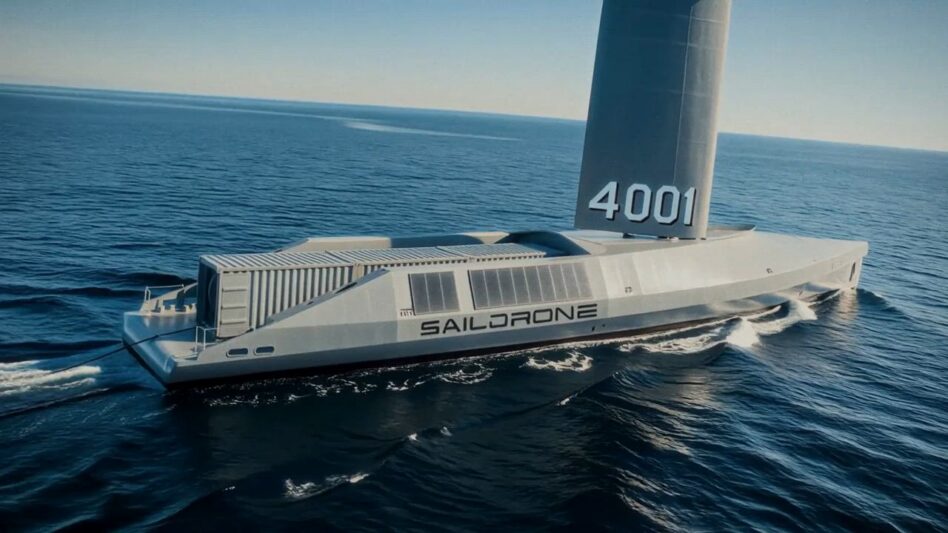
It takes guts to take your biggest customer to court. But when $2.1B is at stake, that gamble is worth taking.
Saildrone rolled the dice—and won.
According to a ruling in the US Court of Federal Claims unsealed yesterday, the US Navy “acted in an arbitrary and capricious manner in its review of Saildrone’s proposal” for the Medium Unmanned Surface Vessel (MUSV) marketplace, ruling that the company’s elimination resulted from “disparate treatment.”
Now the Navy has to reevaluate Saildrone’s proposal and is blocked from spending a big chunk of the $2.1B allocated to the program until it does.
When you come for the most powerful naval force in the world, you best not miss.
Drone-boat drama: If you haven’t been tracking the drama around the US Navy’s Medium Unmanned Surface Vessel (MUSV) program, buckle up, because it’s a wild ride.
- Back in March, the Navy canceled the Modular Attack Surface Craft (MASC) program—originally designed as a prototyping competition to field medium unmanned surface vessels (MUSVs)—in favor of a “regular and recurring marketplace” for mid-sized drone boats.
- USV companies, including many in the mix for MASC, submitted proposals for the new marketplace and a slice of the $2.1B allocated towards the program.
- In June, the Navy selected seven companies—including Sea Machines, HII, Saronic, Leidos, and PacMar—to advance to the at-sea testing phase, receiving $15M from the Navy and eligibility for “follow-on production” contracts.
- Weeks later, two of the companies that didn’t make the cut, Saildrone and Blue Water Autonomy, sued the Navy over their elimination, claiming unfair treatment and arbitrary selection criteria.
- Two companies that made it through the selection process—Leidos and Saronic—countersued. High drama on the high seas.
Mixed bag: Saildrone’s case was successful, per yesterday’s ruling. Blue Water’s was not.
As a result, the Navy must reevaluate Saildrone’s proposal within the next two months and is barred from spending $1.5B of the program’s $2.1B on production.
- That’s notable because Saronic won a $400M OTA contract for 10 of its Marauder MUSVs in September—while the Navy was litigating the cases against Saildrone and BWA.
- As reported by The New York Times in July after the initial selection, some USV firms “told contacts at the Pentagon or in Congress they believed the Navy gave Saronic preferential treatment” because of Saronic’s influence within the Trump administration.
Suit up: Saildrone’s case seemed like a long shot from the outset. The Navy had three core evaluation criteria—proposed business model, vessel solution design, and a plan to complete an on-water MUSV test event—and Saildrone was eliminated on all three.
“Any one failure would exclude you from the competition, and they failed us on all three criteria—you’d think you’d have no hope to come back from the failure of three,” Saildrone CEO Richard Jenkins told Tectonic. “When we challenged them, they immediately dropped two of the three and said, ‘We’re not going to contest those; they’re not defensible,’ essentially realizing that two of the three criteria weren’t valid. The court ruled on the third one, which was technical.”
Fight unfair: The ruling didn’t touch on the technological details of Saildrone’s proposal. The Navy is the judge of that.
Instead, the court found that one of the accepted proposals—Sea Machines’ Steamracer USV—had pretty much the same specs (specifically, maximum displacement). Sea Machines made it through; Saildrone did not.
- “That’s the basis of the court ruling: they applied different metrics to us than they applied to a successful applicant, and that is illegal,” Jenkins said. “That’s why our [case] was very black and white, and why we’re allowed in.”
- “They did everything they could to allow us not to compete by failing us on all three criteria, and all three reasons turned out to be invalid,” he added.
“The Navy’s subsequent treatment of the proposals disparately favored Sea Machines and arbitrarily held Saildrone to a higher standard,” Judge Philip Hadji wrote in his opinion. “Had the Navy applied the same approach to Saildrone’s proposal as it applied to Sea Machines’ proposal, Saildrone would have had a substantial chance of being found acceptable and advancing to the MUSV Test Event.”
“Accordingly,” he added, “Saildrone was prejudiced by the Navy’s disparate treatment.”
Fight fair: Now, Jenkins makes clear that his company’s fight isn’t against the Navy or the Department of Defense, stating that “our fight was with an office that incorrectly treated us, and we believe that was not any kind of direction from Big Navy, the DoW, or anyone else.”
“This is a fight for what is right and a fight for a fair opportunity to compete…and bring private capital to the marketplace at no cost to the government or the taxpayer,” Jenkins said. “Why would you willingly decline that sort of thing?”
“The objective here was to bring our proven technology and private capital to bear on defense tech, and we were unfairly, irrationally, and deliberately excluded,” he added. “From that, we’re very pleased that justice has been done. This is a win for technology. It’s a win for the Navy. It’s a win for fair contracting.”