Anduril’s Arsenal-2 shipyard near Baltimore is billed as the Navy’s factory of the future, so it’s only right they bring in the best-of-the-best in new-age manufacturing tech.
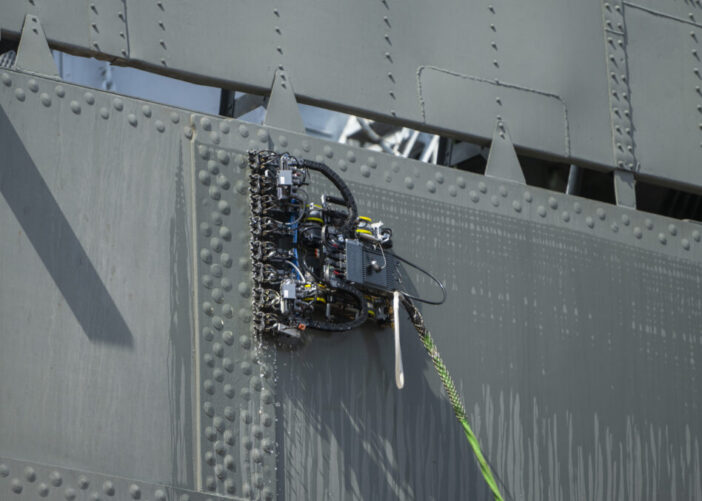
Two short days after Anduril unveiled the $3.7B, 2M-square-foot mega-factory, Gecko Robotics announced that their wall-crawling robots and critical infrastructure inspection software will be deployed at Arsenal-2 and Anduril’s parallel 160,000-square-foot protofactory in Orange County, CA, to ensure all of the components Anduril’s making for Virginia-class submarines are up to snuff.
Arsenal-2 is expected to be up and running in 2030, but Gecko’s already gained a whole lot of experience in the naval industrial base, including on Virginia-class submarines. That made the partnership pretty obvious.
“We’ve been in Virginia-class subs in many different environments; one is…the naval reactors that go into Virginia-class and Columbia-class [submarines] or Ford-class carriers,” Gecko co-founder and president Troy Demmer told Tectonic. Because of its history working on those critical programs, “Gecko is uniquely positioned to create this thread that connects from the earliest manufacturing [stages] through the operational life cycle.”
Fast climber: To back things up, Gecko, founded in 2013 by Demmer and his college friend Jake Loosararian, uses robots, sensors, and some fancy AI-powered software to analyze the health of critical infrastructure, including aircraft carriers, submarines, and power plants.
- Those robots use ultrasonic sensors and AI through Gecko’s Cantilever software platform to detect corrosion, cracks, and structural issues before they become problems.
- Cantilever then produces 3D visualizations and maintenance insights that help customers—including grid operators, the US Navy, and the Air Force—plan repairs, extend asset life, and avoid downtime.
- The company says its tech can identify repairs up to 50 times faster and more accurately than manual inspection methods and cut inspection timelines for forged components, like the ones Anduril will be making for Virginia-class subs, by up to 90 percent.
Sea legs: That tech has proven pretty popular with the Navy and the primes supporting the service’s biggest programs.
- Last year, they announced a partnership with BPMI, the prime for the Naval Nuclear Propulsion Program (NNPP) since 1956, to perform quality control inspections for critical components in nuclear-powered vessels, including Columbia- and Virginia-class nuclear subs and Ford-class aircraft carriers.
- Gecko also snagged a $71M contract with the US Navy in March to deploy its robots and AI maintenance software across a wide range of ships in the Pacific Fleet, starting off with guided missile destroyers (DDGs) and amphibious assault ships (AAS).
Those deals brought Gecko into factories and naval installations retroactively, but Anduril’s pitching Arsenal-2 as a “software-defined” shipyard, built from the ground up to make software and AI-enabled workflows foundational to how the facility runs, namely through its ArsenalOS factory optimization platform.
Gecko’s wall-crawling robo-inspectors are going to be central to that, and they’ve already integrated Gecko’s non-destructive testing (NDT) technology “deeply with ArsenalOS,” per Anduril’s VP & GM of Shipbuilding, Bill Noderer. Beyond Arsenal-2, Demmer said Gecko has worked with Anduril on at least three other programs at different facilities, including on ensuring “airworthiness.”
“Gecko specifically is helping define key aspects and functionality of [ArsenalOS] via what we do, so the workflow we create is this virtual cycle between assessing the material condition of these very critical components and modules, and creating a feedback mechanism to whatever is creating them,” Demmer said.
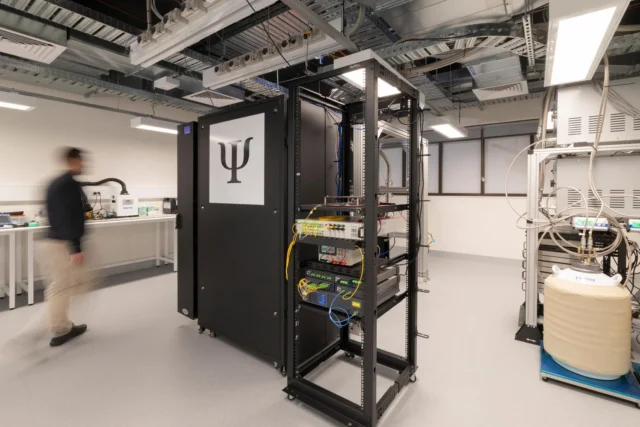
“If you went to the Orange County facility, what you’d see is robots, integrated sensors, and both welding and inspection working in unison to be able to not just construct these components, but also verify and authenticate the condition of them and [ensure] it meets the Navy’s standard,” he added.
Given the delays, cost overruns, and a whole lot of other issues plaguing the Navy’s major shipbuilding programs, especially its nuclear subs, the service is betting that some startup speed and software-defined manufacturing processes, courtesy of Gecko and Anduril, will be key to getting things back on track.