Pew, pew baby. It’s time to talk about lasers again.
This morning, directed energy weapons startup Aurelius announced that it’s raised a $40M Series A to scale up production of its flagship Archimedes laser c-UAS platform.
- The round was co-led by Draper Associates and KAS Venture Partners, with participation from investors including General Catalyst, Hanwha Asset Management Venture Fund, Outlander, Alumni Ventures, Bravo Victor Venture Capital (BVVC), Detroit Venture Partners, and Decisive Point.
- Worth noting that Draper and General Catalyst led the company’s $10M seed last fall.
“We will use this to…expand our capacity to produce systems, build out our team, [and] build out manufacturing and test range development,” CEO and co-founder Michael LaFramboise told Tectonic. “We want to proliferate into the market, get [these systems] out in the range, get them out testing, get them out into customer hands.”
They’re also planning to build out their directed energy component production line, which they announced back in April—that’ll be for internal use and to sell to the industry at large.
“[This] will make us one of two directed energy companies that’s vertically integrated in the United States,” LaFramboise added.
Pew pew: In case you don’t spend your time reading through the Office of the Under Secretary of War for Research and Engineering’s (OUSW R&E) Critical Technology Areas (CTAs), lasers really are so hot right now.
- Laser weapons—otherwise known as directed energy weapons—use a highly focused beam of light (a laser) to damage or destroy targets. Rather than using interceptors—or even bullets—to take down drones, you basically fry them.
- Here’s why they’re so hyped: When they work, these systems provide an “infinite magazine,” provided you’ve got enough power. They’re also super-duper fast.
- The Pentagon’s FY27 budget request includes a whole $2B for these systems—and they’ve doled out some pretty mega contracts for them in the past few months.
- They also make us feel like we’re living in a real-life sci-fi movie, which is a plus.
Greek myths: Aurelius’ flagship system—Archimedes—is designed to counter drones on the Group 1-2 side of things.
- The platform detects incoming UAVs (like cheap drones and quadcopters) using electro-optical sensors, autonomously tracks them using some fun machine-learning, then zaps them with a laser.
- The whole thing is designed to be autonomous—ideally, it takes down threats without a human in the loop.
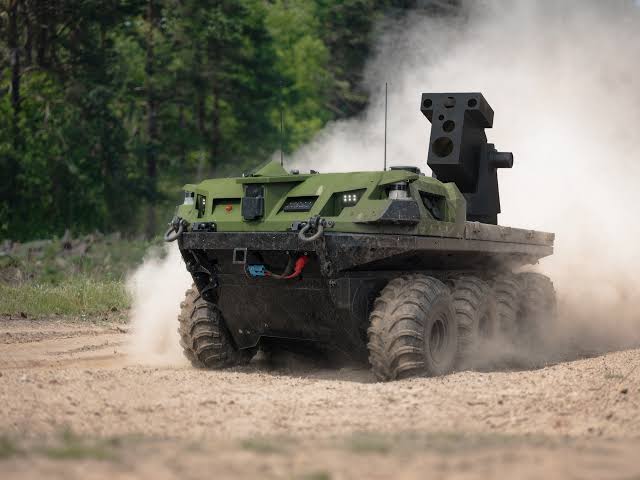
- It’s also been built to be platform-agnostic and field-portable—basically you can throw it on a truck, or a UGV, or even just set it up in a field and it’ll work.
- According to LaFramboise, the system has also been built using mostly commercially available parts—that keeps the price down.
- And fun fact: The system is named for the Greek mathematician and engineer Archimedes, who allegedly designed mirrors or other devices to concentrate sunlight against enemy ships during the siege of Syracuse. Pew pew, indeed.
Fast friends: And the company has already seen some decent traction.
- At OUSW R&E’s recent T-REX 26-2 exercise, the laser successfully downed over 20 quadcopter drones and more than five Army-supplied drones.
- During Operation Jailbreak, they also successfully integrated Archimedes with Anduril’s
- The Aurelius team was also on the ground at the Army’s Operation Jailbreak at Fort Carson, where they integrated Archimedes and their C2 software with Anduril’s Lattice and the Army’s legacy Forward Area Air Defense (FAAD) C2 system.
- They’ve also teamed up with Rheinmetall to build Archimedes onto the prime’s UGVs, and with Chariot Defense to power the system using Chariot’s ruggedized battery.
“Our system is performing in the way that we want to in the hands of the warfighter, shooting down drones in very short periods of time from long distances,” LaFramboise said.
Big ups: This funding will allow the company to basically do more of the same—but at a much larger scale.
“Right now…we have a team that’s able to produce the system and make it, but we need to be able to make 50, 100, 500,” LaFramboise said. “That’s not how we have been set up before, and that’s essentially what we raise the A to do.”
They plan to expand in San Francisco and Detroit, and scale the team up to about 50 people.
- They’ll also invest in building out their production lines for optics and laser sources—those are the bits that they’ll be able to sell to other companies, as well.
- Right now, LaFramboise said they’re primarily working with the Army, but that they have interest from the services. As they scale production, they’ll be able to pursue those (and other partnerships and integrations).
“I think we have a very, very salient path that we’ve gone down in directed energy. I don’t think there are any companies like us where we are,” he added. “We come in at a much, much lower price…and a much more sustainable option for directed energy on the edge than really any other system that’s out there.”