
If there’s one thing sharing a border with Russia has taught the Baltics in the past few years, it’s that drone defense is pretty damn important.
Luckily, a crop of high-octane startups is rushing to meet the moment, and securing some serious cash to get there. Yesterday, Estonian interceptor startup Frankenburg Technologies announced a €30M ($35M) Series A led by Helsing-backer Plural to scale production of its counter-drone mini-missiles.
Led by Kusti Salm, the former permanent secretary of Estonia’s defence ministry, Frankenburg and its mass-manufacturable interceptor missiles designed for short-range air defense have been a hot commodity since the startup was founded in 2024. They now have facilities in Poland, Ukraine, Latvia, Denmark, and Lithuania, on top of their home base in Estonia.
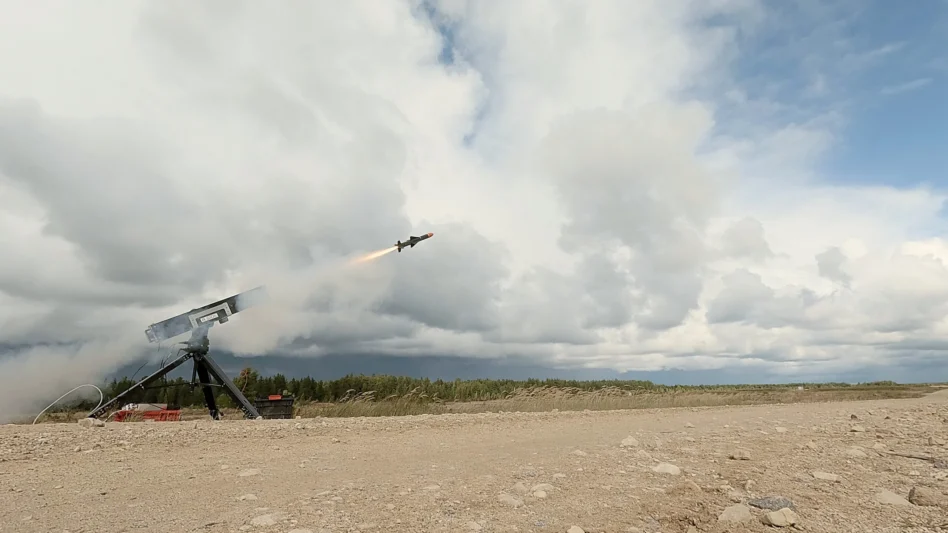
On the mark: With a fresh haul of cash, the company is laser-focused on scaling up production of its core offering, the Mark-1, which Salm called “the product we’ve hit the bull’s eye with.”
- The Mark-1 is designed to defeat Group 1–3 drones and loitering munitions, especially the Shahed drones that Russia’s pumping out across the border.
- It’s about 25 inches from top to tail and powered by a solid fuel motor and AI guidance tech.
- It has a range of 1.2 miles, a max speed of 750 miles per hour, and comes in at less than $50,000 a pop.
- The company currently makes “hundreds a year,” Salm told Tectonic in an interview, and “with the new capital and our production ramp-up plans, the capacity of one factory will be 100 missiles a day.” Ambitious, to say the least.
Even with the mini-missile space getting pretty crowded in Europe and beyond, Salm thinks his tech is in pole position in the interceptor race.
“We see market demand all over the world—the Middle East, Southeast Asia, and not only Eastern Europe, but also Western [European] countries,” he said. “Clearly, we’re way ahead of other competitors when it comes to missile-based defense, which will allow us to be commercially successful and go into longer-distance interceptors, and work has already started in that field.”
Primetime: The validation and interest aren’t coming only from investors—Frankenburg and its Mark-1 have also been a hit with the primes.
In the past few months, they’ve inked deals with the UK’s Babcock for maritime air defense, South Korea’s Hanwha for integration with a next-gen counter-drone land vehicle, co-production with Polish state-owned prime PGZ, and, as of yesterday, BAE Systems, to name a few.
Bigger boom: Frankenburg’s focus in the near term is on the Mark-1 and taking out Shahed-type drones, but Salm has his eyes on bigger and bigger targets.
“The next challenge is going to be mass cruise missiles that are going to be faster and higher,” he said. “Then we go against fixed-wing aircraft, manned or unmanned, and clearly, the next step is anti-ballistic missile defense. This is the top-shelf category, where the cost-to-kill discrepancy is highest.”
Frankenburg’s Series A—on the fourth anniversary of the Russian invasion of Ukraine, which coincided with Estonia’s independence day—is pretty symbolic, and Salm doesn’t pull punches about what their mission is.
“We’re explicit in saying that we develop tech for the free world to win the war, and we see that the biggest deterrence gap in Europe and, in fact, all allies in the free world, is in massing capabilities,” he said. “The reason why the Russians, Chinese, and others are putting their focus on mass is that this is where we’re weak.”
“The only way to deter is to equip ourselves,” he added, “and the only gateway for that is to deliver affordability in the categories needed for winning the war.”
Nothing like sharing a 200-mile border with your greatest adversary to light a fire under you.