
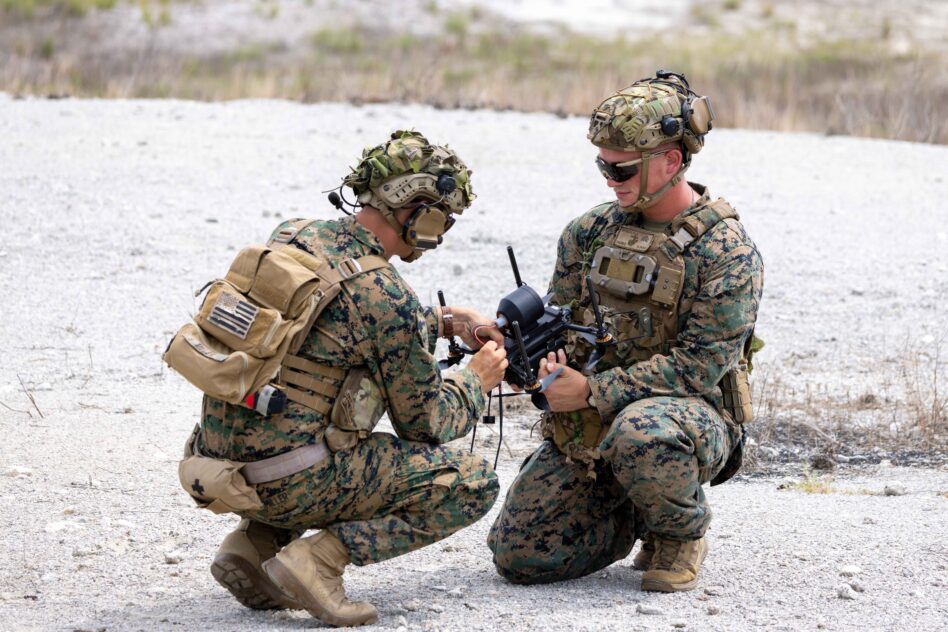
Look out, world. The El Segundo bros are teaming up.
This morning, CX2 and Neros announced in an exclusive release to Tectonic that they’re teaming up to put CX2’s c-UAS tech onto Neros’ made-in-the-USA quadcopter drones.
Specifically, the two companies will build Vadris—CX2’s RF-seeking drone pilot locator—onto Neros’ Archer FPV drone. The idea is to create an all-in-one platform that can “find, fix, and finish” (CX2’s verbiage) adversarial drones and their operators.
“A lot of people think about FPV as one-way attack, and that’s certainly the prime use case,” Neros Head of Growth Ross Pederson told Tectonic. “But by partnering with companies like CX2, who are doing innovative things with RF detection, we can take that low-cost capability and expand it into a new mission set.”
And by “mission set,” he means turning an FPV drone with an (optional) kinetic payload into an all-in-one seek-and-destroy capability.
Don’t know about you, but don’t think we’d want to be on the business end of this mash-up.
Big bucks: Neros and CX2 are both regulars around here—and right at the core of the defense tech darlings ecosystem. Both companies are headquartered in defense tech haven El Segundo (in LA), and are backed by the biggest names in the game.
- CX2—founded by CEO Nathan Mintz (of Epirus fame), along with President Mark Trefgarne, Head of Warfare Porter Smith, and Head of Hardware Lee Thompson—has raised about $46M from big-boy defense investors, including a16z, 8VC, and P72.
- Neros—founded by wunderkinds Soren Monroe-Anderson (CEO) and Olaf Hichwa (CTO)—has raised a whopping $120M, most recently a $75M Series B led by Sequoia.
On the hunt: Neros’ tech is a bit easier to wrap your head around (we all know and love drones), so let’s kick things off with CX2.
The company (put simply) makes fun-sized EW tools designed to help detect and take down drones. Since being founded in 2024, the company has rolled out two main products:
- Vadris: A radio frequency (RF) seeker plug-in for FPV drones that can ID where a drone is being flown from so that one can, theoretically, um, take care of the pilot.
- Wraith: A drone packed full of sensors that can pick up everything from GPS jammers to enemy control links to give operators a picture of where EW is coming from on the battlefield.
Basically, the idea is that if something (jammer, drone, pilot, or whatever) is emitting on the battlefield, CX2 can help you locate it.
Pew pew: Neros, for its part, is pretty laser-focused on small-ish drones.
- The company’s flagship Archer FPV is free of Chinese components and costs about $2,000.
- The drone comes in a few different flavors: A five-inch, an eight-inch, a ten-inch, and even a fiber-optic one built with Kela Technologies.
- Last February, they won a contract to send 6,000 drones to Ukraine, and, in November, they landed another to supply the Marine Corps with 8,000 Archer Strike drones.
- The company has also been tapped for the US Army’s Purpose Built Attritable System (PBAS).
- Last month, the company was also selected to compete in the Pentagon’s Drone Dominance “Gauntlet.”
Fun fact: One of the drones that played prominently in Pete Hegseth’s “Drone Dominance” announcement video was a Neros Archer.
Plug it in: With this new collab, CX2 will plug a Vadris onto a Neros Archer, effectively making it an airborne sensing-and-seeking platform.
“Before a strike, you need to be able to find a target, right? You need some kind of sensor to be able to identify a target,” Pederson said. “That’s where CX2 comes in. Vadris helps the drone operator find a target that is emitting RF frequencies, and ultimately…destroy that target.”
Scott Zolendziewski, CX2’s head of growth, talked us through a use case. “If I am in an overwatch position as [a drone operator] and I have a notification from my RF detect device that there’s an enemy drone in the air, [an Archer with Vadris integrated] provides you that rapid response package to put something in the air and go forward and hunt that operator,” he said.
And the integration has already been tested—Zolendziewski and Pederson said they showed off the Vadris-Archer as part of Project GI for the 75th Ranger Regiment, and are gearing up for a test with SOCOM in a few weeks’ time, according to Zolendziewski.
“It’s been working out really well in large urban environments where we’ve hidden enemy drone pilots in urban areas, day and nighttime, or in vegetated areas…they’ve been able to find [the drone pilots] like 100% of the time,” he added.
The focus right now is on scaling the Vadris-Archer integration across special operations—then, Pederson and Zolendziewski said, they can explore other integrations.
“We’re laser focused on this integration, and there’s a lot of work to be done to get it to scale across SOCOM,” Pederson said. “We’d like to do is to see this kind of joint capability become dispersed across the Joint Special Operations Force.”
“We’re also scoping out a combat validation in Ukraine next quarter,” Zolendziewski added.
Drone dominance, indeed.