Picogrid is proving that teamwork really does make the dream work.
This morning, the El Segundo-based hardware and software integration startup announced in an exclusive release to Tectonic that it has raised $45M in a Series A led by Bessemer Venture Partners to expand its product family, increase deployments, and take its integration tech into new operational domains.
- New investors Washington Harbour and GSBackers participated in the round, alongside existing backers Initialized Capital, Starburst Ventures, Credo Ventures, Alumni Ventures, Giant Step Capital, and defense industry angels.
Running a tight ship: Picogrid, which has run on just $12M in seed funding since its founding in 2020, is a bit of an anomaly in the defense tech space.
The company didn’t need to raise capital to build out and validate prototypes—their stuff is already deployed, and the company’s been cash flow positive “for a while,” CEO and co-founder Zane Mountcastle told Tectonic. “For every dollar we’ve raised, I think we’ve made $2 in revenue.”
- To put it in perspective, Picogrid cracked the top 50 in this year’s Silicon Valley Defense Group’s NatSec100 report with $12M in VC funding. The next closest company had raised $140M.
Race to integrate: The fact that Picogrid is laser-focused on making all of the new tech—and companies—coming onto the scene work together is a big reason for that sustained growth with minimal outside capital.
The more tech that’s introduced into the ecosystem—from drones to radars, sensors, and software—the greater the need for the digital glue that gets it all on the same page. Luckily, Picogrid builds both the hardware and software connective tissue for all of y’all’s shiny new tech.
The company’s products include:
- Legion: Picogrid’s flagship data platform that fuses information fed from different systems to integrate physical assets, streamline data, and connect to operational tools, like ATAK, Palantir’s Maven Smart System, and other platforms. Think of it as a connective tissue between the many sensors, autonomous systems, and software on the battlefield.
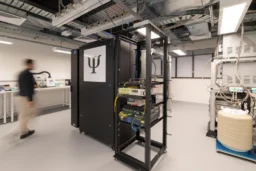
- Helios: A portable “Expeditionary C2 Node” that provides the physical hardware infrastructure and edge compute to connect different assets in the field to each other and Legion.
- Portal: A smaller edge compute and networking node that fits into a backpack for dismounted operations.
Friends everywhere: Another reason for Picogrid’s fast growth is its ever-growing partner ecosystem.
No one makes friends faster than a hardware integrator, and Picogrid has over a hundred buddies that use Legion and Picogrid’s hardware to play nicely with others. The Picogrid clique includes everyone from primes like Northrop Grumman to startups including CHAOS Industries, CX2, radar-maker Echodyne, Skydio, and Palantir.
Per Mountcastle, Picogrid’s growth has become a “sort of self-fulfilling prophecy, where the companies know that they can trust us, so we continue to exist and to grow, versus if we were just burning money and might close up shop tomorrow.”
“Being so efficient means that [companies] can actually build their technology on our stack,” he added.
Field-tested: Picogrid’s integrations have been tested in a whole bunch of exercises—including with the Army’s XVIII Airborne Corps to quickly set up and demonstrate a full sensor-to-shoot counter-drone kill chain.
Plus, the company:
- Has won contracts with the Air Force to integrate sensors on bases for counter-drone security;
- Was invited to join the Army’s “Right to Integrate” hackathon at Fort Carson, alongside far bigger partners like Raytheon, Lockheed Martin, Northrop Grumman, Palantir, and Anduril;
- Announced this month that the Army had taken Legion and Picogrid’s Expeditionary C2 Nodes from testing to “forward deployment in under 90 days.”
Mountcastle told Tectonic that Picogrid’s tech—including “stuff we haven’t announced publicly”—has been “operationally deployed across multiple allied nations within the [Middle East], supporting multiple US military units on a variety of different applications.”
Cash money: With $45M in fresh capital, Picogrid’s looking to take those deployments up a notch, including in new domains and with some new tech.
“We raised to continue to build out what we’ve proven really works on a small scale, and do so at a larger scale across more missions, more services, allies, and beyond,” Mountcastle said. “Now that we have access to more capital, we can do a hell of a lot more per dollar raise than other companies can.”