Everywhere you look, M&A activity seems to be slowly picking up. Turns out, the trend has made its way to space, too.
Earlier this week, space and defense comms unicorn CesiumAstro snapped up Virginia-based defense mission software firm 1Aardvark, with an eye on expanding its work in missile defense and tracking.
The acquisition is CesiumAstro’s third this year and comes as the company’s reportedly oversubscribed Series D nears closing.
- CesiumAstro didn’t disclose the terms of the deal.
- The company bought up SATCOM, EW, and radar-focused semiconductor company Jariet Technologies earlier this month, and Vidrover, an AI company building software to help prioritize tasks and automate repetitive processes, in February.
- Also in February, CesiumAstro raised a total of $470M—split between a $270M equity round led by Trousdale Ventures and $200M in debt financing from the Export-Import Bank of the United States (EXIM) and JP Morgan—to catapult its valuation into unicorn territory.
Astroworld: CesiumAstro is a familiar name for Payload readers, but may be new to those with their eyes trained closer to Earth.
- The company was founded in Austin in 2017 and builds phased-array comms and antennas that can form and steer RF beams without moving parts and be updated remotely via software.
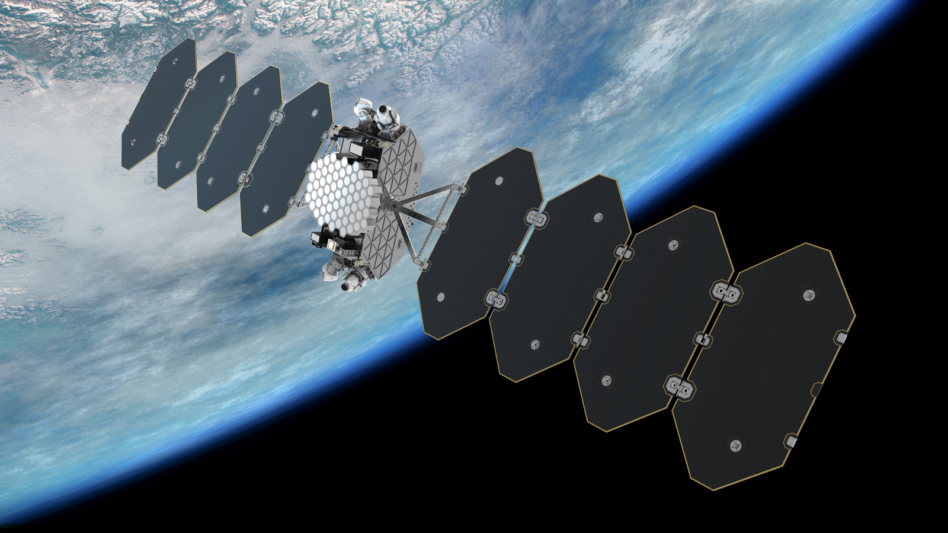
- They’ve since expanded into building SATCOM terminals, communications payloads, onboard processors, and fully integrated satellites for space and defense missions.
- CesiumAstro’s ultimate goal is to become a full-stack satellite constellation operator. In October, they’re planning to launch a satellite that’ll get them on their way to an expected constellation of more than 700 spacecraft.
If this all sounds a bit too Payload-y, don’t worry. A big focus of CesiumAstro’s expansion is on defense programs, especially the fun Golden Dome-flavored missile defense and tracking one.
Hey, what a wonderful kind of day: That’s where 1Aardvark comes in.
For Tectonic readers, 1Aardvark is probably even less of a familiar name, but the company has quietly built up a portfolio of work with the Missile Defense Agency and Space Force in the on-orbit missile tracking software world since it was founded in 2023.
- The company designs and integrates software for connecting space assets, data, and operators into “one autonomous mission network” that operates in comms-denied environments and on a range of hardware, according to the company.
- “We develop a software suite that works on the payload and works on your ground-based command-and-control system, and we give you easy-to-understand application programming interfaces (APIs) that you work with, rather than trying to go demystify the whole hardware stack,” 1Aardvark President Ryan Kenward told Tectonic.
- On the missile defense side of the ball, the company’s software is designed to enable distributed on-orbit tracking systems to coordinate more reliably in contested environments.
Combo deal: By snapping up 1Aardvark, CesiumAstro’s goal is, put simply, to put as much mission-critical technology—from AI to embedded software and comms hardware—under one roof.
“The next generation of defense space systems requires more than exceptional hardware,” CesiumAstro founder and CEO Shey Sabripour said in a statement. “It requires systems that can adapt, make decisions, and continue executing the mission in increasingly complex environments.”
The combo deal, Kenward said, enables the company to “co-engineer” the software and hardware before it’s launched, “and then work all the way through that cycle.”
“Instead of building software and hardware separately, we’re moving to a point where we’re able to take an entire mission and come up with a solution to go do [it], whether it be Golden Dome-related or, quite frankly, even commercial offerings,” he added.
Golden child: On the Golden Dome front, CesiumAstro and 1Aardvark are “technically aligned on what we thought the art of the possible was in terms of what that could offer, and one of the goals that we have is processing things closer to the edge,” Kenward said. “Looking at scenarios that would require additional compute where you don’t have the luxury of long timelines, you want to be able to go directly to an interceptor or directly to a warfighter to take action. That’s the kind of direction we want to drive.”
That sounds pretty useful, assuming Golden Dome boss Gen. Guetlein gets the money for it.