To everyone who likes to bash the primes for not innovating fast enough—watch out, because you might just get what you ask for.
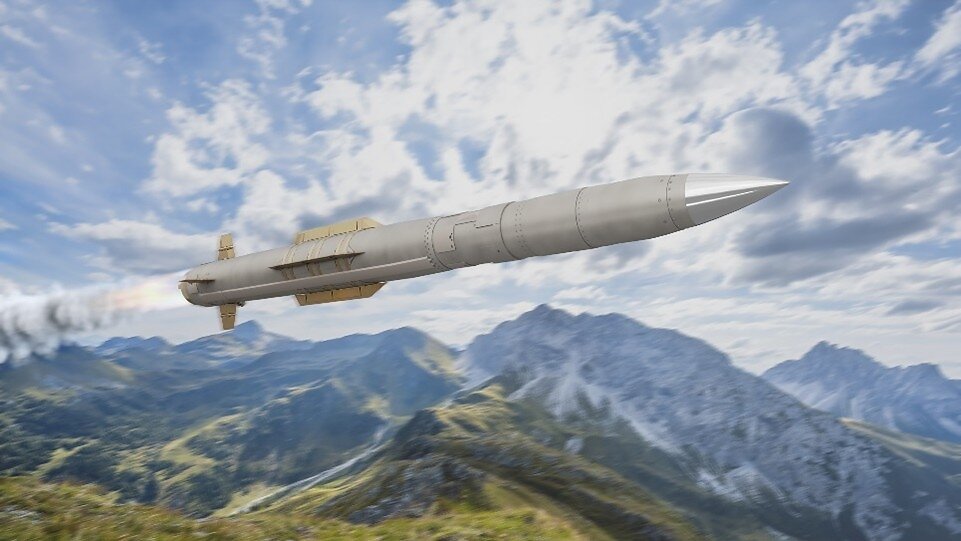
At the Farnborough International Airshow in the UK yesterday, Lockheed Martin unveiled two new additions to its portfolio of air defense technologies: a lower-cost version of the Patriot (PAC-3 MSE) called the PAC-3 ACE (Adapted Capability Effector), and a “one‑to‑many” airborne High Power Microwave (HPM) drone-zapping drone the prime says will be able to “neutralize more than 50 enemy drones in a single flight.”
ACE in the hole: Busy first day in England for the world’s largest defense firm, so we’ll kick things off with Lockheed’s ACE interceptor.
The OG Patriot is a household name at this point, and for good reason. The interceptor is famously capable and infamously expensive, and demand for them—especially in Ukraine and in the Middle East—has been through the roof as US and allied militaries rush to counter ballistic and cruise missile threats.
- Patriots boast a $1.1B per-battery and $4M per-missile price tag, but are one of the few air defense systems capable of reliably taking down ballistic missile threats.
- Lockheed inked a “framework agreement” with the Pentagon in January to more than triple annual production to 2,000 over a seven-year period, and a $4.7B contract in April to get the ball rolling. But deliveries in FY 2026 number just 172; US and allied forces need more, like, now.
The ACE is designed to address both the cost and mass-producability concerns.
- When we’re talking Patriots, low-cost is relative. Lockheed says the ACE will come in at around “a third of the cost” and cover about “two-thirds” of the area the current MSE variant defends, Lockheed COO Frank St John told the FT, putting the price between $1.5M-$2M.
- To cut costs, Lockheed will “throttle back” some of the priciest components (especially solid rocket motors and seekers), Lockheed’s head of Missiles and Fire Control, Tim Cahill, told reporters yesterday.
- It’s also neither meant to replace the MSE’s capabilities in intercepting longer-range ballistic missiles on the higher end nor intercept cheaper drones on the lower end of the cost-per-kill curve. However, it’ll still be “built on the proven PAC‑3 fire‑control system and fully linked to the Patriot weapon system and the Integrated Battle Command System (IBCS),” per Lockheed’s statement.
- Cahill said it’s instead designed to bridge the gap and “go after air-breathing targets, so aircraft and cruise missiles, short-range ballistic missiles, kind of intermediate ballistic missiles” in order to “thin the herd” of aerial threats without straining exquisite interceptor supplies.
Euro trip: It’s also designed with Europe in mind. The mega-prime is planning to base production of the ACE in Europe, and is already in talks with partners on the Old Continent to supply rocket motors, seekers, and other parts for the interceptor. That way it “really becomes Europe’s missile,” Cahill said.
- The company could also produce the missiles together with a yet-to-be-named European partner (Lockheed has already inked a deal to build ATACMS in Germany with Rheinmetall, and President Trump has agreed to give Ukraine a license to produce Patriots domestically).
- “My intention is to bring a capability in and quickly turn it into, for example, an entire European-sourced missile, built in Europe,” he added.
The Matrix: That wasn’t all Lockheed had up its sleeve on Day 1 of Farnborough. The prime also unveiled plans to build a “one‑to‑many” High Power Microwave (HPM) drone-downing drone called MORFIUS that it says will be able to “neutralize more than 50 enemy drones in a single flight.”
- While the ACE isn’t designed for the low-cost drones wreaking havoc across the Middle East and Ukraine, MORFIUS is being built with the cheaper threats in mind. It’ll offer “a significantly low cost per kill, protecting defense budgets while maintaining relentless firepower,” according to Lockheed, which is a wee bit ironic coming from a company that makes more than anyone from the defense budget.
- HPM systems (like those built by Epirus), put simply, use a directed energy-based, high-power microwave beam to disable drone swarms by, well, frying their circuits. Lockheed wants to take that airborne with MORFIUS.
- The prime says it’s “accelerating prototype production of MORFIUS and its HPM payload,” and is “planning the next series of flight tests.”
If that’s what Lockheed had to show on the first day of Farnborough, we might be in for a big week from the defense world’s big dog.