
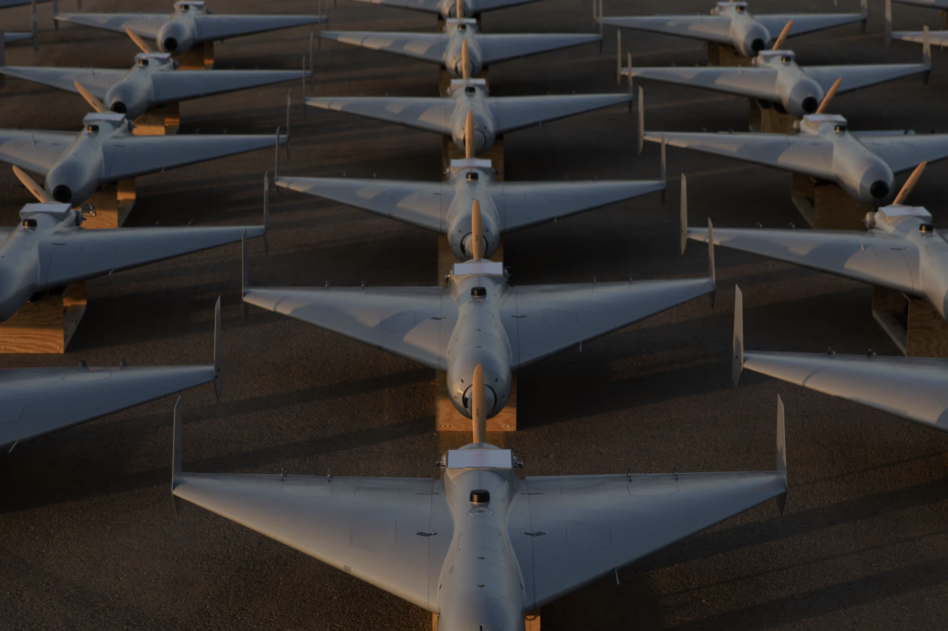
If you thought you’d heard the last of the LUCAS program, think again.
Yesterday, orchestration startup NODA AI announced that it’s won a $10M contract with the Pentagon to develop MAESTRO (Multi-Domain Autonomous Enhanced System for Tactical Reasoning and Orchestration), algorithms designed “to project commander’s intent into coordinated autonomous action across air, maritime, ground, and subsurface domains.”
In other words, the goal is to make sure that drones of all shapes and flavors are tasked and keep on keeping on as part of a swarm, even when comms are cut.
The contract was awarded under the Department’s Multi-Domain Collaborative Autonomy (MDCA) program and will advance NODA’s “integration with LUCAS (Low-Cost Uncrewed Combat Attack System),” as well as vendors and platforms across the Pentagon’s autonomy portfolio.
“Maestro is the program for the orchestration layer, the horizontal autonomy, the ability to project intent,” Noda AI co-founder and CEO Philong Duong told Tectonic. “We don’t need to develop an AI pilot for [platforms like LUCAS]. Our function here is the horizontal autonomy layer…if all these companies are building vertical stacks and capabilities, we’re this horizontal layer that is independent.”
Holding hands: We’ve covered NODA AI before.
The company was founded back in 2024 by Duong and Thomas ‘Dave’ Corbett and set out to solve a pretty thorny problem—the orchestration (or “brains”) that coordinates all of the different autonomous platforms the Pentagon has developed a liking for.
- Their founding thesis was that everyone is building better “chess pieces” (drones, boats, robots, missiles), but no one was building the “chess player” (the orchestration layer that makes the whole thing go “checkmate”).
- They raised a $4M seed round last year to flesh out the idea, then another $25M Series A led by Bessemer at a $125M valuation back in February.
The whole “make stuff work together” thing might sound simple, but it’s actually pretty freaking neat:
- Instead of vertically integrating hardware and autonomy software, NODA’s orchestration software sits atop its partners’ platforms and command-and-control systems as a decision engine with pre-programmed playbooks.
- During onboarding, NODA programs an autonomous system’s capabilities and limitations into its synthetic environment. From there, it runs simulations to understand how the platform operates in different mission sets and threat environments—and how it plays with other platforms. It also notes each platform’s capabilities and vulnerabilities—as well as those of potential targets.
- The company’s orchestration layer then allows the user to draw up plays with that mixed fleet of systems and respond to targets and threats as they emerge.
Basically, per Duong, they enable “the projection of a commander’s intent down to the robots to execute across all different domains, from sub-sea all the way to space.”
Think of it like this: Instead of tasking each individual platform (or even families of systems developed by individual vendors), a commander can say, “Hey, secure this coastline while searching for mobile missile launchers and preserve enough strike assets for follow-on attacks.”
The software will then break that down into tasks and roles for different systems (including manned systems) and cue them to carry them out.
Rise of the robots, indeed.
Under MAESTRO, NODA’s commander-intent-to-mission-execution orchestration software won’t just be built onto LUCAS, but onto autonomous platforms across the Pentagon.
“Now, we’re probably north of a dozen and a half unique platforms, and…the Maestro in the middle is dynamically reasoning through tasks, reassigning tasks as targets pop up, validating the targets, and then reasoning through what is the right way to prosecute that target,” Duong said. “What you’ll see is the ability…of our orchestrator to not only manage autonomous capabilities but also bring in manned capabilities.”
In particular, this contract will integrate NODA on MDCA platforms including LUCAS, MUSIC, Vigilant Spirit, and Arbitrator.
In the field: Duong couldn’t comment on whether the platform is currently operational (with LUCAS or other platforms), but said that they’re working on lots of different contracts and increments.
- The company was also selected alongside Anduril, Shield AI, Palantir, Lockheed Martin, Auterion, Helsing and others to participate in CDAO Crucible 2 (Swarm Forge) for, well, swarming capabilities.
- Back in 2025, the company also won an Air Force SBIR Phase II award to orchestrate autonomous platforms from different vendors.
“I’ve been working on this thesis inside the Pentagon for the better part of a decade,” Duong said. “In the early days, it was a very pie-in-the-sky, very fluffy, abstract idea that I think only the most forward-looking technologists really really gravitated towards. It’s non-controversial now that the unmanned space…is here to stay.”