
If you’ve been paying attention to the past year of Tectonic (!!), you’ll recognize a sneaky three-letter acronym that pops up on a lot of defense tech cap tables: IQT.
For those lucky enough not to be in the know, that stands for In-Q-Tel, a not-for-profit venture fund backed by the US government and investing in tech for the US intelligence community and the DoD. The organization receives about $100M in taxpayer funding each year, and for most of its 26-year history has remained pretty firmly in the shadows, as most CIA-linked organizations are wont to do.
But now, that’s starting to change. In the past year alone, IQT has sat prominently on some of the splashiest deals we’ve covered—Rune, Neros, Vatn, and STARK among them. Plus, the organization has leaned harder into “pure-play” defense tech, especially as private venture dollars have absolutely flooded that way.
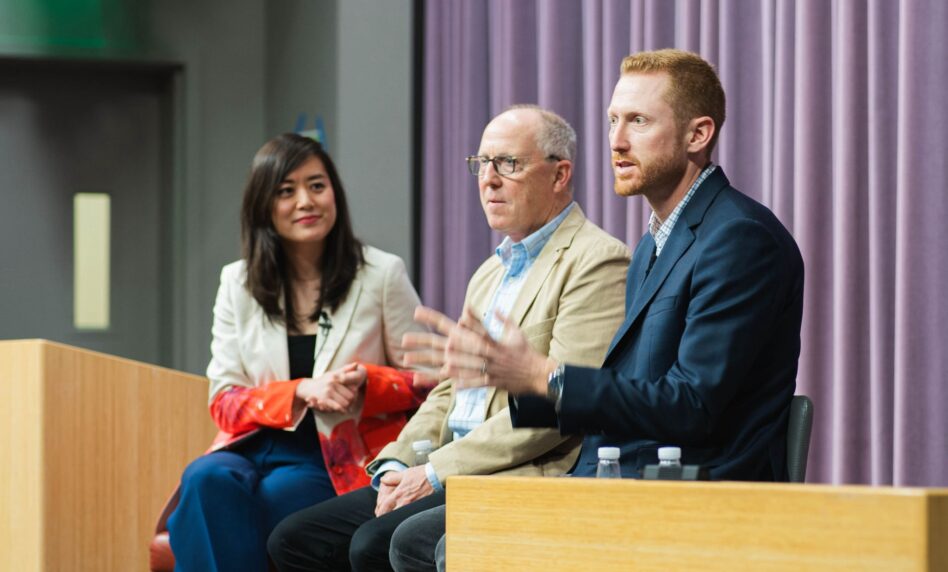
One of the people leading this charge is A.J. Bertone, a managing partner at In-Q-tel who leads the organization’s US investment. An Army vet and former Bain consultant (we’ll forgive him), Bertone has spent the last nine years at IQT “making sure [his team is] making the best possible investments in emerging technologies, and bringing those to the government partners that [he serves].”
We sat down with A.J. on the eve of the Reagan National Defense Forum last week to talk about IQT’s investment thesis, the organization’s relationship to the intelligence community and the Pentagon, and what really keeps him up at night.
Note: This interview has been edited for length and clarity.
Tectonic: Tell me about In-Q-Tel’s work right now, and how your approach to investing—and even your investment thesis—has changed in recent years.
A.J. Bertone: I describe In-Q-Tel as a strategic investor for the US intelligence community and the Department of War. We exist for two primary reasons: the first is to connect emerging technology to mission, and the second is to help our government partners understand how the evolution of the global technology landscape may impact them or our adversaries. The ultimate bottom line is about ensuring that our nation maintains its technological superiority as it relates to our work.
I think we’re seeing an incredible time right now in national security investing. When I came to In-Q-Tel, it was post-fallout from Project Maven with Google and some of those contracts. That pendulum has swung back the entire opposite direction, and there’s a tremendous amount of really interesting and relevant national security technologies to invest in. We’re looking across every possible technology pillar to ensure that we’re placing bets in the right places so that, again, those technologies are available to the partners that we serve.
Where are you guys making bets? What excites you, what thrills you? And what do you think is over-hyped?
A lot of folks who know of In-Q-Tel think of us as an intelligence community investor. We’re also a defense technology investor, and that has been a very exciting area for us over the past few years as more pure-play defense technology companies have come to market. We were investors very early in Palantir. We were investors very early in Anduril. There weren’t many companies like that until the past few years, and now we’re seeing many more potential game-changing companies that we’re investing in.
So I’d say broadly: pure-play defense tech is a very exciting category for us. We’ve placed bets in UAS and UUVs, and a bunch of other autonomous technologies for what I think of as more traditional military or warfighting applications. We’re investors in a broad range of other domains, too: we’re very forward-leaning in artificial intelligence, in cybersecurity, enterprise software-type tools—some very nuts-and-bolts stuff. We’ve even invested in a tax accounting company because there are use cases for that type of technology across the government.
We’re also investing in novel things in GenAI that no one else really is, like GenAI that’s going to be used for science. Self-driving labs, autonomous science end-to-end. You have a foundational model that’s designing an experiment, running an experiment, analyzing the results, and then that entire feedback loop. It’s a very, very broad range of technology.
Sometimes we say we invest from software to space, everything that’s in between. If it’s relevant to national security and there’s a commercial company out there that’s at venture scale doing it, we’ll look at it and potentially invest.
You said pure-play defense tech. Tell us a little about your perspective on dual-use.
As In-Q-Tel came up 26 years ago, the general thesis was that there were technologies springing up in the venture-backed startup ecosystem that the intelligence community was not going to be able to take advantage of without something like In-Q-Tel to find them at the earliest stages, invest in them, and bring those technologies over.
Predominantly, for our first decade or two, we were doing a lot of creation of dual-use tech. A lot of the pure-play defense tech stuff was viewed as relatively niche and wasn’t an attractive venture category.
The backdrop now is a little different. In particular, in the last 12 months, there’s been a tide shift occurring, and the national security community is leaning in on advanced technologies broadly. That creates an opportunity for In-Q-Tel to invest in companies solely targeting defense as an application, where there is venture return potential and an opportunity for In-Q-Tel to be an accelerant to those companies to get on mission faster.
We’ve always thought of ourselves as trying to find the technologies that have the best possible mission impact opportunity and the best possible commercial viability. If you think of that as a two-by-two, we want to be in the upper-right-hand quadrant—because those are going to be the technologies that make the most impact on mission and do that on an enduring basis.
So you see dual use as more of a means to that longevity or sustainability?
Yeah, it’s really important. You have to have a strong commercial footing in many cases.
Historically, that has been the case: you need [commercial applicability] to sustain the business and attract outside capital. Investors are going to be looking at business performance and growth metrics. And you need that to fuel a lot of the innovation.
Without that, the view in the past was: are you going to be able to stay at the bleeding edge? Are you going to be long-term viable? Or are you going to become shelfware—something that becomes stale for the government?
But again, what we’re seeing now is that private capital is interested because there is this view that the government is changing. That changes the calculus a little bit. And there’s this class of companies—the “neoprimes,” as people are calling them—that has the potential to have tremendous impact, going first and foremost toward the national security community as its primary customer.
Talk me through the elephant in the room. How explicitly does the intelligence community or the Department of War direct what you invest in?
I’d say it’s a push-and-pull model. One really important part of In-Q-Tel—and a muscle we’ve built over 25 years—is understanding the problems that exist across this base of partners we serve. Most of our staff have top-secret clearances. We have relationships with senior end users. It allows us to get in there and be over their shoulders and really understand not just what the requirements are, but what the problem is that the IC or the Department of War is trying to solve.
From that, we can come back to the startup and venture ecosystem, and as we discover novel technologies, do this mental matchmaking: We saw this problem over here, we see this really interesting technology over here—how can we put those two things together?
In some cases, the government might say, “Hey, we really need something here.” In other cases, we’re saying, “Hey, we know you’re trying to do this thing. We saw this new thing over here that you’ve never seen before, and we think it can be applicable.”
In-Q-Tel has two different types of investments. We make directed investments, where we’re funding the adaptation of technology for a specific use case with close involvement of a government entity. Roughly half of our investments are of that form.
The other half are pure equity investments, where we’re investing to bring a company into our portfolio, expose them to the government partners, and try to get them in a position to either sell directly to government or do a directed investment later. In that case, it’s informed, but it’s unguided—not at the direction of the government partner.
Talk me through how you decide to make directed investments versus equity investments. How do you decide which tack to take?
It’s through two lenses. Most financial VCs are looking through a single lens—how do I make money? We’re not financial returns-driven, but we do look through that lens because we want to understand how this company is going to be viewed by other investors that will be needed to fund the company over time. In-Q-Tel brings in something like $40 of outside capital for every dollar we commit, so it’s really important that other private funds want to back these companies.
We also look through a strategic lens: what’s the relevance of this technology to the government partners we serve? And it comes back to our two functions: putting tech on mission and understanding how the global tech landscape is evolving and how that might impact national security.
In some cases, we’re investing in fields where we don’t see a near-term application, but there could be some technological strategic surprise if China or another adversary were to have some de novo moment of innovation. So we invest in these categories ahead of defined government applications because we think they could shape the future.
We were very early in quantum, for example. We’ve been forward-leaning in life sciences. Critical minerals—topical right now—we had a view four or five years ago that this would be vitally important and that we were greatly exposed to China. So we’ve been investing there for years, putting us in a tremendous position to help our government partners access these technologies.
What’s the pie-in-the-sky preparatory investment or forward-looking investment you’d make right now if you had full control?
That’s an interesting question. Here’s how I think of it: where is there underinvestment? What are people not talking about?
We’re thinking a lot about the industrial base and manufacturing. That’s been a popular topic, but I haven’t seen a lot of capital deployed. I’d love to make some bets in that space. Robotics is another area. We’ve made investments in physical AI and robotics companies. I worry about whether we are going to have a DJI-type moment with robotics here in the US.
We’re also looking at autonomy. In pure-play defense tech, a lot of companies are doing their own thing. I’m interested in a company that’s going to orchestrate all the autonomous systems—who’s going to bring that all together? That’s going to be critical for the Department of War.
Counter-UAS is getting a lot of talk. I’m also interested in counter-UUV. No one’s really talking about that as UUVs proliferate. These things could be operating all around our ports in the US. and be extremely difficult to defend against. Those are just a few examples.
Talk me through your return structure. How does not being returns-oriented change the way you invest and the way you work with other investment partners?
We don’t invest for financial return. We do look through that lens, though, because it’s important we invest in venture-viable companies. We want to look as other investors would.
That being said, proceeds are beneficial in the sense that they allow us to reduce the cost of our model to the taxpayer over time. We receive funding annually from the government, but an increasing percentage of our spend annually is actually funded from our balance sheet. As a 501(c)(3), when there’s a liquidity event, proceeds come back to In-Q-Tel—we don’t have carried interest—and we plow those proceeds back into the business.
So, much of what we do annually is self-funded by In-Q-Tel, and that allows the government to not have to contribute as much to achieve the objectives of getting access to tech and understanding the tech landscape.
So, you get around $100M in funding from the government each year. Can you tell me a little more about the size of the checks you write?
For equity investments, those are typically $250K checks, stage-agnostic from pre-seed to growth. Again, we’re not targeting ownership or financial return. Sometimes we’ll put in $250K into a round that’s hundreds of millions of dollars because it’s about formalizing that relationship, getting on the cap table, getting in the boardroom. We take a board observer seat on every deal.
For directed investments, we allocate capital based on what’s needed to get the tech to a point where it can be tested against the use case. We’re looking at the problem in the national security community, the company’s roadmap, where they overlap. We fund the development for that use case. These are typically low single-digit millions checks. Sometimes we make multiple investments in a company on a stage basis.
Do you think the government effectively leverages the technology you guys are funding? Do you think the funnel is working?
I do think it’s working. Could it work better? Yes. We’ve made 800 investments since our inception. Over 500 have transitioned to government—that’s over 60%, which I think is tremendous when you consider all the reasons things could go wrong.
Could it be better? Potentially. We’re working every day to think through how we can drive more impact. Very encouraged by changes over the last 12 months—the government is making meaningful change that will increase the rate of transition.
At the same time, we’re a risk model. We want to be doing stuff that’s out on the periphery. That’s what venture is about. We’re looking for outside strategic return. If our transition rate were 100%, we’re not taking enough risk.
Make the case for In-Q-Tel for me, even as more private capital flows into the sector.
If there’s a bunch of VC dollars going into a defense tech company—great. Nobody has the relationship that In-Q-Tel has with government. We can be an accelerant in connecting companies to end users and problems across government.
In directed investments, we’re programmatically funding development of technology, facilitating a pilot, and ideally driving adoption. That’s the bottom line: when the startup’s tech makes an enduring impact on the national security mission, and as a result, the national security community makes an enduring impact on that company’s income statement. That’s how we measure success.
I’m not aware of any other VC oriented around that metric.
What do you think the government—or the Pentagon or the IC—are still getting wrong about encouraging innovation in defense and national security tech?
You said “encouraging innovation”—maybe that’s what I’ll latch onto. I think of it as [having] a policy pillar and a practice pillar. Policy is directives and regulations. There’s been tremendous reform on the policy pillar in the past 12 months—changing the rules of the playing field. But that doesn’t change how the game gets played. That’s the practice pillar.
Having previously served in the military, I’m aware there’s a risk-averse culture across the public sector, and that can impede the national security community from getting the most out of emerging tech.
It’s incumbent on leadership to ensure the right incentives are in place for people to take risk, knowing some things are going to fail. That’s the hardest part—cultural change across the public sector to encourage risk-taking and the extra work needed to bring unknown things into their software environment or out onto the battlefield.
What scares you the most? What do you think is the biggest threat to the United States? What keeps you up at night?
As it relates to this conversation, two things worry me about defense tech. One is tactical, one is strategic.
The tactical one: we do not have good testing infrastructure in the United States. There’s a lot of talk about the value of being deployed in Ukraine to rapidly iterate on the battlefield. We don’t have that here. If you want to test in a GPS-denied environment, where are you going to go in the US? If you’re a startup, you need relationships with government; it takes months to coordinate.
That relates back to the strategic point: I worry about speed. We need to be moving much faster, even though I’ve been encouraged by the change in pace this past year. I worry, structurally, there are things that will hold emerging tech companies back and hold government back because we don’t have the requisite infrastructure or the right incentives to be as fast as we need to be.
China has unilateral control. It’s a totally different playing field for them. I’m not saying we should replicate that system, but parts of ours put us at a disadvantage. We need to lean into change to take advantage of all the great tech coming to market.